








Today’s post won’t be overly long. It doesn’t need to be, as the advice is fairly straightforward.
One of the advantages of having an agent, beyond increased chances of selling our work to a traditional publisher, and increased access to secondary sales of media rights and translation rights, is that agents understand contracts. When I first entered the business, I didn’t know the first thing about them. I have learned over the course of my career, but I’ve been in publishing for twenty-five years. If I hadn’t learned it would be downright embarrassing.
The fact is, though, in today’s marketplace, finding an agent is harder than ever. And for many of us, it might not be absolutely necessary. Yes, those subsidiary sales are nice, but if our goal is simply publication here in the U.S., and if we’re willing to sign with a small press, we can do this without representation.
But here’s the thing: If we don’t have an agent, we need to educate ourselves on the meaning of contracts. Because no writer should ever sign a contract unless they understand and agree to every single clause.
Look, there are a lot of publishers out there. Small, large, and in between. And many of them — most of them, I would say — are decent, honest, and well-meaning. Many of them are also competent and capable of drawing up a contract that is comprehensive and legally sound. And the Venn Diagram that finds the overlap between those two groups probably includes a good number of publishers.
But it definitely doesn’t include all of them. There are some who are competent but untrustworthy. There are some who are honest but not so good with the legal words thing. There are some who are incompetent crooks, and there are some who probably mean well but simply have some wonky stuff in their business model.
Sadly, none of them come with signs attached telling us to which category they belong. It is up to us to read and understand the legal agreements we’re signing. If we don’t, we have no one to blame but ourselves when we get screwed later on.
Read your contracts line by line. Make notes of anything you don’t understand and ask questions. Ask other writers or editors or publishers you know. Ask that friend who happens to be a lawyer. Seek professional, paid legal advice if you need to. Yes, this last will cost you something on the front end, but you’ll be glad you did it. If you understand the contract but find some of the provisions not to your taste, bring those clauses to the attention of your publisher and try to negotiate a change.
Finally — and this might be the hardest bit of advice to follow — be prepared to walk away if the publisher won’t budge. Believe me, I know how difficult that can be. Getting a book offer is heady stuff. It’s easy to be caught up in the moment, to believe that this is the ONE opportunity that will ever come our way. It’s easy to convince ourselves that if we let this one go, we will regret it for the rest of our lives. And I can’t guarantee that’s not the case. But I can tell you these two things: 1) If one publisher thinks our book is publishable, chances are another will too, even if we have to wait a while; and 2) Signing a bad contract can absolutely be worse than signing no contract at all.
So understand your contracts. Ask questions about anything you don’t understand or don’t like. And be prepared to take your book elsewhere.
Keep writing.
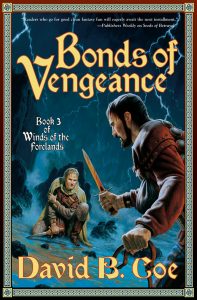 Many years back, while I was working on one of the middle books in my Winds of the Forelands quintet, my second series, I came downstairs after a particularly frustrating day of writing and started whining to Nancy about my manuscript. It was terrible, I told her. There was no story there, no way to complete the narrative I’d begun. The book was a disaster, and I might well have to scrap the whole thing.
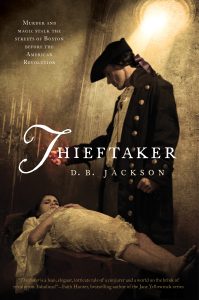 I would love to be a bestselling author. And with each new project I take on, I wonder if this might finally be the literary vehicle that gets me there. Thieftaker, Fearsson, the time travel books, the Radiants franchise. I had high hopes for all of them. All of them were critical successes. None of them has taken me to that next level commercially. So does that mean I should give up?
 The difference between what I did with those two projects and what I am telling you not to do is this: I kept working on these books, but I also moved ahead with other projects, so that I wouldn’t stall my career. Yes, I worked for six years on the first Fearsson book. But in that time, I also wrote the Thieftaker books and the Robin Hood novelization. This, by the way, is also the secret to finding that balance I mentioned. By all means, keep working on the one idea, but do so while simultaneously developing others. Don’t become so obsessed with the one challenge that you lose sight of all else.
 One of the great delights of writing historical fiction is the opportunity to leap into research and go bouncing off into every conceivable rabbit hole—er, to do a deep dive into a specific time, place or topic which will provide the backdrop for the story you have in mind. Unless you’re already a historical specialist in that area, doing the research is likely to consume a lot of time, attention, and other resources.
 But at the very least, we need to see our main heroes grappling with what they have endured and setting their sights on what is next for them. We don’t need this for every character but we need it for the key ones. Ask yourself, “whose book is this?” For me, this is sometimes quite clear. With the Thieftaker books, every story is Ethan’s. And so I let my readers see Ethan settling back into life with Kannice and making a new, fragile peace with Sephira, or something like that. With other projects, though, “Whose book is this?” can be more complicated. In the Islevale books — my time travel/epic fantasy trilogy — I needed to tie off the loose ends of several plot threads: Tobias and Mara, Droë, and a few others. Each had their “Louis” moment at the end of the last book, and also some sense of closure at the ends of the first two volumes.
 Why do I do this? Why am I suggesting you do it, too? Because while we are telling stories, our books are about more than plot, more than action and intrigue and suspense. Our books are about people. Not humans, necessarily, but people certainly. If we do our jobs as writers, our readers will be absorbed by our narratives, but more importantly, they will become attached to our characters. And they will want to see more than just the big moment when those characters prevail (or not). They will want to see a bit of what comes after.
 February has begun, Punxsutawney Phil has done his schtick, and time seems to be moving at breakneck speed. In a little over two weeks, Invasives, the second Radiants book, will be released by Belle Books.