








Last week, I revisited an old Magical Words post I’d done about eliminating excess verbiage in our writing, putting a new spin on the discussion. As promised, I would like to continue that conversation today.
Before I dive back into the topic, though, I would like to address what might seem like a basic question: Is more concise always better? To my mind, concise is ALMOST always better. I can imagine situations — perhaps when writing a period piece, or trying to do something stylistically with a particular narrative voice that we want to be stuffy and verbose, or scattered and therefore wordy — in which concision is not a desired goal. But those are pretty specific instances. For the most part verbosity is not a style, but is rather a hindrance to effective storytelling. In general — and again I will accept that there may be a few exceptions to this — wordiness gets in the way of flow, of clarity, of linguistic precision. Others might disagree, and I would be open to debating the issue over beers. But I am skeptical of any argument that presents excess verbiage as a virtue.
In last week’s post, I covered passive writing, distancing phrases, and using mannerisms of speech in our prose. Let’s move to this week’s topics.
Adverbs: Yes, there are Adverb Authoritarians out there who will tell you that every adverb is an abomination, that none of them is necessary. I disagree. Used sparingly, adverbs can add to our prose, refining the meaning of our sentences and bringing more clarity, not less. Having said that . . . . A few years ago, when I edited the three volumes of my LonTobyn Chronicle in preparation for their re-release, I found way, way too many adverbs in the text, and I eliminated ninety percent of them. For the most part, adverbs add clutter, and often wind up being redundant.
So often, in my own older work as well as in the stories and books that I edit for others, I have found constructions like these: “He glanced at her briefly.” “She tapped lightly on the door.” “They ran quickly across the field.” None of those adverbs (“briefly,” “lightly,” “quickly”) is necessary. A glance is always brief; that’s why it’s a glance. A tap is light by definition, as opposed to a “knock” or a “rap” or a “pound.” And running suggests relative quickness. You rarely hear anyone say, “They ran slowly” (unless they happen to be commenting on my running speed . . .). Again, I would be reluctant to say “never use adverbs.” But I would say before using them, make sure the word is needed. More often than not, I believe you’ll find they add little to your narrative.
Weakening words: I am SO guilty of this one. I constantly need to look through my work to weed out words like “somewhat” and “a bit” and “slightly.” Or else I start phrases with things like “He found that . . .” or “She tended to . . .” All of these words make my prose mealy and soft, wordy and weak. It’s not that EVERY phrase has to be definitive and strong. Of course there are times when we want to soften a statement or qualify it in some way. Words and phrases like these become problematic when they occur as crutch words, as things we throw in without thinking because we can’t find a better way to write the sentence. And all writers do this on occasion. I have a list of manneristic words and phrases that crop up in my prose. When I finish the first draft of a manuscript, I do universal searches for all the crutch words on that list and I do my best to eliminate as many of them as possible. And too many of them are weakening words like these.
Beginnings and starts: These are a bit like passives, in that they clutter up and weaken verb phrases. Instead of “He ran,” we write “He started to run,” which says essentially the same thing with less power and in twice as many words. In almost all instances, we don’t need to be told that a character “started” or “began” to so something. A few sentences ago, they weren’t doing it. Now they are. We can assume that somewhere in the interim, they started doing it. This really isn’t complicated.
Now, as with many of these other issues, some instances of “started” or “began” are necessary. There are moments when the initiation of a certain action is, in fact, significant and worth noting. But those moments are pretty rare. For the most part, in my experience editing other people’s work and revising my own, I find these phrases to be empty and unnecessary.
Dialog tags and name checking: I could devote an entire post to writing decent dialogue and tagging speakers in subtle, effective ways. Actually, I’m sure I have written such a post. Still, it’s worth repeating a few key points. We don’t need tags for every line of dialogue. I often go through early drafts of my work and take out tag after tag after tag. As with other writing “rules,” I don’t subscribe to the “never do this” approach to dialogue tags. There is a place in good writing for “She said” and “He asked.” I’m merely pointing out that we often overuse these phrases. I would suggest you read through your dialogue and remove any tags that are not needed to clarify who is speaking when. In conversations between just two characters, that will be most of the tags. In conversations involving several characters, tags become crucial clarifying tools, requiring us to keep a far higher percentage of them.
“Name checking” refers to having one character address another by name in written dialogue. In most cases, we simply should not do this. Don’t believe me? Go ahead and initiate a conversation right now with a friend or a partner or someone else in your life. And use their name in every other sentence. “How was work today, Nancy? Did you have lots of meetings? Who were they with, Nancy?” Etc. It won’t take you long to realize that you sound ridiculous.
Now try doing it every fifth sentence. That will sound ridiculous, too. Trust me. Aside from moments when we’re calling to one another from another room, or something of that sort, Nancy and I can go for days without using each other’s names. Most of us are like that. Name checking makes our characters sound weird and unrealistic. And it clutters up our prose.
Keep writing, whatever your name might be!
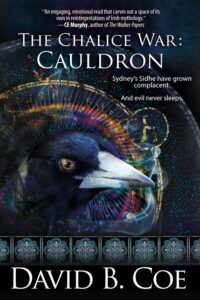 As I mentioned in a recent post, I have been doing a tremendous amount of editing and revising these past several months. Between co-editing (with
 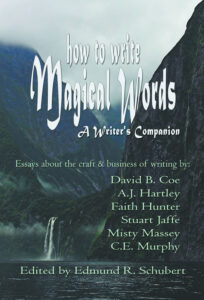 We kept the site going for nearly a decade (thanks Todd Massey), and the site still exists, for those interested in wading through the extensive archives. We also produced a writing book, which is still available.
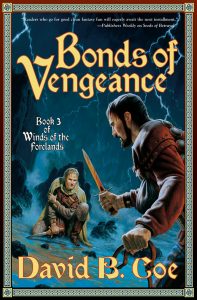 I have two other projects underway as well. A nonfiction thing that I am not ready to discuss in detail, and, at long last, the editing of the Winds of the Forelands books for re-release in late 2023 or early 2024. And I have another writing project — a collaborative undertaking — that I also cannot describe in detail, simply because I am not the organizing force behind the project, so it is not mine to reveal. But I am excited about it.
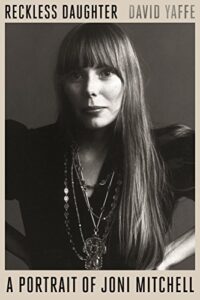 Recently, I have been reading a biography of Joni Mitchell (a holiday gift from my older daughter), a long-time favorite of mine and, in my opinion, the finest songwriter in the history of rock and roll (more on that shortly). It’s been an interesting read — the author is a bit fawning for my taste, and a bit too eager as well to weave Mitchell’s (admittedly phenomenal) lyrics into his prose. But as is often the case when I read biographies of artists I admire, the book made me think about creativity and the artistic process.
 I’ll preface this discussion with the obvious: I’m old. I’ve been in this business for a long time — it’s been nearly three decades since I signed my first contract. When I got started in the business, publishers were just beginning to expect that writers would maintain websites. Websites! Facebook and Twitter and the rest didn’t even exist. And when we signed contracts, writers could rightfully expect that our publishers would handle the bulk of the necessary publicity, which consisted mainly of taking out ads in journals, sending review copies to print magazines (kids, ask your parents) and other critical venues, setting up newspaper, radio, and television interviews, and arranging signing tours and individual store events.
 Blogging and social media are extras. Yes, in this day and age, they are important extras. Crucial, some might say. We have to publicize our books, or no one will buy them or read them. But as vital as this part of the job might seem, I would once again turn the previous phrase on its head: We have to publicize in order to be read? Yes, we do. But more important by far is this: We have to write the books in order for any of that publicity to be worth a damn.
 And I did. The book was Invasives, by the way. It contains the best character work I’ve ever done, and that is no coincidence.