








If we have to write — and I’ve always felt that writing is an imperative, something I do to tame the voices in my head, the stories burning in my heart — then we should do it to satisfy that passion.
This past weekend, while at DragonCon, I spent a lot of time on writing panels, talking with other literary professionals in front of audiences made up largely of aspiring writers. We mostly discussed ways to improve various elements of our storytelling, but we spoke as well about the state of the current writing market, and the challenges of embarking on a literary career.
Reflecting on those conversations, it occurs to me that much of what we discussed warrants repetition and amplification in this venue.
This has been a summer of bad news for those of us who (try to) make our livings writing books. Book sales are down across the board this year. Barnes and Noble is rumored to be cutting back drastically on what books it will carry and market. The trial to determine the future of the proposed merger between Penguin-Random House and Simon & Schuster has revealed that book sales for the vast majority of volumes published each year are shockingly, depressingly low. Those numbers may or may not be accurate, but if they’re not, that would only mean that publishers routinely mislead authors about their sales numbers, which would also be shocking and depressing. Lose lose.
I have neither the data nor the experience to state categorically that it has never been harder to be a professional writer, but I can say that right now the business outlook for our industry pretty much sucks.
Which has left me wondering — as I attend conventions and get ready to teach at the Hampton Roads Writers Conference — how can I mentor young writers when the market is so dauntingly hostile? I struggle with this nearly daily.
I have been in the business for a long time. I have literally dozens of publishing credits — as a novelist, as a short story writer, as an editor. I have awards to my name, a history of strong reviews, a reputation as a professional who hits his deadlines, turns in clean manuscripts, and is reasonably easy to work with. (Mostly.) And yet, I still get lots of rejections when I shop new projects. My advances are lower now than they were early in my career. My sales numbers have declined with those across the industry. Maintaining my career has never been harder — it feels like all my accomplishments and credits mean nothing at all.
Again, I question how I can, in good conscience, tell people, “Yes! Go forth! Write your books! Try to make a career for yourselves in this crazy, cruel, struggling business!”
If I could go back in time, knowing what I know now, and advise young me on the career choice I made back in the mid-1990s, would I tell him/me to embark on this career? Probably. But I have been extraordinarily fortunate in certain ways (and chronically unlucky in others), especially in that I have enjoyed the support of an incredible, generous, accomplished life partner. If I was doing this alone, without Nancy? No way in hell.
If that hypothetical time travel worked differently, and young me was starting now? I would probably advise him/me to find another career, or at the very least to approach this one very, very differently, to look upon writing as a paying hobby, not as a profession, and to keep his/my expectations quite low.
Throughout my career I have spoken often of the importance of loving what we do. And I mean it in several ways. On one level, love what we do means write for the love of it, because the payoffs of this profession, financial and emotional, can be slim and fleeting. On another level, love what we do means we must love the stories we write, and write the stories about which we’re passionate. The market is a moving target. Writing to the market is just about impossible. So we should write the stories that sing in our hearts, because that love will shine through in the final product, and we will enjoy the process more. Finally, love what we do means we must take satisfaction in the stories we produce, because often the artistic creation itself is the lone reward for a job well done.
Strangely, even in this current market — indeed, especially in this current market — “Love what we do” remains good advice. If we have to write — and I’ve always felt that writing is an imperative, something I do to tame the voices in my head, the stories burning in my heart — then we should do it to satisfy that passion. Writing because we think it’s just a good gig, a great way to make a few bucks? If that’s what you’re thinking, I suggest you go back and reread the opening graphs of this post.
As queasy as I might feel about encouraging young writers to go out and try to make a go of literary careers, I feel even worse saying, “No! Don’t do it! That way lies madness, not to mention bruised egos and poverty!” In a sense, there is no good option here.
And so I will continue on this middle course. I will continue to say the following: “Writing is hard. It’s always been hard. It’s even harder now. But it’s also a glorious journey through imagination and emotion and creation, a wondrous alchemy by which we take words and turn them into living, breathing characters and their fully realized lives. And here are some tips for doing that as effectively as possible . . . .”
Enjoy the rest of your week, and keep writing.
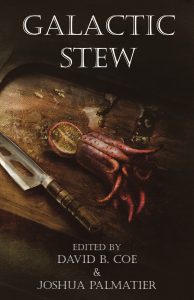 This will be the fifth anthology I have edited for ZNB (after
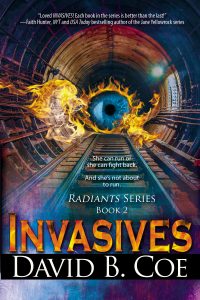
 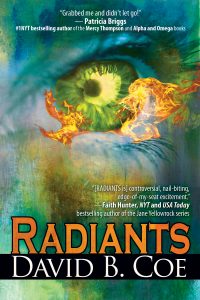 My editor at Belle Books is a woman named Debra Dixon, and she is a truly remarkable editor. This first book in the Celtic series is our third novel together, after Radiants and Invasives. In our time together, I have never once felt that her responses to my work were intrusive or unhelpful. With each book it’s been clear to me that her every observation, every criticism, every suggestion, is intended to help me tell my story with the greatest impact and in the most concise and effective prose. A writer can’t ask for more. This doesn’t mean I have agreed with every one of her comments. Now and then, I have felt strongly enough about one point or another to push back. And she’s fine with that. That’s how the editor-writer relationship is supposed to work, and she has always been crystal clear: In the end, my book is my book. But even when we have disagreed we have been clear on our shared goal: To make each book as good as it can be.
 My struggle right now is simply this: Her feedback on this first book is quite extensive and requires that I rethink some fundamental character issues and cut or change significantly several key early scenes. And she’s right about all this stuff. No doubt. This first book has been through several revisions already, and the second half of the book — really the last two-thirds of the book — just sings. I love it. She loves it. The first third is where the problems lie. To be honest, the first hundred (manuscript) pages of this book have always given me the most trouble. I wrote the initial iteration of the book more than a decade ago, and in some ways those early chapters still reflect too much the time in which they were written. They feel dated.
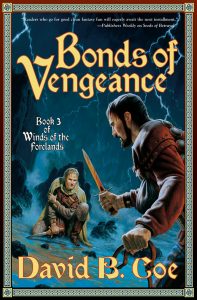 Many years back, while I was working on one of the middle books in my Winds of the Forelands quintet, my second series, I came downstairs after a particularly frustrating day of writing and started whining to Nancy about my manuscript. It was terrible, I told her. There was no story there, no way to complete the narrative I’d begun. The book was a disaster, and I might well have to scrap the whole thing.
 After publishing
  Mostly, as I say, I’ve been editing. My work. Other people’s work. The Noir anthology. I’ve been plenty busy, but I have not been as productive creatively as I would like. And I wonder if this is because of
 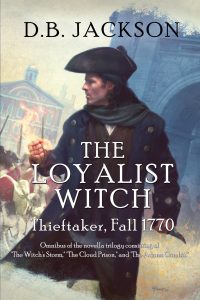 But at the very least, we need to see our main heroes grappling with what they have endured and setting their sights on what is next for them. We don’t need this for every character but we need it for the key ones. Ask yourself, “whose book is this?” For me, this is sometimes quite clear. With the Thieftaker books, every story is Ethan’s. And so I let my readers see Ethan settling back into life with Kannice and making a new, fragile peace with Sephira, or something like that. With other projects, though, “Whose book is this?” can be more complicated. In the Islevale books — my time travel/epic fantasy trilogy — I needed to tie off the loose ends of several plot threads: Tobias and Mara, Droë, and a few others. Each had their “Louis” moment at the end of the last book, and also some sense of closure at the ends of the first two volumes.
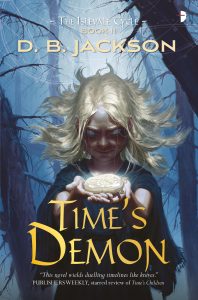 Why do I do this? Why am I suggesting you do it, too? Because while we are telling stories, our books are about more than plot, more than action and intrigue and suspense. Our books are about people. Not humans, necessarily, but people certainly. If we do our jobs as writers, our readers will be absorbed by our narratives, but more importantly, they will become attached to our characters. And they will want to see more than just the big moment when those characters prevail (or not). They will want to see a bit of what comes after.