








 For the past several weeks, I have been sharing “My Best Mistakes,” which have included inappropriate remarks at a convention, poor business decisions, and replies to reviews. This week’s “Best Mistake” is a little different, in that it’s less about interactions with others and potential damage to my career than it is about self-care and maintaining equilibrium in a difficult profession.
I started my career as a complete unknown in fantasy and science fiction. This was before Amazon had ever turned a profit. It was before ebooks had really become a thing. If one aspired to a notable writing career, New York traditional publishing was essentially the only game in town. So when I sold my first novel to Tor Books, one of the top names in speculative fiction, I was excited. My first advances, I now realize, were actually pretty decent, although at the time they felt small. But I dreamed of bigger things to come.
 My first series, the LonTobyn Chronicle, did well. It won the Crawford Award as the best fantasy by a new author, and my sales grew steadily. Children of Amarid would eventually go through six printings. When I signed contracts for my second series of novels, Winds of the Forelands, Tor gave me significantly higher per-book advances.
I say all of this not to brag, but rather to set up a discussion of my expectations at that point in my professional development. Up through the releases of the first couple of Forelands books, my career had followed a steady upward trajectory. And — my big mistake — I began to assume that this was simply the way of things. I was climbing, just as I had hoped. My career, I thought, would build and build and build. Maybe I would never be a huge seller, but I would improve my sales with each publication, and improve my advances with each new contract.
It never occurred to me that the industry would undergo a set of seismic transformations, impacting everything from publishing’s corporate structures to the way we read books, and undermining all assumptions about the publishing business. On a personal level, it never occurred to me that certain mistakes made by others would have profoundly negative consequences for my sales. Nor did it occur to me that my luck — and yes, luck plays a large role in all of this — would turn on a dime from terrific to terrible.
To be clear, I wasn’t wrong to hope for progress. Ambition is good. Dreams of growth are good. Rather, my mistake lay in expecting that everything would keep getting better, in assuming that I could anticipate what the publishing industry would look like five years after I started or ten years after. I won’t even say I thought books would always be made of paper, or that the traditional New York publishing model would always remain ascendant. If someone had asked me if I believed such things I would have said no. Change is inevitable. But I certainly didn’t imagine such dramatic transformations would come so quickly.
I also should be clear in saying I know how fortunate I have been to have the career I’ve had. I love what I do. I get to play “let’s pretend” every day and I get paid for doing so! No, my career hasn’t followed the path I had hoped for. But twenty-five-plus years on, I am still writing, still selling novels and stories to publishers.
More to the point, I still love the work I’m producing. While my commercial performance might not improve with every novel, the quality of my writing and storytelling does. I am still learning my craft, and I take great satisfaction in the progress I make as a writer from one project to the next.
But the consequences of my mistake, of my unrealistic and unrealized expectations, were severe and long-lasting. It’s easy to look back now and see the magnitude of those changes in the industry, or appreciate the part chance can play in any writer’s fortunes. But in the moment, I blamed myself for things over which I had no control. I saw the vicissitudes of the business as personal failure. I convinced myself that instances of bad luck were an indication that on some level I didn’t deserve the success of which I had once dreamed. And I grew bitter with each new disappointment. So many times, I considered giving up on this job I love.
It took me years to come to grips with things I probably should have understood sooner. That in any profession, hard work doesn’t always guarantee success; that what we achieve and what we convince ourselves we “deserve” are often not the same; that in business, as in life in general, there is no point in complaining about what is “fair” and what isn’t; and that all any of us can ever do is work to the best of our ability, and treat people with respect and courtesy. The rest is in the hands of fate, or the divine, if that’s your thing.
In the years since those first books had me believing I was on a professional escalator to the proverbial heavens, my career has had plenty of ups and downs. I have had no choice but to adjust to the fact that there is no guarantee of more and more and more success. Waves and troughs, I now know, are the norm. And one of the reasons I am so happy in my work these days — happier than I’ve ever been — is that I have internalized these realizations. I write the stories I want to write, the books I know I would enjoy reading if they weren’t mine. And while I still do what I can to make my books successful, I no longer live and die with sales figures and reviews and such. I do the best work I can do, and that’s enough. It has to be enough. Because that’s life.
Keep writing.
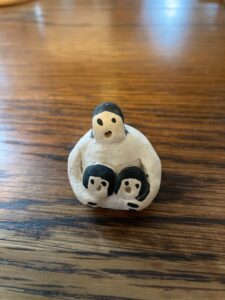 During our tour, we encountered many people selling pottery in front of their homes. And at one table, a mother displayed her wares beside those of her young daughter. I think the girl must have been around 7 or 8, give or take a year, and she had made a few small bowls, seed pots, and dishes. And she had made a tiny storyteller. As one would expect, it was quite crude compared to those we had seen for sale back in Albuquerque (we hadn’t yet been to Santa Fe or Taos), but something about the figure spoke to me. Maybe is was just that the storyteller was so cute. Or maybe it was that the girl herself was so proud of it. Or maybe I saw in this child’s early effort to follow in her mother’s footsteps something akin to my dream of becoming a professional writer. Whatever the reason, I asked the girl how much it cost.
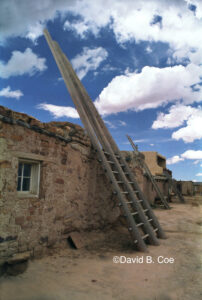 That was a magical day in many ways. Acoma was as beautiful as we had been told, the pale red stone of the Pueblo seeming to glow beneath a deep azure sky, wooden kiva ladders rising above their structures and reaching toward the clouds. At one point, I spotted a rainbow in the clouds overhead — there was no rain, just the prismatic color, which appeared for a moment and then vanished. I think I was the only one on the tour who saw it. I believed that, together, the rainbow and my little storyteller were omens, signs that my dream would, in fact, come to pass.
 Two months later, I got my first contract from Tor Books. Children of Amarid wasn’t published for another three years — that first book needed a lot of editorial work. But I was on my way.
 Yes, sometimes we think we’re going to miss a deadline, and then we make it. And if we alert our publisher prematurely, we could lose our spot in the queue. So be it. That’s the price of acting professionally. When our older daughter first was diagnosed with cancer, I told my editor and my agent what had happened, and let them know I was probably going to be late with the novel I was writing. As it turned out, writing that book — Invasives, the second Radiants novel — was a wonderful escape, and I met my deadline. But I had given up my publishing spot and so the book was released later than I had hoped. It wasn’t that big a deal. As I say, the most important thing is be up front about the situation with those who need to know.
 My “What matters?” series of posts will conclude next Monday, after a Monday Musings post this week that straddled the personal and professional a bit more than usual. In the meantime, I am using today’s Professional Wednesday post to begin pivoting toward the impending release of my new series, a contemporary urban fantasy that delves deeply into Celtic mythology. The series is called The Chalice War, and the first book is The Chalice War: Stone. It will be released within the next month or so, and will be followed soon after by the second book, The Chalice War: Cauldron, and the finale, The Chalice War: Sword.
 I finished the book and showed it to my agent. She liked it a lot, but thought it needed work. She was right, of course. But by that time, I had signed the contracts for Robin Hood and the Thieftaker books. Not too long after, I finally sold the Fearsson series to Baen Books and so had that trilogy to get through.
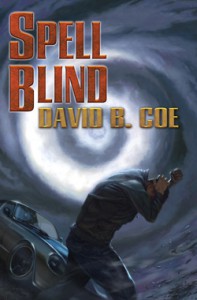 But I never forgot my Celtic urban fantasy, or its heroes Marti and Kel. When I had some spare time, I went back and rewrote the book, incorporating revision notes from friends and from my agent with my own sense of what the book needed. I rewrote it a second time a couple of years later, and having some time, started work on a second volume, this one set in Australia (where my family and I lived in 2005-2006). I stalled out on that book about two-thirds of the way in, but I liked what I had. By then, though, I was deeply involved with the final Thieftaker books and the Fearsson series. And I was starting to have some ideas for what would become the Islevale trilogy.