Tag Archives: business of publishing

Monday Musings: Where Does Mentoring Fit In With Today’s Publishing Realities?

I have a very good friend, also a writer, with whom I often discuss the depressing state of the writing world at this point in history. We have a sort of gallows humor about the whole thing — a lot of joking comments about low pay, the dearth of readers, the way New York publishing has basically lost interest in the midlist author, and the generally low quality of self-published works that we encounter when we dare to dip our toes into those murky waters. (No slight intended to anyone — seriously, if you are self-published, please don’t tell me that I have insulted you. There are good self-published books out there. But let’s be honest: The self-pubbed gems tend to be overwhelmed by the dross. Too many self-published books have had no serious editing or proofing, leaving them overlong and filled with errors that might easily have been avoided.)

Writers starting today face formidable obstacles that did not exist when I began my career (you know, back in the day when we carved novels into stone tablets….). There are more wannabe writers hawking their wares on various online platforms now than there have ever been. The democratization of publishing technology has convinced many that they can be professionals simply by writing something, slapping it into the appropriate app, and putting it up for sale. Again, some of those books might be very good, but none of them have had to make their way through any vetting process. I am a dedicated amateur photographer, and I am pretty good. I have even sold some of my work and had images published. But I am not truly a professional. I know professionals. Most of them are far, far better than I am. But I have access to digital photo equipment that has helped me elevate my skill. I have access to printing services that make my photos look professional. I have even put together a book of my work that looks like any other coffee table photography book. In short, I have benefited from the same sort of democratization in photography that I am describing with respect to publishing, even though I KNOW that I am not nearly as good a photographer as most professionals.

So, anyway, that is one obstacle: The sheer number of authors out there these days, competing for the attention of an ever-shrinking pool of potential readers.

Why ever-shrinking? That’s obstacle number two. I actually think the absolute number of devoted readers has remained roughly the same over the course of the past, say, fifty years. But if that number is remaining relatively static while the population grows, and while the number of would-be authors grows… well, you do the math.

The third obstacle I mentioned above: New York publishing — a moniker used to refer to what some might call legacy publishing — basically means the publishing houses that have dominated the industry for so long: Alfred A. Knopf, Random House, Saint Martins (which includes my old publisher, Tor Books), and other such behemoths. When I started writing, these big publishing houses were still (mostly) independently owned. They ran their businesses with at least some sense of the mission of their founders. They understood that publishing was not simply another profit-maker. The success of big-name authors allowed these houses to nurture the careers of beginning writers, and of those in the so-called midlist who had solid readership but who were probably never going to break into the ranks of those bestsellers. (And allow me to say here that legacy publishing was far from an idyllic business world. Yes, it supported authors in a range of sales categories. But the vast, vast majority of its authors were male and White.) Around the turn of the millennium, New York publishing began to consolidate. Mergers and buyouts disrupted that old model, and when the dust settled, many of the remaining publishing houses were subsidiaries of larger corporations that had no interest in sustaining the careers of authors who didn’t sell all that well. They still gave contracts to the big names, and they still gave contracts to young writers who showed promise, but they had little patience if those young voices didn’t catch on quickly, and they stopped maintaining the midlist pretty much entirely.
The publishers also squeezed out a lot of editors, feeling that editing was a luxury, and an expensive one at that. “Look at all those self-published titles selling online,” they said. “They’re not edited, and their readers don’t seem to care. Why should we spend so much when most readers just aren’t that discerning?” My editor at the start of my career was, to put it mildly, a problematic character. He was difficult to work with, unreliable, and slow. And eventually, he was fired for cause. And yet, I learned a ton from him. He taught me about the business. He taught me to be a much, much better writer, simply by working with me to improve my craft. I would be lying if I didn’t admit that I owe much of my career to his peculiar brand of wisdom. Young writers need that sort of mentorship. And in today’s world, few of them get it.

I should also say (in a post that is already lengthy) that today’s young writers also have to compete with a faceless, soulless technology that can produce passable stories at virtually no cost, in virtually no time. How the hell are human authors supposed to compete with that? Yes, AI generated characters and stories are not very good (yet). But again, many readers have come to accept mediocrity as entertainment, so long as it has a plot and serviceable characters. It may not be great, but it will divert my attention for a little while.

And all around us, civilization collapses….

Polaris Award, David B. Coe 2025That brings me to the larger point of this post. Last year, at ConCarolinas, I was given the Polaris Award, in large part for the mentoring of young writers I have done, and continue to do. Right now, I have no fewer than half a dozen writers who consider me a mentor. Over the course of my career, that number is far, far higher. I benefited from the wisdom of many established authors when first I began my career. I have always felt that it was my duty, and also my privilege, to offer the same guidance to those coming up after me. I love mentoring.

But in recent years, I have come to wonder how I can offer encouragement to young writers knowing how difficult a path they face in this profession. I have discussed this at length with the friend I mentioned at the beginning of this post. He feels much the same way, and yet he continues to mentor, too. Why do we do this?

At the risk of speaking on his behalf…. We do everything in our power not to mislead our mentees. We tell them all that I have said in this post about the state of the publishing world. We try to make certain that they understand fully the challenges laid before them. We make sure they know that there are many easier careers available to them, all of them more lucrative. But the truthis, this litany of obstacles usually does little to dissuade them. Which also begs that simple question: Why?

I believe the answer is the same for those seeking mentorship as it is for those of us who mentor. And I find hope in that answer. Storytelling is fundamental to being human. So is the act of receiving stories. Yes, that explains the glutting of the marketplace. But it also explains why so many of us continue to write for a world that seems less and less interested in the tales we create. Many of my friends who are writers tell me that they can’t not write. Writing is an imperative. It is as fundamental to their (our) being as breathing, eating, sleeping. This has been true for me for as long as I can remember. And it is also true for those seeking mentorship today. Just as reading (or listening to books and stories) is essential to those who still seek out books at cons and in bookstores. I have said repeatedly in this post that many readers are not all that discerning. They will accept stories that are just so-so in the absense of anything else. But I also believe that when they encounter a story written with passion and elegance, they recognize it, and they celebrate it.

This is a difficult time for the arts — not just writing, but also music, photography, painting, theater, dance, etc. Our digital world competes with those endeavors for our time, our ears and eyes, our money. And with the digital in our palms all the time, it has a huge advantage. And yet, new creators, with new creations, emerge from obscurity every day. Because at an elemental level, we yearn for art, for story and narrative, for beauty. These things are part of what make us human. I refuse to believe that they won’t remain so for generations to come.

Have a great week.

Professional Wednesday: New Anthology Project In The Offing!!

Disruptive Intent announcementIn the next week or so, we — Sarah J. Sover, the good people at Falstaff Books, and me — will be starting a Kickstarter for a new anthology, Disruptive Intent.

Sarah and I will be co-editing the collection. Falstaff Books will be publishing it. And we have a terrific lineup of authors who have committed to submitting stories. The theme of Disruptive Intent is, essentially, stories that have a key element challenging the political/social/cultural orthodoxy of this moment in history. Each story will be accompanied by an author’s note, detailing their intent and their reasons for challenging that orthodoxy as they have. Ever wonder while reading a story, “Did the author mean to do that?” Well, wonder no longer!

We are not yet announcing who our authors are — that will come as we draw nearer to the start of the Kickstarter. But trust me: You’re going to want to read these stories. As for my fellow editor, Sarah J. Sover, author of the Fractured Fae series, is as wonderful a writer as she is a person. She is passionate about this project, and like our other authors, she is committed to writing a story as well as editing. And, for the record, I’m committed to writing one, too.

Our publisher, of course, is Falstaff Books, owned and operated by the shy and retiring (/snort) John G. Hartness. So, you know the book is going to be beautifully produced, reasonably priced, and packed with the sort of innovative, exciting stories for which Falstaff is known.

So, watch this space for updated Kickstarter information and author announcements! And help us meet our funding goal!

Professional Wednesday: Writing Work-For-Hire Projects

Love what you write.

I say it a lot. It is the single piece of advice I always offer when asked what tips I would give to young writers (young of age, young of career). And I believe the advice is sound. Love what you write means a few things. It means love the process, love the act of creation, because writing is hard and isolating and, for most of us, not very profitable. It means write the story that burns in your soul, the story you ache to write, because if you write a story for which you have little passion in the hope of matching the market, chances are you will write an inferior story (and still miss the market, which is a moving target). And it means take time to appreciate your achievement in completing a story, in writing a great scene, in creating something entirely your own, because, as I say, writing is hard, and so is the publishing business, and we need to recognize our own successes.

But here’s the thing: We can’t always love what we write, and we certainly can’t always write what we love. Writing is an art, of course. It is creation. It can be fun and thrilling, soothing and healing. It can feed the soul.

It is also a business, a way of making a living. I am happiest when writing stuff that excites and nourishes me. Writing the Radiants books and the Chalice War trilogy was incredibly fun, and also a balm in a time of emotional turmoil. In the past, though, I have also written not for joy but for a paycheck. That is part of what I do. I have written media tie-in books that I would never, ever have written if not for the promise of money at the end of the process.

That may sound crass. So be it. I am a professional, which can mean a lot of things, some of them positive and dignified, some of them mercenary. I bring this up today, because I am on the verge of signing a contract for new work-for-hire writing. I can’t talk about the particulars right now. At some point, I’ll be able to. But I can discuss the process in general terms and even give some tips for dealing with this sort of work.

The thing about work-for-hire writing and media tie-in projects is that they are, in many instances, not necessarily what we would choose to write if left to our own preferences. Obviously this is not always the case. I have several colleagues who spend a good deal of time writing in the Star Wars universe, or the Star Trek universe, or some other genre franchise. And they love the work. They enjoy playing with characters they have grown attached to over the years, much as I enjoy playing with Thieftaker characters in new situations.

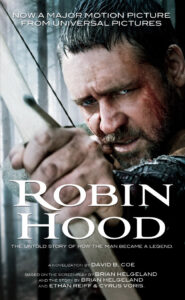
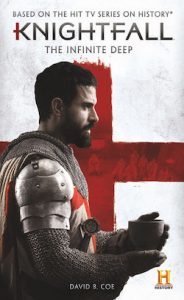
Robin Hood, by David B. CoeBut the media work I have done in the past wasn’t like that. Back in 2009-2010, I wrote the novelization of Ridley Scott’s movie Robin Hood, starring Russell Crowe and Cate Blanchett. The movie wasn’t out yet — I worked from a script — and I didn’t know whether or not I would love it. (I didn’t.) In 2018, I wrote a novel that tied in with the History Channel’s Knightfall series about the Knights Templar. In this case, I got to see all the episodes of the first season before the series was aired. I liked the show well enough.
In both cases, though, I always felt as though I were playing with someone else’s toys, which made the writing a bit challenging. I didn’t have the freedom I feel when working on my own stories in my own worlds. So, how did I make the work tolerable? DID I make the work tolerable? Good questions.

1) Look for something — anything — that allows you to take ownership of the project. This was particularly tough with the Robin Hood book, because the studio with whom I contracted maintained a death-grip over every element of the story. I could not add or delete ANY dialogue or scenes from the screenplay. I was utterly at the mercy of the script and the shoot, although the studio heads were so secretive, they would not allow me to see the movie!! I had to work from stills and from a couple of two minute movie-theater trailers. That was it!

So how did I take ownership? Point of view. I was in the minds of the characters, and since no internal monologue can be scripted, I could do with those passages whatever I wanted (to a point). There is one scene in the book of which I’m particularly proud — it’s written from the point of view of an old and fading Richard the Lionheart and I believe I nailed it.

Knightfall: The Infinite Deep, by David B. CoeWith the Knightfall book, I had a good deal more freedom and control, and so I enjoyed the process much, much more. But still I was mostly writing from the viewpoint of someone else’s characters. There is one point of view character, though, who I made my own — a child who appears later in the series as an adult. But her childhood POV was mine and gave me that sense of ownership, of personal investment in the book.
2) Take pride in what is yours and acknowledge the limitations placed upon you by what is not. Put another way, write the best book you can given the flaws inherent in the larger franchise. Robin Hood is not a great book. Robin Hood was not a great movie (though I believe it was better than many critics said). I believe I did as much with the book as I could under the circumstances, and that is all I can ask of myself.

3) Accept that work-for-hire makes possible the stuff we WANT to write. There is nothing wrong with writing for money. Hell, that’s what nearly all of us strive for when we begin this professional journey. When people ask me which of my books are my favorites, I never mention Robin Hood or Knightfall. But I don’t shy from talking about the experience of writing the books. I’m not ashamed of having written them. I’m a professional writer, and in both cases the media work provided a necessary financial bridge between personal projects. Without Robin Hood, I might not have written the Thieftaker books. Without Knightfall, I might not have written the Islevale Cycle.

Media tie-in, work-for-hire — call it what you will. This sort of work is part of the business, and while it may not be my favorite sort of book to write, it is part of what I do to maintain my career and to pay a few bills. If work of this sort comes your way, jump at the opportunity. The money is good and the publications bring exposure and possibly more jobs. Just remember to make the work your own in some way.

Keep writing!!

A Word of Thanks, and a Bit of Bragging

My summer of releases continues tomorrow!!

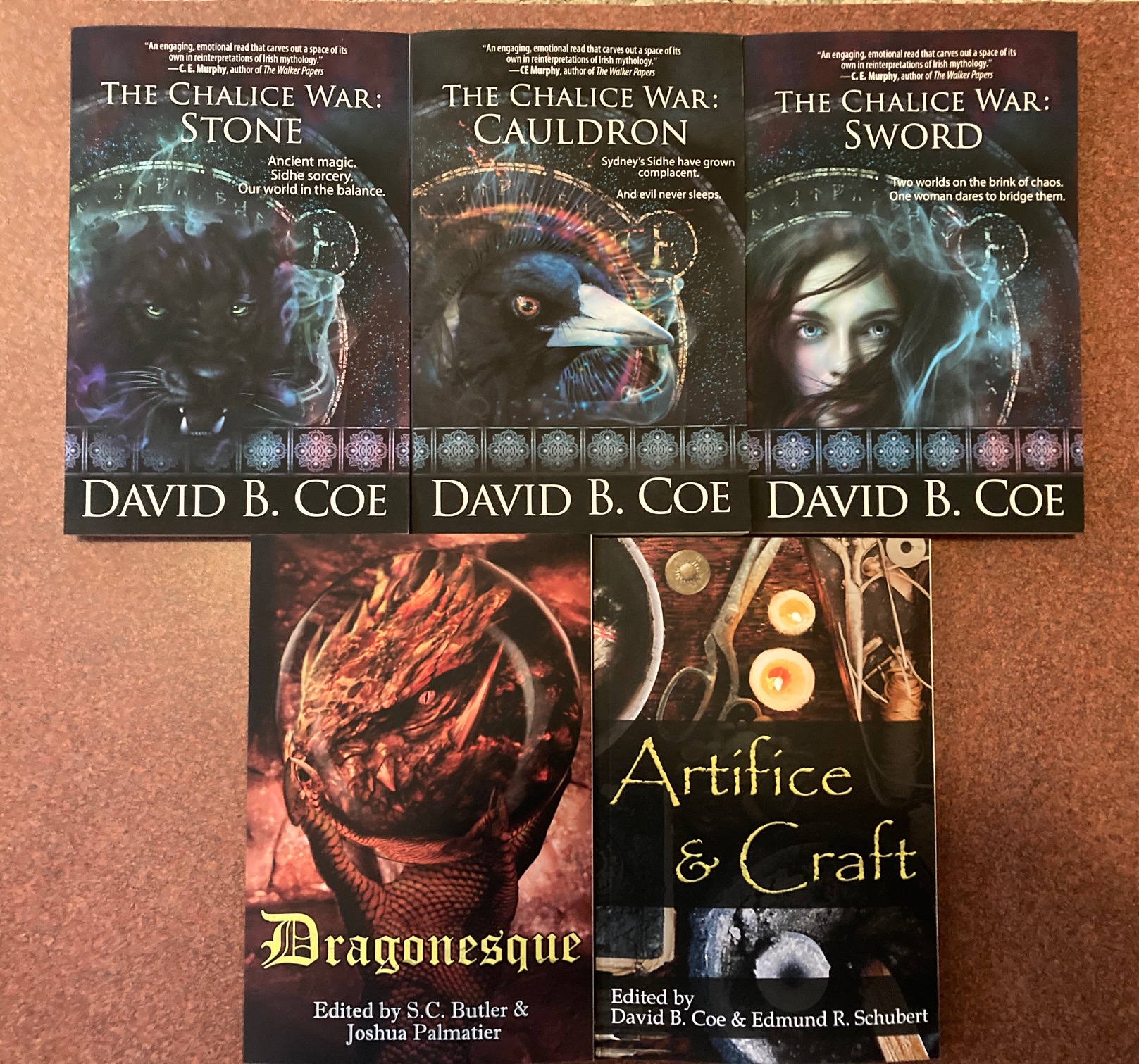
So far this year I have had releases in May (The Chalice War: Stone, the first book in my new Celtic urban fantasy), June (The Chalice War: Cauldron), and July (Artifice and Craft, which I co-edited with Edmund Schubert, and Dragonesque, which includes my short story, “Reenactment”). Now we’re into August, and tomorrow sees the release of The Chalice War: Sword.My Summer 2023 releases

Yes, I say all of this with tremendous pride. I have been productive over the past year. And over the past three years, going back to 2021, I have published four short stories, edited three anthologies, and produced five novels and a trilogy of novellas. That’s nothing to sneeze at. The truth is, my work has been a balm and a welcome distraction from other things. Being productive has been a form of therapy for me.

I want to thank you all so much for your support of my work, and of me personally. I’m more grateful than I can say. The past few years have not been easy, but your interest in my new books and stories, and your willingness to read my blog posts and social media screeds has meant the world to me. No, I’m not going anywhere. I have more projects to work on, more blog posts to write. But I wanted to pause and say thanks. I wish all of you the best.

Professional Wednesday: Beginnings, Middles, and Endings, part VI — Final Thoughts

This week I close out my Professional Wednesday feature on “Beginnings, Middles, and Endings” with some general observations about narrative structure. If you are just coming to this series of posts, I would recommend you go back and read the previous entries on openings, middles (here, here, and here), and endings.

Not surprisingly, I stand by all I have written in the preceding essays. But I also think it is worth pointing out that everything I’ve written in this series of posts thus far assumes a linear approach to narrative. And for writers who are at the start of their careers, still learning their craft and/or still trying to break into the business, that is the safest approach to storytelling, if not the most exciting or innovative. The three-act narrative structure has been around for a long time. Lots of creative careers have been built on it. One could argue that the entire movie industry was founded upon it, and did quite well for a long time, thanks very much.

But for many of us, the real fun begins when we take apart that traditional narrative structure and piece it back together again in ways that are less predictable and more challenging, for creator and audience alike. There are so many fine examples of this, I hardly know where to begin. William Faulkner’s masterpiece, The Sound and the Fury, is the first one that comes to mind. In it, Faulkner tells the story of a tragically dysfunctional Southern family by focusing on the events of four days as experienced by four different point of view characters. Each section adds crucial details of the family’s rise and fall, until the final point of view brings all the previous elements together into a coherent whole.

One of my favorite novels of all time is Angle of Repose, by Wallace Stegner, which consists of two narratives, one of an older man coming to terms with the looming end of an unhappy life, and the other tracing the life of his mother, which the man reconstructs as he reads through her journals. The two narratives intertwine and feed one another in unexpected and poignant ways.

Many of you are probably familiar with Quentin Tarantino’s film Pulp Fiction, which interweaves several storylines, playing with chronology, coincidences, and chance encounters to create a fascinating (albeit bloody and graphically violent) fractured whole.

No doubt you can think of many other examples — together we could go on for pages and pages pointing to all the innovative narrative structures we’ve encountered, be it in novels, short stories, movies, television episodes, etc.

My point in presenting these posts was to familiarize readers of my blog with the basics of traditional, linear narrative structure. Because before we as artists start breaking the rules, we need to KNOW the rules and even master them. Miles Davis and Charlie Parker didn’t start off their musical lives creating jazz classics that sounded like nothing that had come before. They started by learning their craft and by becoming virtuosos of well-established jazz styles. THEN they innovated and changed the world.

The other thing to remember is that straying from narrative traditions doesn’t always work. The examples I have given, and those you can think of, are the ones that were successful and memorable. As many as we might think of, I’m certain they represent a minute fraction of those that have been attempted. The vast majority likely fell flat. And even those that are part of successful works are not always worth emulating.

The end of The Lord of the Rings (the books, not the movies) actually has two climaxes. There is the final battle with Sauron’s army which coincides with Frodo and Sam’s final ascent of Mount Doom and the fight with Gollum over the fate of the Ring. From there the book starts to wind down, with the coronation of Aragorn and leave-takings and resolutions to so many relationships. But then the hobbits return to the Shire and we have the second climax, “The Scouring of the Shire,” which sees Frodo, Sam, Merry, and Pippin having to rally their fellow hobbits to defeat Saruman and Wormtongue. The books were successful obviously, but that is not a structural quirk I would recommend for any beginning writer or established author.

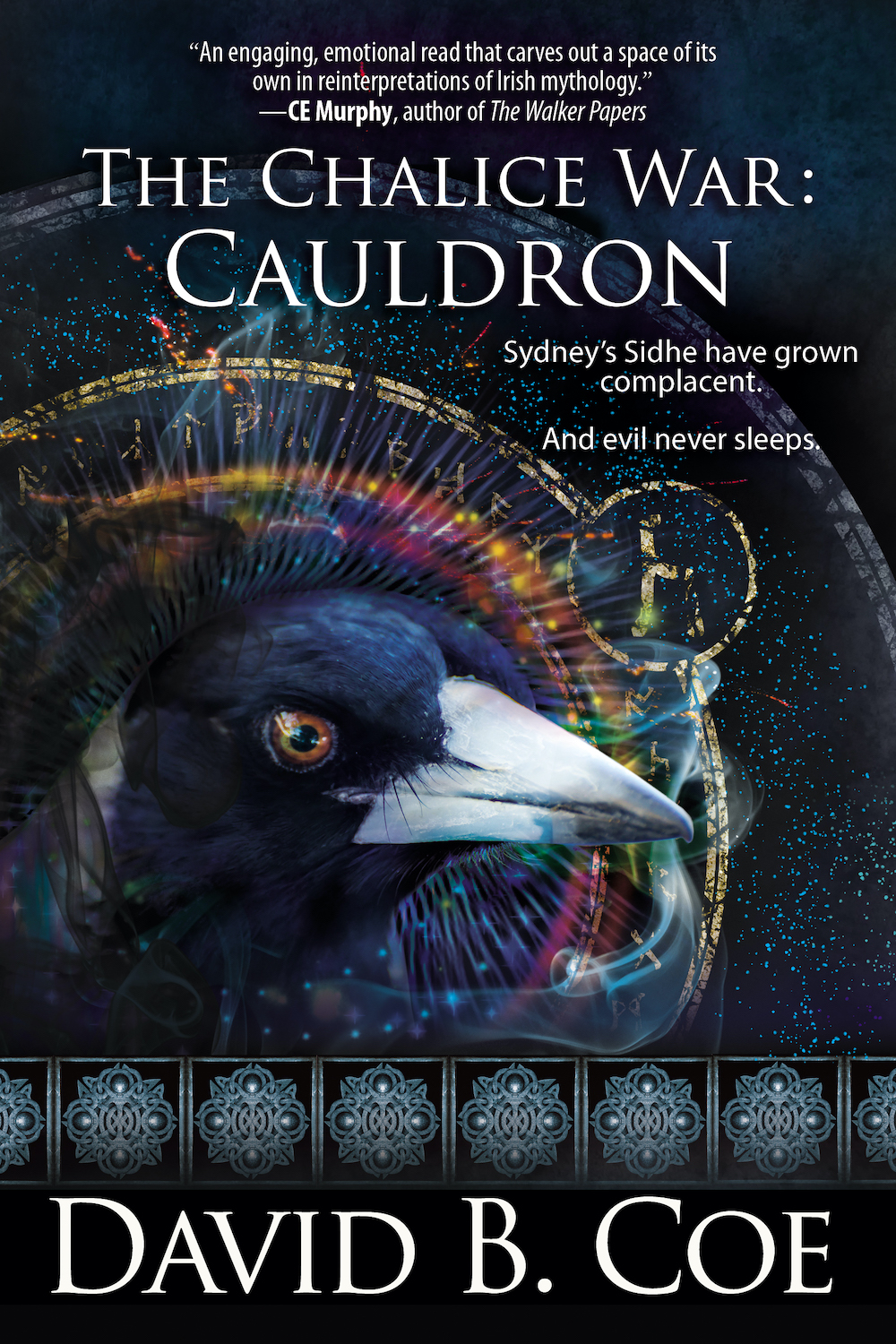
Islevale compositeWhich is another way of saying that innovation for the sake of innovation is not necessary or advised. Yes, it’s fun and challenging to write books or stories that don’t conform to simple linear narrative. I learned that with the Islevale Cycle, my time travel/epic fantasy series. And if you have ideas for playing with chronology or otherwise changing up your narrative style, by all means give it a try. But don’t feel that you have to. There are plenty of books, movies, plays, and stories out there that conform to regular old narrative form, and they do just fine. Better to write a story in the normal way and have it come out well, than to change things up just for the purpose of doing so, and thus leave your audience confused.
Keep writing!!

Professional Wednesday: Marketing Strategy, a New Release, and an Excerpt!!

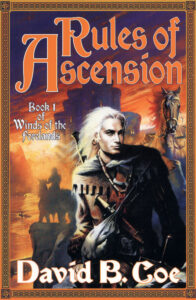
The Chalice War: Cauldron, by David B. CoeThis Friday — the day after tomorrow!! — The Chalice War: Cauldron, the second book in my new Celtic-themed urban fantasy series, will be released by Bell Bridge Books. For those of you thinking, “Wait, didn’t you JUST have a release in this same series?” you’re right, I did. The Chalice War: Stone came out May 5, four weeks before this week’s release. And the final book in the series, The Chalice War: Sword, will be out in July or August. (And wait until you see the jacket art: Spoiler Alert — it’s spectacular!)
The thinking behind rapid-fire releases of this sort is pretty simple: If the first book interests readers, and if they fly through that opening volume, they will be eager for more and won’t want to wait. I can’t tell you how many times authors hear from readers, “Oh, I hate waiting for each book in a series to come out, so I wait until the last book is published before I buy any of them.”

This is deeply frustrating for those of us who write and sell books for a living. I get it, of course. Sometimes, fans have to wait a year or more for subsequent volumes in a series to be released. And on occasion, those subsequent volumes never appear at all. The series is dropped by the publisher, or the author simply never gets around to completing the story. Writers aren’t the only ones who can find the publishing schedule frustrating.

Here’s the thing, though: Quite often, the publication of second and third and fourth volumes in a given series is dependent on the sales of the first book. If sales of Book I disappoint, some publishers will decide to drop the series, rather than go to the trouble and expense of putting out the later volumes. And so the reluctance of readers to buy that first book, lest the others don’t find their way to print, becomes self-fulfilling.

The rapid release model is relatively new in the publishing world, but it is intended to prevent this sort of thing from happening. If readers see the second and third books coming out so soon after the first, they will be more willing to buy that initial installment, and might go ahead and just grab all three as they appear. This is certainly my hope.

So, in the spirit of marketing and piquing your interest, let me tell you a bit about Book II, Cauldron. In book I, Stone, we meet Marti Rider, a Sidhe conjurer, and Kelsey Strand, two strangers who are bound to each other by a powerful magical artifact. They are attacked and pursued across the country by Fomhoire demons and their allies, who are intent upon killing them, claiming the artifact as their own, and using it to conquer our world. Along the way, we encounter a host of Celtic immortals who help our heroes or hinder them, depending on their shifting alliances.

In Cauldron, the pursuit of these magical chalices shifts to Australia, where we are introduced to Riann Donovan and her friend (and perhaps more) Carrie Pelsher. Riann is a Sidhe sorcerer who has fled the States to Australia to escape a tragic past. Carrie is a journalist with a strange affinity for magic. When the Sidhe community in Sydney is devastated by a coordinated Fomhoire assault, the two women find themselves in a race against time and a dance of intrigue among gods, Furies, and demons. And yes, for those wondering, Marti and Kel will find their way to Australia to join the fun.

As I’ve said before, I love all of these books. Writing Cauldron allowed me to draw upon experiences and memories from the year I spent Down Under. Many of the locations described in the book are places Nancy, the girls, and I visited. It was a special book to write. And I hope you enjoy it.

And, to whet your appetite for the book even more, here is a short excerpt! Enjoy!

*****
The train had just pulled out of Redfern station when the first frisson of magic brushed across Sara’s skin. She shivered, tasting darkness in its touch.

Fomhoire. Here, in the middle of Sydney. Nearby and closing in, accompanied by . . . by what? Wight? Demon? Yes, demon. All this she read in that initial contact. More, she sensed the Fomhoire had already found her, was intent on her and closing the distance between them.

Sara stood, crossed to the nearest of the sliding doors, and stared out into the inky black of the railway tunnel, desperate for the light of the next station. Never had the distance between Redfern and Central felt so great. The train car rocked, and she grabbed hold of the steel pole beside her to keep from tumbling into the lap of a young businessman.

“Pardon me,” she whispered.

His gaze flicked to her. He answered with a nearly imperceptible nod and turned his attention back to the Herald.

Morning commuters crowded the CityRail trains and stations. Surely Fomhoire assassins wouldn’t attack her here, in front of so many.

A small voice in her mind replied, Why not?

She wore work clothes, carried her briefcase, was on her way to her office in the CBD. Roger, her tabby, her conduit, was at home, safe in her flat, too far away to help her with spells. She was powerless, defenseless.

The train slowed—finally!—and the train guard announced their arrival at Central Station.

“Change here for Northern, Carlingford, North Shore, Cumberland. . . .”

The moment the doors opened, she pushed her way out, heedless of the men and women in front of her and those on the platform waiting to board. People shouted after her; a few muttered obscenities. She didn’t care. She hurried to the nearest stairway, one that would take her to the concourse. The magic followed, aimed like a weapon at her back.

By the time Sara reached the top of the stairs, she was breathing hard, sweating through the blouse she wore beneath her blazer. She switched her briefcase to the other hand, wiped her slick palm on her skirt.

She kept to the crowd, surrounding herself with people, using them as shields and searching frantically for anyone who might give off enough glow to let her defend herself.

How can there be Fomhoire in Sydney?

She and the others maintained a network, a web of magic. Like Sidhe in other parts of the world, they watched for portals and Fomhoire incursions from the Underrealm. As far as she knew, they had sensed nothing.

For decades, Sara and her fellow Sidhe had protected one another, warned one another. These last several years had been quiet, peaceful. She knew other Sidhe in countries far from Australia had battled Fomhoire recently. Harrowing reports had reached her from the States, from Europe and Africa and Asia. But here . . . . Relative peace had reigned for so long, she had grown comfortable, lax. Caution needed to be a routine, like exercise. And she had grown lazy. How many mornings had she left her flat without taking the simple precaution of warding herself? This morning had been no different from yesterday, from the day before, from the one before that. Except it was entirely different. And she might well die because of it.

She exited the gates, threaded her way through the throng in the concourse, hoping to lose her pursuers among the masses. She would exit the station onto Pitt Street and grab a taxi. That was her plan anyway.

As she neared the doors at the west end of the concourse, she sensed more magic. Wights probably, but without Roger, she wouldn’t stand much chance against them, either. She slowed, halted. People flowed around her on either side, as if she were a stone in a stream.

Eddy Street then—the nearest exit.

After a single step in that direction she stopped again. More magic. They had her surrounded.

Another train perhaps. If she could return to the gates and get to a North Shore platform, or maybe the Illawarra line . . . .

A spell electrified the air and made the hairs on her neck stand on end. Sara could do nothing except brace herself for its impact.

Magic fell upon her an instant later, obliterating thought, will, consciousness. She couldn’t say if she remained standing or fell to the floor or ran in circles like some ridiculous child’s toy. Time was lost to her.

When next she became aware of her surroundings, she was still upright in the middle of Central Railway Station’s Grand Concourse. A woman stood before her radiating so much power Sara had to resist an urge to shield her eyes.

“Hello, Sara,” she said in a cool alto and an accent that would have convinced any native Aussie.

“Who are you?” Sara asked, surprised she could speak.

The woman smiled. She was beautiful, of course. The Fomhoire always were here in the Above, regardless of how they appeared in the demon realm. Pale blue eyes, flawless olive skin, golden brown hair that fell in a shimmering curtain to her shoulders. As brilliant and superficial as a Carnival mask. She wore jeans and a long sleeve Sydney FC T-shirt; nothing that would have made her stand out in a crowd.

A second form hovered at her shoulder, as hideous as the woman was lovely, as ethereal as she was solid. It appeared to be little more than a cloud; shapeless, smoke grey, undulating. What might have been eyes shone dully from within the shadow, like stars partially obscured by a nighttime haze. Its lone substantial feature was a mouth at its very center, nearly round and armed with several rows of spiny teeth.

Two demons. One ghastly, the other lovely. Both deadly, no doubt.

None of the people passing by took note of them. Sara sensed that she, the Fomhoire, and the cloud demon were invisible to all.

Professional Wednesday: Looking At Our Old Work With Compassion

Rules of Ascension, by David B. Coe (Jacket art by Gary Ruddell)I continue to read through and revise the books of my Winds of the Forelands epic fantasy series, a five-book project first published by Tor Books in 2002-2007. The series has been out of print for some time now, and my goal is to edit all five volumes for concision and clarity, and then to re-release the series, either through a small press or by publishing them myself. I don’t yet have a target date for their re-release.
Last week, I wrote about the number of passages I have found in the first book, Rules of Ascension, that are repetitive or overly explanatory. My younger self had yet to learn the simple lesson of trusting one’s readers, and, by extension, trusting oneself. We often don’t need to tell our readers as much as we think we do. We can trust that the groundwork we have set in place will make clear the plot points, character backgrounds, and world building details we want our readers to grasp and remember.

In previous weeks, I have written about the excess verbiage we often put into our books, at the expense of flow, clarity, and effective story telling. And yes, I have found a great deal of this in Rules of Ascension as well. Too many adverbs, too much passive writing, too many dialogue tags. This was only my second series, and I was still learning to write.

This week, though, I would like to shift my focus a bit, and, in a way, give my younger self a break. Because despite the many, many flaws in my early prose, I am also finding some things to enjoy and even admire about this early work.

I suppose it might strike some as self-serving — even egotistical — to look back on earlier work and say, “I like this; this is good.” The truth is, I find myself grappling with self-criticism for even contemplating praising my own work. Hence this paragraph. But I had a text exchange the other day with a dear friend, someone I have known for decades. And he pointed out to me — in a somewhat different context — that extending ourselves grace and compassion, not to mention forgiveness and understanding, can be incredibly difficult, but also profoundly important.

Children of Amarid, by David B. Coe (jacket art by Romas Kukalis)We are often our own most unrelenting critics. This is certainly true for me in other elements of my life. I am hard on myself. Too hard. And, on a professional level, I am the first to notice and criticize flaws in my writing. So reading through old books in preparation for re-release is often an exercise in self-flagellation. It was with the LonTobyn reissues that I did through Lore Seekers Press back in 2016. And it is again with the Winds of the Forelands books.
Then as now, I had to force myself to acknowledge the good in the novels. Because I was hyperaware of instances of clumsy prose and heavy-handed story telling. I still am.

But . . . .

The Winds of the Forelands books marked a turning point in my career. I had enjoyed some success with the LonTobyn Chronicle, and with this new project I wanted to take my writing to the next level. I challenged myself in several ways: I featured a protagonist who was, at least at the outset of the saga, really difficult to like. I built a world that was exponentially more complex and intricate than what I had constructed for LonTobyn. And I wove together numerous plot threads, creating an ambitious (and, I believe, ultimately successful) narrative that I wouldn’t have dared to attempt with my first series.

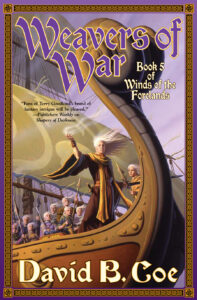
Weavers of War, by David B. Coe (Jacket art by Romas Kukalis)As I have read through this first book in the story, polishing and trimming the prose, I have rediscovered that narrative. I remember far less of it than I would have thought possible. Or rather, I recall scenes as I run across them, but I have not been able to anticipate the storyline as I expected I would. There are so many twists and turns, I simply couldn’t keep all of them in my head so many years (and books) later.
So, I constantly find myself thinking, “Oh! I forgot this! What a cool twist!” If I’m being honest, I have to say that it’s quite gratifying.

I have written here before about the importance of self-defining our successes. Artists in general, and writers in particular, are subject to business models and creative traditions that depend largely on external markers of success or failure. Royalty statements and sales numbers, print runs and new contracts, reviews in journals, reviews on Amazon, awards, etc. We look outside ourselves for affirmation. If it comes, great. But if it doesn’t, many of us label our latest endeavors “failures.” Or, worse, we label ourselves that way.

To my mind, one of the secrets to enjoying, or perhaps enduring, a career in writing, is learning to self-define what it means to succeed. We need to take satisfaction and a sense of accomplishment from the things we can control — hitting our deadlines, writing books we know are good, managing to craft that difficult scene or plot point in just the way we had envisioned.

Which brings me back to where I began. Rules of Ascension will benefit from the polishing I’ve done. The other four books in the series will be better when I complete similar revisions on them. But these are good books. They’re exciting, suspenseful, poignant. They’re written with passion and a keen eye for detail. The character work is strong, the plotting tight, the world building compelling.

I say this not to brag, but to affirm something I wish I’d been able to say as a young writer, too obsessed with those external measures of accomplishment to look beyond a poor review here or a disappointing sales report there: These books were a success. And I’m damn proud of them.

I look forward to reissuing them so you can enjoy them, too.

Keep writing!

Monday Musings: This Blog, My Books, Your Support

This Blog:

I want to say from the outset that I love maintaining this blog. I write my twice-weekly posts because I enjoy sharing my thoughts (on Mondays) and my writing tips (on Wednesdays). Writing on demand in this way is always good practice. Delving into various issues with the Musings posts often is therapeutic for me, and forcing myself to think about different craft issues on a weekly basis helps me continue to hone my own writing skills.

I will also admit, though, that maintaining the blog is time-consuming. Some weeks, the posts flow pretty easily. Other weeks, not so much. It can take me a full day to write the two essays, occasionally more than a day. That’s fine, too. As we all know, writing can be like that — easy one week, excruciating the next.

To state the obvious, I am not compensated in any way for my blogging. That has been by choice, and I do not intend to place a paywall between my readers and the content on my blog. That, I fear, would change the dynamic between my blogging and reader response to my posts, which feels very organic right now. I want to keep it that way. I have thought, though, about creating a Patreon (for those unfamiliar with Patreon, it offers creators a chance to gain financial backing from subscribers) and asking people to contribute voluntarily. If every person who visited my blog and every person who subscribed to it gave just one dollar per week, that would be ample compensation.

As I say, it’s something I’ve considered. But . . . .

My Books:

As I’ve already said, I maintain the blog because I enjoy doing so. But, to be perfectly honest, I also do it to bring traffic to my website. The calculus is a little convoluted, but it goes something like this: If people come to my site to read the blog, maybe they will stick around and look at the other pages. And if they look around, maybe they’ll become interested in my books, and maybe they’ll start buying and reading those books. As marketing strategies go, it is neither brilliant nor revolutionary, but I’m a fantasy writer, not a Madison Avenue executive, and it’s the best I’ve got.

And so, I am a little reluctant to set up a Patreon because in a way I already ask you for a financial contribution, don’t I? I make no secret of my desire for you to read my books. I write about them in my blog posts, I refer to them in my social media posts, I talk them up and even hand-sell them at the conventions I attend. If someone were to ask you, “What do you think David B. Coe wants from you?” you probably wouldn’t have to think too long and hard before coming up with, “Well, I guess he would like me to buy his books when they come out.”

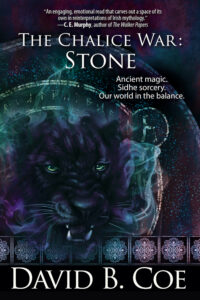
The Chalice War: Stone, by David B. CoeLet’s back that up with a little math. I said a moment ago that, were I to start a Patreon, I would be happy with contributions of $1.00 per week, which comes to $52.00 for the year. Now, as it happens, I have the first book of a new trilogy coming out on Friday of this week, May 5th. This is The Chalice War: Stone, the first book in my new Celtic urban fantasy from Bell Bridge Books. The second book, The Chalice War: Cauldron, will be out in June, and the third book, The Chalice War: Sword, will be out soon after that. Each printed book lists for $17.95. Factor in sales tax, and the three books together would cost about $57 or $58, or about $1.12 per week. (If you read ebooks, the three together will cost a total of about $16, or $0.31 per week. What a bargain!!)
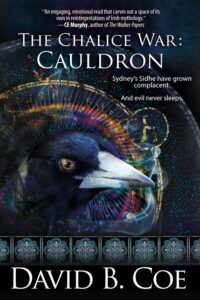
The Chalice War: Cauldron, by David B. CoeSo, for about what you might give to a Patreon, you could have all the blog posts AND all three books in the new series.
And so . . . .

Your Support:

Yes, with a Patreon, most of the money goes directly to the author. When you buy our books, we authors get a much smaller share of the proceeds. And yet, most authors I know would make that trade every day of the week and twice on Sunday. Why? Because we write! Because we LOVE to write! Because we have new ideas that we are eager to write and have published!

Much that we hear about the publishing industry sounds arcane and confusing, and many of us respond to elements of the business with amazement and dismay, wondering why anyone ever chose to set up an entire sector of the economy in quite this way. But boiled down to its most basic elements, the business model is pretty straightforward. Authors write books, publishers put out those books, readers purchase and read those books. And if all goes as it should, and readers do their part, authors get to write and publish more and more books. Lather, rinse, repeat.

Which brings me, at long last, to my point. I need for you to buy my books. It really is that simple. If you like the blog — if you navigate to my page on Mondays and Wednesdays, or if you subscribe to my feed and the posts come to your inbox — you know how much I love to write. I love it so much I do it for free twice every week. But I can only do that if the books move off the shelves and I get to write and publish more of them.

Your support is vital, not just for me, but for every author whose work you care about. Stories matter. The written word matters. Today, more than ever before. All over the world and, sadly, all over our country, self-expression is under assault from those who fear ideas. All over the world, and all over our country, literature is dying a death of a thousand cuts: book bannings, apathy, the allure of gaming and television and social media. Books and authors need the passion and commitment of readers, just as readers need the passion and commitment of writers.

And, to state the obvious, authors need to make a buck. This is our passion, our obsession, our craft and art. It is also our livelihood.

So, please, enjoy my blog posts. If you’ve missed any recently, feel free to go back and read through the archives. And take a look around the site. Make yourself at home, and rest assured that I’ll be back with another post on Wednesday, and with more in the weeks to come. But also please consider that when you buy my books, and those of other authors, you not only get those stories, you also make possible all the content we make available to you.

Thanks for reading this. Have a great week.

Monday Musings: Joni Mitchell and the Creative Journey

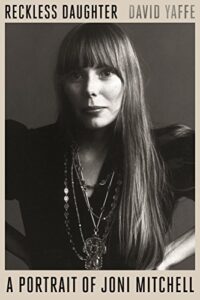
Reckless Daughter, by David JaffeRecently, I have been reading a biography of Joni Mitchell (a holiday gift from my older daughter), a long-time favorite of mine and, in my opinion, the finest songwriter in the history of rock and roll (more on that shortly). It’s been an interesting read — the author is a bit fawning for my taste, and a bit too eager as well to weave Mitchell’s (admittedly phenomenal) lyrics into his prose. But as is often the case when I read biographies of artists I admire, the book made me think about creativity and the artistic process.
First, to my statement about Joni Mitchell’s place in rock history: In my opinion, if you look at her lyrical work, her melodies, and the remarkable alternate tunings she brought to her guitar work (a response to the weakening of her hand that resulted from a childhood battle with polio), she emerges as the most innovative, eloquent songwriter rock music has ever seen. And if she was a man, I don’t think there would be any argument. I know Bob Dylan is generally recognized as the best, but though his lyrics are great I believe his music and melodies lack the sparkling originality one sees in Mitchell’s songs. Honestly, I believe Joni’s toughest competition comes not from Dylan but from Paul Simon, whose music is as brilliant as his poetry. And between Simon and Mitchell the comparison is quite close. I prefer Mitchell ever so slightly.

In 1971, as Joni Mitchell was preparing to bring out her next album, she had already established herself as one of THE up-and-coming songwriters on the folkrock scene. Other artists had enjoyed success covering her songs, most notably Judy Collins with “Both Sides Now,” and Crosby, Stills, Nash, and Young with “Woodstock.” But Joni herself had yet to become a performing star. That changed with the 1971 release of Blue, an album that is revered, and rightfully so. Its ten songs are uniformly excellent — there isn’t a dud in the collection. And several, most notably the incredible “A Case of You,” are as good as any songs put out by any of the singer-songwriters of the late ’60s and early ’70s. She followed Blue with 1972’s For the Roses, an album that has been added to the Library of Congress’s National Recording Registry, an honor reserved for recordings of historic and/or aesthetic significance. In 1974, she released Court and Spark, her biggest commercial success, and Miles of Aisles, her first live album. She followed these with The Hissing of Summer Lawns (1975) and Hejira (1976). Five years, five studio albums and a live recording. The studio albums are remarkable for their consistent quality (among all the recordings I can think of one song — one — that is less than great) and their stunning musical diversity. The live album is just damn good.

I would challenge anyone to point to a better, more productive five-year stretch from any artist. Yeah, I know: The Beatles. Next to Mitchell’s songs, their early efforts sound simplistic, and the quality of their later production is sporadic.

So, yeah, in my opinion, Joni Mitchell is a once in a generation talent, who was slow to gain the recognition she deserved because she was a woman trying to find fame in a man’s world.

But I also have to say that I found the biography’s personal portrait of her disturbing and disappointing. Her incredible ego, her flirtation with casual racism, her inability to let go of old grudges or admit fault in any number of longstanding feuds, her tendency toward harsh judgments and summary dismissals of colleagues, old lovers, and former business partners, her self-destructive addiction to cigarettes, which ruined her voice — they all combined to leave me with the sense that while I love to listen to her music, I wouldn’t wish to know her. (This is not a quirk of this biography — another Mitchell biography left me feeling much the same way.)

More, I was struck as well by the degree to which her artistic sensibility and creative ambitions undermined her commercial success. I mentioned earlier that the brilliant studio albums she put out in the early 1970s were musically diverse. I cannot emphasize this enough. Blue was the ultimate expression on the singer-songwriter movement. Lyrically, For the Roses is just as good, but the music is far more complex, the instrumentation richer. Court and Spark manages to be commercial, capturing perfectly the pop sensibility of the early 1970s, while also offering breathtakingly eloquent poetry. Hissing of Summer Lawns begins her embrace of jazz themes, taking her music in unexpected directions, and Hejira refines and perfects that combination of jazz and pop.

But with Hejira her audience began to drop off slightly. The following studio album, Don Juan’s Reckless Daughter, which continued her experimentation with jazz and pop themes and pushed her music in less accessible directions, saw a more dramatic drop in sales. The trend continued for the rest of her musically productive years. She never recaptured the success of her early albums. By comparison, Paul Simon continued to experiment musically as well and found renewed success in the 1980s with Graceland and The Rhythm of the Saints. Miles Davis, the king of cool jazz and a favorite of Mitchell’s (and mine), experimented throughout his long career, sometimes with stunning success, other times with results that fell flat with fans and critics alike.

Other musicians I listen to — James Taylor, CSN, Elton John, Bonnie Raitt, to name a few — didn’t change their sounds all that much. They were content to follow the formulas that made them successful without the sort of experimentation and risk-taking one sees in Mitchell’s career arc. As a result, they have continued to sell. Also as a result, their creative journeys seem less impressive, less weighty.

Years and years ago, I met a writing hero of mine, a person I had read early in life whose works made me want to become a published author. This person spoke with some bitterness about the trajectory of their career. They had shifted directions after their early successful series, only to find that their audience fell off dramatically. When they changed directions a second time after the aforementioned project sold poorly, they lost even more of their audience. The writer’s message was clear: If you’re doing well with what you’re writing, keep writing it.

I have changed directions a few times in my career, with mixed commercial results. The Thieftaker books originally represented a marked departure from what I had done before. They sold quite well (albeit under a different name). Other shifts in direction have proven less fortuitous. But every time I have taken on a new project I have been driven more by artistic impulses rather than by commercial ones. I suppose that is evidenced by my sales . . . . [Rimshot] But without daring to put myself on an artistic level with the likes of Joni Mitchell (or any of the other creators I’ve mentioned by name) I would say that I have followed her example, or at least attempted to.

I write the story that burns in my heart. With the exceptions of the media tie-in work I’ve done, I have never taken on a project for financial reasons. I write what I’m eager to write. I love to challenge myself with new sub-genres, with new worlds and characters and themes. I think I would have long since lost interest in writing had I not taken my creativity in so many different directions.

Which is not to say this is the “right” approach, or that others who follow a different course are “wrong.” The fact is, I don’t listen to any of Joni Mitchell’s later albums. I don’t like them. On the other hand, I buy and listen to everything James Taylor puts out, because I know what I’m going to get, and I like the sound. And no, to anticipate the next question, I would not want people to make similar choices with respect to my books.

I have no answers, no absolutes to embrace, no advice to offer. This is one of those Monday posts that’s long on musing and short on solid conclusions. Each of us must follow our own creative path. I admire Joni Mitchell’s integrity, and I am awed by her brilliance. I certainly understand the artistic decisions she has made over the course of her career. And yet, I would have loved for her to put out more albums like those I loved from the Blue-to-Hejira era.

I also know that when people tell me, “I wish you would write more LonTobyn books,” I always want to respond, “Really? Have you seen the stuff I’ve written since? It’s SO much better . . . .”

I have been, and remain, of two minds about all of this. And I continue to muse.

Have a great week.

Professional Wednesday: What Holds Me Back, part I — Life Issues

As we turn the calendar to March, I thought I would turn to a new series of posts in my Professional Wednesday feature. This month, as I struggle with a bit of work-related inertia, I have decided some might find it helpful to read about “What Holds Me Back.” Because let’s be honest — those of us who seek to make a living as professional creators face no shortage of obstacles to productivity. We have to be self-motivated, we have to be disciplined, we have to be imaginative and prolific on demand. None of this is easy and at times it seems hobgoblins lurk in every corner, threatening to undermine even the most sincere determination to get stuff done.

What — or who — are my hobgoblins? How do they disrupt my work patterns, and what do I do to keep them at bay? These are the questions I hope to address in the next several Wednesday posts.

This week, I address perhaps the most obvious and formidable hobgoblin of them all: Life.

Life is a fickle bastard, with a cruel streak a mile wide, a perverse — at times evil — sense of humor, and a preternatural knack for intruding at the absolute worst moment. But Life can also be charming, deeply attractive, kind, generous, and downright fun. This is part of what makes Life such a difficult opponent in the battle over productivity. Life is as changeable as March weather, as unpredictable as the best storyline, and as relentless as time itself. Life happens constantly; Life will not sit quietly in a corner reading a book and respecting our need for calm just because we have a looming deadline or a new idea we are eager to explore. Life lives to mess with us.

All strange metaphors aside, in my experience, relating to my own work output and also my interactions with other professionals, general life disruptions are responsible for the vast majority of missed deadlines and punted obligations. Sometimes it’s the (relatively) small stuff — a kid with a bad cold or stomach bug, a blown car engine or flat tire, a flooded basement or loss of power. Sometimes it’s more serious than that — an ailing elderly parent, a dire illness in the family, a failing marriage, the death of a friend or relative. I’ve faced my share of such things — not all, but enough; every one of us has.

And in the short term, there is nothing we can do about them. Life imposes its own exigencies. When our kid is sick or our parents are fading or a relative or friend is in need, we have no choice but to prioritize the people we love and the obligations we’ve taken on as parents and partners, offspring and siblings and friends. No one with a thread of compassion or decency should punish or blame us for this. Those who would, do so at their own risk, because eventually they, too, will be on the receiving end of Life’s caprice.

The problem comes later, after the crisis has passed, but while the aftermath lingers. Nearly two years ago, when our daughter received her cancer diagnosis, I withdrew from . . . well, pretty much everything. I told my agent and editor that I wouldn’t be able to make a deadline that was still a couple of months away. I stopped seeing friends. I hunkered down with my fear and my grief and my anger, and I essentially surrendered to this terrible thing Life had done to my family and me. I was sure I couldn’t work through it, and so I didn’t even think it worthwhile to make the attempt.

Nancy responded differently, not because she is better or stronger than I am (although she might well be both . . .) but because she deals with emotional strain differently. She is great at compartmentalizing, which is good, because at the time she had a high-stress, high-profile job. In the time since, she has advanced to a position that is even more high-stress and high-profile. Her ability to compartmentalize has served her well.

I don’t have that ability. I can’t compartmentalize. But, I realized, I had a different ability I could harness. I had learned years ago — when we lost my parents, and later when we lost my eldest brother — to channel my grief and pain into my art. And it didn’t take me long after hearing the news of our daughter’s illness to understand that was precisely what I needed to do. Within a week of calling my agent and editor to tell them I was pulling back, I sent them new messages. I am working through this. I will make my deadline.

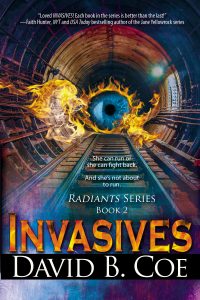
INVASIVES, by David B. Coe (Jacket art courtesy of Belle Books)And I did. The book was Invasives, by the way. It contains the best character work I’ve ever done, and that is no coincidence.

I suffer from anxiety and panic disorder. I sometimes walk the edge of depression. I know as well as anyone that coping with life is hard, and that glib, easy-fix solutions to the shit life throws at us are worse than useless. Such facile responses can actually hurt, because they suggest to those of us who struggle that the problem isn’t the circumstance but rather our inability to deal with it.

But I know as well, from my own experience, that we don’t have to be whole to create. Life elicits emotion and those emotions can overwhelm and paralyze. The thing is, though, we’re creators, and emotion is our bread and butter. Yes, at times the emotions we feel in life’s rawest moments are like a downed electrical wire. We touch them at our own risk. As I found a couple of years ago, however, we can be resilient in the face of the worst circumstances. Long before I was ready to interact with other people, I was ready, even eager, to take hold of that live wire and use it for something constructive and healing.

Life can disrupt our art. We all know this. But we are alchemists at heart. We can turn grief and hurt and fear and anger into golden moments on the page (or the canvas or the guitar or the stage — whatever). And, for me at least, that is how I keep life from holding me back.

Keep writing.