








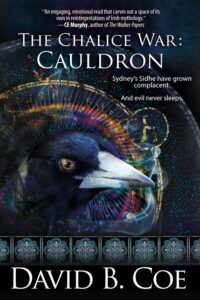
 As I mentioned in a recent post, I have been doing a tremendous amount of editing and revising these past several months. Between co-editing (with Edmund Schubert) the Artifice and Craft anthology for Zombies Need Brains, revising my upcoming Chalice War trilogy, and working on manuscripts for clients of my freelance editing business, I have been through literally half a million words of text! And that is to be expected. Books and stories require careful editing and committed revision to reach their fullest potential.
During this time I have noticed, in my own work and in the prose of others, certain phrases and verbal habits that make our writing wordier, and therefore less effective, than it needs to be. Last week, I drew upon one of my old Magical Words post for inspiration to revisit a writing issue, and I thought I would do the same thing this week. Our topic today: cutting excess verbiage.
Just about all of us use more words than we should in our initial drafts. Hence that need for editing I mentioned above. With experience comes the ability to catch at least some of our worst writing habits. And yet, I have been writing professionally for more than twenty-five years, and I still fail to see all of them on my first revision pass. Fortunately, I have a wonderful editor who catches the wordy constructions I miss. (Be forewarned: She’s not editing this, so . . . well . . . yeah.)
Still, in revising my own work, and editing that of others, I have noticed a few patterns that all of us should watch for in our prose.
Passive constructions: Passing writing takes a number of forms, but at its most basic it uses weak verb constructions that rely on forms of the verb “to be.” These include “is,” “was,” ”are,”“were,” etc. Instead of “He ran” or “she speaks,” passive writers might say, “He was running” or “She is speaking.” Yes, in these examples passive constructions add only one word, but the damage goes far beyond word counts. Passive writing can flatten our prose, making it less powerful and less impactful. Or, put in another, stronger way . . . . Passive writing flattens our prose, robbing it of power, of impact. To state the obvious, we can’t remove every “to be” verb construction from our writing, at least not without relying on tortured syntax. Sometimes there is no other way to say what we want to say. (See what I did there?) We can, however, look for every opportunity to change a weak, passive phrase into a strong, active one.
Distancing phrases: When writing fiction, we should always be in a character’s point of view. Usually I try to avoid blanket statements of hard and fast rules, but I feel strongly about this. Point of view is the greatest tool we possess as writers. We should use it. One reason why? POV makes distancing phrases “he felt,” “she heard,” “they saw,” etc. unnecessary. “She heard cannon fire booming in the distance.” “He felt the house tremble with the rumble of thunder.” Those sentences are fine, but they’re unnecessarily wordy. In each case, we’re in a character’s point of view, and so the “she heard” and the “he felt” are redundant. If she experiences the sound, we KNOW she heard it. If he experiences the movement of the house, we KNOW he felt it. So . . . . “Cannon fire boomed in the distance.” “A rumble of thunder shook the house” or “The house trembled with a rumble of thunder.” Either works. Both are better than the original construction.
How about this one? “They could see dust rising from the road as a company of horsemen approached.” Here we have lots of unnecessary verbiage. Starting with the “They could see.” Again, we’re in a character’s point of view, and that character is part of the “they.” We also have the “as” phrase, which less experienced writers also tend to overuse. If we present cause and effect with clarity, words like “as” and “while” become unnecessary. So . . . “Horsemen approached, dust billowing from the road in their wake.” More concise, more powerful, more evocative. When we use words like “saw,” “felt,” “heard,” we TELL our readers what is happening. With more direct language, we SHOW them, which is always preferable.
Including mannerisms of speech in our prose: Humans are, as a species, remarkably inarticulate creatures. When giving advice on writing dialogue, I often tell writers to have their characters speak not as we do, but as we wish we did. This by way of eliminating “er”s and “um”s, “you know”s and “like”s, and all the repetitions and circularities of everyday speech. But there are other ways in which our speech patterns infect our prose. Just a moment ago, I started a sentence like this: “One thing we can do to improve our writing is . . . .” That is a TERRIBLE phrase. Just awful. I caught myself immediately and rewrote the offending sentence. Often, however, such phrases slip by our internal editors and find their way into early drafts. When we speak, we use roundabout constructions like that one to gather our thoughts, and we do it without even thinking. It’s a way of answering a question or opening a conversation with something other than a) silence, or b) inarticulate rambling. The thing is (and yes, “The thing is” is another example of the same phenomenon) when we write, we don’t need those filler phrases. Indeed, we don’t want them. They add clutter to our writing. We can’t possibly anticipate all the nonsense phrases that might slip into our prose in this way, but we can watch for them, recognize them when they crop up, and eliminate them.
Next week, I will continue this discussion of excess verbiage in our written work.
For now, keep writing!!
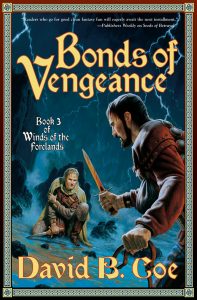 I have two other projects underway as well. A nonfiction thing that I am not ready to discuss in detail, and, at long last, the editing of the Winds of the Forelands books for re-release in late 2023 or early 2024. And I have another writing project — a collaborative undertaking — that I also cannot describe in detail, simply because I am not the organizing force behind the project, so it is not mine to reveal. But I am excited about it.
 Right around the holidays, I was shouting from the virtual rooftops about my new Celtic urban fantasy trilogy, The Chalice War, which would be coming out early in 2023. The first book, I bellowed (virtually), would be coming out in February, and it would be called The Chalice War: Stone. It would be followed, a month or so later, by The Chalice War: Cauldron, and then a couple of months after that by the finale, The Chalice War: Sword.
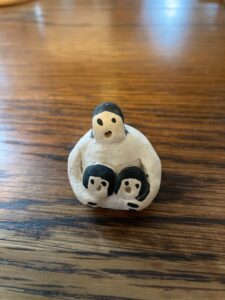 During our tour, we encountered many people selling pottery in front of their homes. And at one table, a mother displayed her wares beside those of her young daughter. I think the girl must have been around 7 or 8, give or take a year, and she had made a few small bowls, seed pots, and dishes. And she had made a tiny storyteller. As one would expect, it was quite crude compared to those we had seen for sale back in Albuquerque (we hadn’t yet been to Santa Fe or Taos), but something about the figure spoke to me. Maybe is was just that the storyteller was so cute. Or maybe it was that the girl herself was so proud of it. Or maybe I saw in this child’s early effort to follow in her mother’s footsteps something akin to my dream of becoming a professional writer. Whatever the reason, I asked the girl how much it cost.
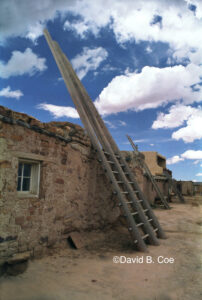 That was a magical day in many ways. Acoma was as beautiful as we had been told, the pale red stone of the Pueblo seeming to glow beneath a deep azure sky, wooden kiva ladders rising above their structures and reaching toward the clouds. At one point, I spotted a rainbow in the clouds overhead — there was no rain, just the prismatic color, which appeared for a moment and then vanished. I think I was the only one on the tour who saw it. I believed that, together, the rainbow and my little storyteller were omens, signs that my dream would, in fact, come to pass.
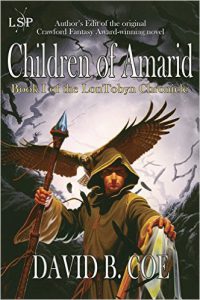 Two months later, I got my first contract from Tor Books. Children of Amarid wasn’t published for another three years — that first book needed a lot of editorial work. But I was on my way.
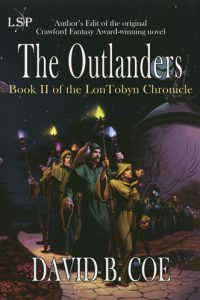 The first deadline I missed was on my second novel, The Outlanders, the middle book of the LonTobyn Chronicles trilogy. And I had good excuses. Between the time I started writing the book, and the day the first draft of the manuscript was due to Tor, our first child was born, my mother died, my father died, and my siblings and I had to settle my father’s estate.
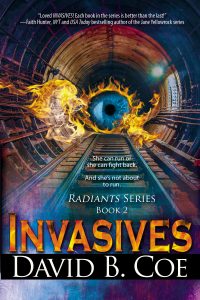 Yes, sometimes we think we’re going to miss a deadline, and then we make it. And if we alert our publisher prematurely, we could lose our spot in the queue. So be it. That’s the price of acting professionally. When our older daughter first was diagnosed with cancer, I told my editor and my agent what had happened, and let them know I was probably going to be late with the novel I was writing. As it turned out, writing that book — Invasives, the second Radiants novel — was a wonderful escape, and I met my deadline. But I had given up my publishing spot and so the book was released later than I had hoped. It wasn’t that big a deal. As I say, the most important thing is be up front about the situation with those who need to know.
 So far, we have received some very good stories. We have also received far, far more that won’t make the first cut. And so I thought I would go over again, briefly, the things that can make or break a story submission, at least for this editor.
 Will I reject a story simply because it is single-spaced instead of double-spaced? No, I’m not quite that mean. But when reading a story, knowing I have literally dozens more waiting in the queue, I will only tolerate so many flaws before I reject it. Remember, I have 500 stories to choose from. I can and will find what I’m looking for. No story is ever perfect, so ask yourself, do you want to expend one of your flaws on formatting? Or do you want to present your story correctly so that I can judge it on its artistic merits? The answer seems self-evident to me.
 1) I abhor the cliché, but think outside the box. As