Tag Archives: writing life

Professional Wednesday: The Last Book of a Series

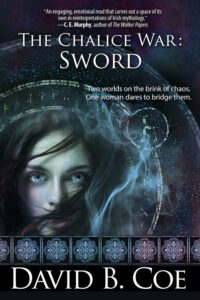
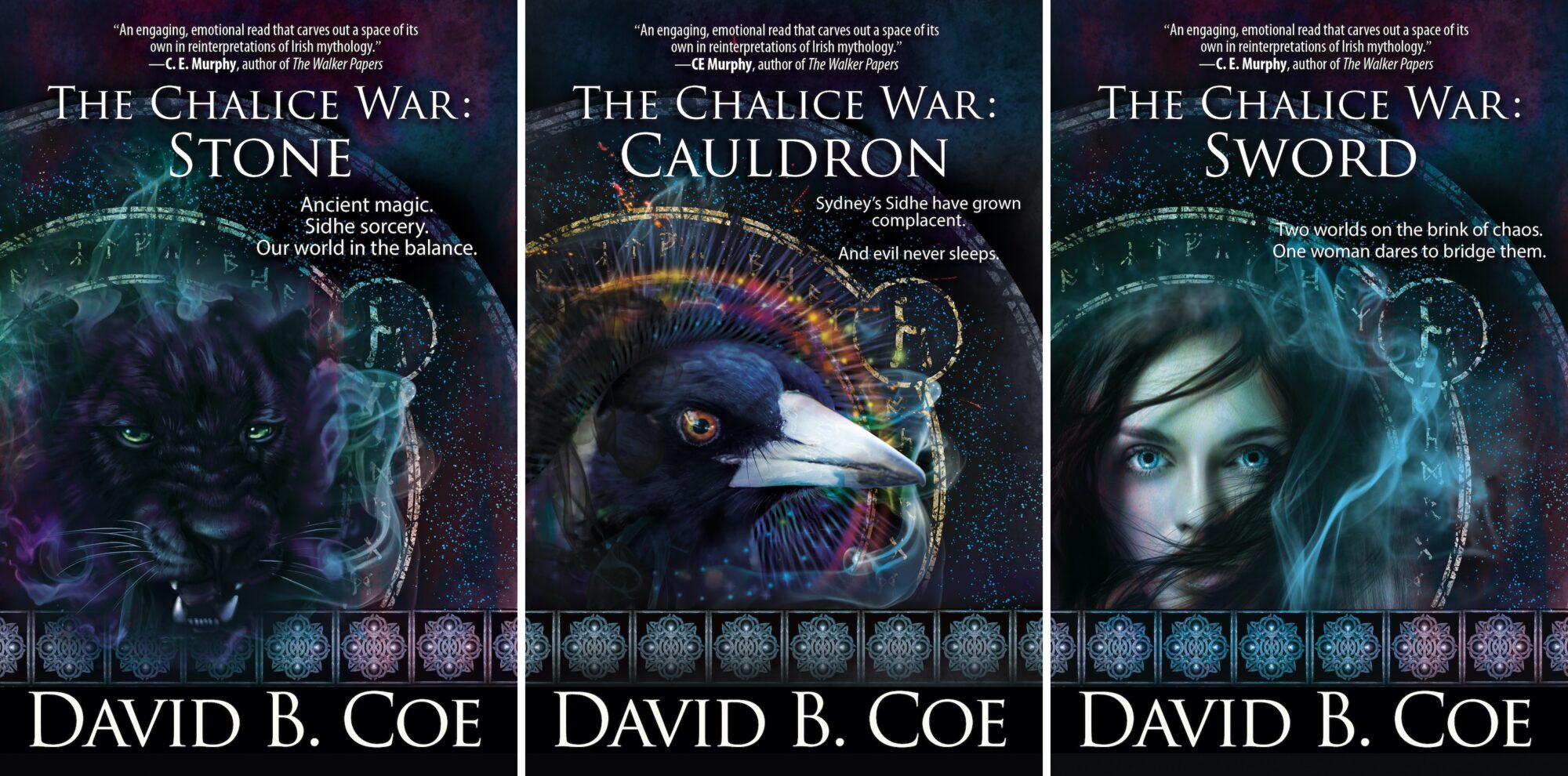
The Chalice War: Sword, by David B. CoeA week and a half from today, on Friday, August 4, The Chalice War: Sword, the final book in my Celtic urban fantasy trilogy, will be released by Bell Bridge Books. (The first two books, The Chalice War: Stone and The Chalice War: Cauldron, are already out and available. If you haven’t already gotten them, please consider doing so. And if you have read them, please consider leaving reviews at your favorite book sites.)

I won’t bother telling you that I’m excited for this release (though I really am). The fact is, I get excited for every new release (but especially this one — really!). Even after so many published books (Sword will be my 30th) the thrill remains much the same. And there is something extra special about the concluding book in a series. A couple of weeks ago, near the end of my “Beginnings, Middles, and Endings” feature, I wrote about the things we want to accomplish with the final chapters of our novels, including bringing our story to a satisfying and thrilling culmination, completing our character arcs, and tying up our remaining loose ends. We want to do this with any novel, but to state the obvious, it is absolutely crucial to nail the ending of a final book in a series.

The Chalice War: Stone, by David B. CoeThe premise of The Chalice War trilogy is fairly simple. The four treasures of the Sidhe — the Stone of Fal, the Spear of Lugh, the Daghda’s Cauldron, and the Sword of Nuadu — are chalices of magic. As long as they remain in this world, the Above, the Sidhe sorcerers living in our midst can continue to protect our world. But the Fomhoire, masters of the demon Underrealm, seek to take the chalices from our world into the Below, and if they succeed, magic will cease to exist in our world and demons will overrun the face of the earth.
The first two books are set entirely in the Above — our world — where Sidhe sorcerers do battle with Fomhoire demons to protect two of the chalices (the titles give away which ones). But I wanted to do something different with the third book. And honestly, for a long time, I didn’t know what exactly that would look like.

The Chalice War: Cauldron, by David B. CoeYou see, I wrote the first iteration of book one, Stone, more than a decade ago, when I was in a lull in my career and was looking for something to write for the fun of it. I loved that first draft, but it needed work, and around the time I finished it, I signed my first Thieftaker contract, putting an end to the aforementioned lull. I started work on the second book, Cauldron, about seven years ago, hit a wall, put it away, came back to it four years later and finished it. Now, usually when I write a series, I know as I begin book one how the last book will end. Not with this series, because when I wrote that first book, I was playing around. I had no idea what it would become. So even after I finished the second book, I still wasn’t sure what to do with the series, because I had no idea how to write the third book without making it simply a repeat of one of the first two.
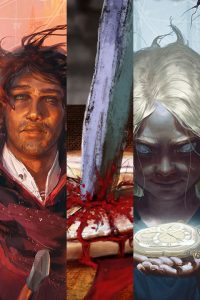
Except that’s not quite true. Early in the series, I reveal that the Fomhoire have already succeeded in stealing one of the chalices. The Sword of Nuadu is already in the Underrealm; the future of our world is poised on the edge of a blade. So, naturally, book 3 had to be about a journey into the Underrealm, the demon world, to steal back the lost sword.

But the idea of this intimidated me. I had no idea what the demon realm was like. I had no idea how to write such a book. So, I put books 1 and 2 back in a drawer, and I wrote the Radiants books, which was fun and great. I LOVE those books.

But the Chalice books haunted me. And the challenges of that third book called to me. I needed to create the demon realm, making it believable and tangible and rich and compelling, but also menacing enough to carry its share of the plot. I needed to have an exciting, engaging second plot line set in our world so that the characters who don’t go to the Below are still busy with Important Stuff. And, as mentioned earlier, I needed to nail the ending, to hit all the right emotional notes while tying off every one of my plot threads from the three books.

No pressure.

The fact is, not knowing what to write is an impediment to starting a project. But perceiving challenges? Seeing in a potential novel tasks that are going to force me to grow as a storyteller? That right there is incentive. And once I started working on the third novel, once I overcame that sense of intimidation, the book flowed quite easily. The result, in my biased opinion, is a strong, successful conclusion to what I believe is one of my best series yet. I hope you agree.

I posted a teaser last Friday, and will post another one this Friday. I hope you enjoy all three books. Thank you, as always, for your support of my work!

Keep writing!!The Chalice War trilogy, by David B. Coe

Professional Wednesday: Beginnings, Middles, and Endings, part VI — Final Thoughts

This week I close out my Professional Wednesday feature on “Beginnings, Middles, and Endings” with some general observations about narrative structure. If you are just coming to this series of posts, I would recommend you go back and read the previous entries on openings, middles (here, here, and here), and endings.

Not surprisingly, I stand by all I have written in the preceding essays. But I also think it is worth pointing out that everything I’ve written in this series of posts thus far assumes a linear approach to narrative. And for writers who are at the start of their careers, still learning their craft and/or still trying to break into the business, that is the safest approach to storytelling, if not the most exciting or innovative. The three-act narrative structure has been around for a long time. Lots of creative careers have been built on it. One could argue that the entire movie industry was founded upon it, and did quite well for a long time, thanks very much.

But for many of us, the real fun begins when we take apart that traditional narrative structure and piece it back together again in ways that are less predictable and more challenging, for creator and audience alike. There are so many fine examples of this, I hardly know where to begin. William Faulkner’s masterpiece, The Sound and the Fury, is the first one that comes to mind. In it, Faulkner tells the story of a tragically dysfunctional Southern family by focusing on the events of four days as experienced by four different point of view characters. Each section adds crucial details of the family’s rise and fall, until the final point of view brings all the previous elements together into a coherent whole.

One of my favorite novels of all time is Angle of Repose, by Wallace Stegner, which consists of two narratives, one of an older man coming to terms with the looming end of an unhappy life, and the other tracing the life of his mother, which the man reconstructs as he reads through her journals. The two narratives intertwine and feed one another in unexpected and poignant ways.

Many of you are probably familiar with Quentin Tarantino’s film Pulp Fiction, which interweaves several storylines, playing with chronology, coincidences, and chance encounters to create a fascinating (albeit bloody and graphically violent) fractured whole.

No doubt you can think of many other examples — together we could go on for pages and pages pointing to all the innovative narrative structures we’ve encountered, be it in novels, short stories, movies, television episodes, etc.

My point in presenting these posts was to familiarize readers of my blog with the basics of traditional, linear narrative structure. Because before we as artists start breaking the rules, we need to KNOW the rules and even master them. Miles Davis and Charlie Parker didn’t start off their musical lives creating jazz classics that sounded like nothing that had come before. They started by learning their craft and by becoming virtuosos of well-established jazz styles. THEN they innovated and changed the world.

The other thing to remember is that straying from narrative traditions doesn’t always work. The examples I have given, and those you can think of, are the ones that were successful and memorable. As many as we might think of, I’m certain they represent a minute fraction of those that have been attempted. The vast majority likely fell flat. And even those that are part of successful works are not always worth emulating.

The end of The Lord of the Rings (the books, not the movies) actually has two climaxes. There is the final battle with Sauron’s army which coincides with Frodo and Sam’s final ascent of Mount Doom and the fight with Gollum over the fate of the Ring. From there the book starts to wind down, with the coronation of Aragorn and leave-takings and resolutions to so many relationships. But then the hobbits return to the Shire and we have the second climax, “The Scouring of the Shire,” which sees Frodo, Sam, Merry, and Pippin having to rally their fellow hobbits to defeat Saruman and Wormtongue. The books were successful obviously, but that is not a structural quirk I would recommend for any beginning writer or established author.

Islevale compositeWhich is another way of saying that innovation for the sake of innovation is not necessary or advised. Yes, it’s fun and challenging to write books or stories that don’t conform to simple linear narrative. I learned that with the Islevale Cycle, my time travel/epic fantasy series. And if you have ideas for playing with chronology or otherwise changing up your narrative style, by all means give it a try. But don’t feel that you have to. There are plenty of books, movies, plays, and stories out there that conform to regular old narrative form, and they do just fine. Better to write a story in the normal way and have it come out well, than to change things up just for the purpose of doing so, and thus leave your audience confused.
Keep writing!!

Professional Wednesday: Beginnings, Middles, and Endings, part IV — Keeping Our Plots Tight

Today, I bring you one more “Middles” post in my several-weeks-long feature on “Beginnings, Middles, and Endings.” You can find past posts in the series here, here, and here.

I made the self-evident point a couple of weeks ago that the vast middle of any book is by far the largest segment, which is why I have spent a few weeks on the subject. At the same time, though, there are as many different ways to approach the middle (and the beginning, and the ending) as there are books to be written, which is to say there’s an infinite number. And so there are only so many specifics I can offer. This, it seems to me is especially true of the middle. Beginnings share a common purpose — we use them to hook our readers. Endings seek to cap off our narratives, tie off loose ends and, perhaps, hint at additional story elements to come in subsequent volumes.

The purpose of the middle is to tell the story. How’s that for vague?

As I say, the middle can take readers literally anywhere. That said, though, I believe strongly that every scene in the vast middle has to serve a narrative purpose. This is one reason why I tend to rely on an outline when I write. Even if that outline is rough and purposefully sketchy, it helps me organize my thoughts and plan out my story. I don’t do it because I’m OCD. (I mean, I am OCD, but that’s not why I outline. Or at least it’s not the only reason. Okay, moving on . . . .) I do it because I don’t want wasted pages in my manuscript. I want my pacing as taut and clean as it can be.

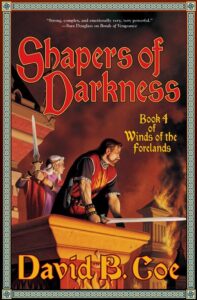
Shapers of Darkness, by David B. Coe (Jacket art by Romas Kukalis)I am currently reading through my Winds of the Forelands series, editing OCR scans of the books in order to re-release them sometime in the near future. Winds of the Forelands was my second series, a sprawling epic fantasy with a complex, dynamic narrative of braided plot lines. At the time I wrote the series (2000-2006) I worked hard to make each volume as coherent and concise as possible. Looking back on the books now, I see that I was only partially successful. I’m doing a light edit right now — I’m only tightening up my prose. The structural flaws in the series will remain. They are part of the story I wrote, and an accurate reflection of my writing at the time. And the fact is, the books are pretty darn good.
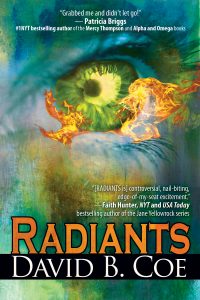
RADIANTS, by David B. Coe (Jacket art by Belle Books)But when I hold Winds of the Forelands up beside the Radiants books, or the Chalice War novels, or even my Islevale Cycle, which is my most recent foray into big epic fantasy, the older story suffers for the comparison. There are so many scenes and passages in WOTF that I could cut without costing myself much at all. The essence of the storyline would remain, and the reading experience would likely be smoother and quicker. — Sigh — So be it.
Again, the purpose of outlining, and the purpose of revising and editing, ought to be to make our work as concise and focused as possible. I can think of several books by big name authors that have in their vast middles scenes that meander, that serve little or no narrative purpose, that (in my opinion) actually detract from the larger story. I won’t name the books or authors, but chances are you have come across similar scenes in books you’ve read. Maybe you’ve encountered the same ones I’m thinking of. This is the sort of thing we want to avoid. Big name authors can get away with doing this occasionally. Authors seeking to break into the business, or mid-list authors looking to move up the ladder, simply can’t.

So, how do we avoid those superfluous, serve-no-purpose scenes?

Well, as I’ve said already, one way to avoid them is to outline. I know there are many dedicated so-called “organic writers” out there, and I respect that. Again, I outline loosely, precisely because I want to maintain the organic quality of my writing. Still, outlining really can help keep us from straying from our crucial plot points.

So can something called Vernor’s Rule. This is a writing principle I have discussed before in various venues. Allow me to explain it again here. “Vernor” is multiple Hugo-award winning author Vernor Vinge, who is best known for such books as A Fire Upon the Deep and A Deepness In the Sky. For a time, he and I had the same editor at Tor Books — that editor is the person who first told me of Vernor’s Rule.

Vernor’s Rule goes like this: There are basically three things we authors do as storytellers. We advance our plots, we build character, and we fill in background information. (Yes, this oversimplifies things a bit, but if you think about it you soon see that all we write can be placed under these three broad headings.) Every scene we write should be doing at least two of these things simultaneously. Preferably, each scene should do all three things at once. If a scene only accomplishes one of these things, or — heavens forbid — none of them, our narrative has stalled and we need to rework the scene.

Got that? If not, read the paragraph again — it sounds more complicated than it is. Really. It means essentially that writers need to multitask all the time. Every scene, every passage, ought to accomplish several things at once. That’s how we keep our narratives moving. That’s how we tackle the vast middle.

Next week we start endings. As it were.

Keep writing!

Professional Wednesday: Beginnings, Middles, and Endings, part III — The 60% Wall

Today, I add to my series of posts about “Beginnings, Middles, and Endings,” with a continued focus on the vast middle of the novel. If you wish to go back and read my first two essays in this feature on openings and middles-part I, feel free to do so. We’ll wait.

Ah, very good. Moving on . . . .

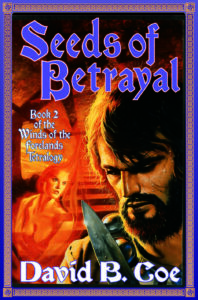
Seeds of Betrayal, by David B. Coe (Jacket art by Gary Ruddell)I have spoken before about the recurring problem I have with manuscripts at about the 60% mark. For those unfamiliar with the phenomenon, which afflicts many writers — not just me — it is fairly simple to explain. When I write a novel, I tend to make fairly steady progress until I approach the final third of the narrative. At that point, I run into a wall. And this has been true from the very start of my career. I didn’t recognize the pattern until one afternoon, while working on my fourth or fifth book. I came downstairs after a frustrating day, and Nancy asked me how my novel was coming.
“It’s awful,” I said. “There is no story here. I don’t know what I was thinking. The whole thing has fallen apart on me, and I have no idea how to move forward.”

“Ah,” said she, without surprise or very much sympathy. “So, you’re about 60% in.”

Cue heavenly light and revelatory music sung by angels. Because, yes, I was 60% in. Apparently, I complained this way, at this exact spot, with every book.

As I say, this is not all that uncommon. Lots of writers struggle with a similar wall. For some it comes a little earlier, for others a little later. But I would suggest that it is caused for all of us by the same basic dynamic in our process.

For the first 60% of our narrative (again, your percentage may be slightly different) we are doing what comes naturally to us writers: namely piling layer after layer of awful shit onto our protagonists. We set them up with lives — with love and security and comfort, with friends and family and colleagues, with belief systems and confidence and purpose. And over the course of 250 pages, we strip all of that away. We throw tragedy at them. We place them in danger. We rob them of the things they need and love most.

Those of you who don’t write fiction might, at this point, ask why we do this. That is a topic for another series of posts. The short answer is, we are horrible human beings, possessed of unbounded cruelty, bordering on sadism. But we are also sane enough (barely) to understand we ought not to do all these terrible things to REAL people. And so we do them to our characters. Also, it makes for really good reading. And what that says about the rest of you, I will leave unspoken . . . .

In any case, after we have done all these awful things to our characters, we suddenly realize (for me at around 60%) that we have to start repairing some of this damage. We can’t end the book with our heroes tied in knots, their lives destroyed, their spirits broken. Because while readers might enjoy watching us torture the poor dears, they also want us to offer them redemption and a new start after all is said and done.

All kidding aside, the problem in plotting comes at that pivot point, the place where the tide finally turns and the main characters start to work their way out of crisis. Setting up all the bad stuff is actually pretty easy. Getting characters to move beyond it, to find their way to a new equilibrium — that’s hard.

So, how do we get past that wall? How do I defeat the 60% block again and again and again?

First, breathe. Our story has not suddenly blown up. The situation is not hopeless. This is no time to give up our dreams of being a writer and turn to orthodonture. Seriously, that turning point is never easy, and writing is not one smooth exercise in creation. Fits and starts are part of the process. So relax. There IS a story here, and there is a way to get our heroes to where we want them to be. But we have work to do. I can’t tell you how many aspiring writers have unfinished manuscripts that break off at this pivot point. Let’s not allow ours be one of them.

Second, we need to think about the ending we have in mind for our novel, and then work backward from there, step by step. What needs to happen in order for our narrative and our characters to get to that finale? Take notes, make a reverse outline, plot point by plot point. In doing this, we may realize that we need to make some revisions to the first 60% of the novel — adjustments that make the ending possible. That’s fine. This is our first draft. No one will know but us. Yes, we might even have to kill a darling or two. That’s part of being a writer.

Third, if the 60% problem still seems intractable, we need to look for places where our story as it reads now has deviated from what we had in mind when we first conceived of the narrative and its ending. Maybe we have taken a narrative detour, or added in a new character, or killed someone off who it turns out we need. Again, this is draft. Rewrites are part of the process. So if we have stuff to fix, so be it. Or maybe we keep those deviations in place and have to rethink our ending. That works, too. But we might need to make some adjustments.

Finally, we keep moving forward no matter what. Don’t give up. Don’t retreat into those rewrites now. We’ll make notes on all we have to revise in the earlier part of the book, and then we will finish. Because that’s what writers do.

Remember, the pivot is hard for all of us. We can overcome it. If we couldn’t, there would be far, far, far fewer books in this world.

Keep writing!

Professional Wednesday: Beginnings, Middles, and Endings, part II — Narrative Structure

Last week, I began a new Professional Wednesday feature called “Beginnings, Middles, and Endings,” in which I plan to write about the various parts of story writing. In last week’s post, I focused on openings, on how to approach the beginning of a novel or short story.

This week, I take on middles, and I imagine this will be the first of a couple of essays on the subject. Because let’s be honest: By far the biggest chunk of what we write is the “middle.” Even if we take the first two or three chapters as the opening, and the last two or three as the ending, that still leaves the vast majority of our novel occupying the middle. So any discussion of how to handle that middle is going to have to touch on several topics. And today, I am beginning with a general overview — the 10,000 foot view, if you will.

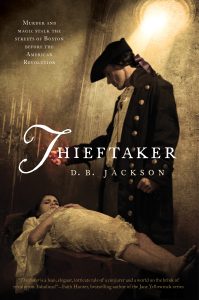
Thieftaker, by D.B. Jackson (Jacket art by Chris McGrath)First, though, it occurs to me that in writing about openings last week, I left out one crucial, but easy-to-describe story element: “the inciting event.” The inciting event of your narrative is, quite simply, the thing that jump-starts your story, that takes the characters you have introduced in your opening lines from a place of relative stasis to a place of flux, of change, of tension and conflict and, perhaps, danger. It is the commencement of the narrative path that will carry your characters through the rest of the story. In his description of the Hero’s Journey, Joseph Campbell referred to the inciting event as the “Call to Adventure.” If you’re looking for examples, think of the arrival of the first letter from Hogwarts in Harry Potter and the Sorcerer’s Stone, or the appearance of Gandalf at Bilbo Baggins’s door in The Hobbit. In pretty much all the Thieftaker books and stories, it is the arrival of whoever Ethan’s new client will be for that episode.
Your inciting event can be anything. Whatever launches your narrative, taking your lead character from a place of balance and peace to one of conflict and tension. And really, that’s it. We can make it more complicated, but it doesn’t need to be.

This description of the inciting event allows me to segue into a broader discussion of story structure, since any formula for narrative will include the inciting event. The most common storytelling model — the one that comes up most when I have conversations with fellow writers — is the three-act structure. This is a fairly simple and helpful framework by which to organize our narrative. Act One is the “Setup” and includes an introduction to our characters and setting, as well as the inciting event and an early climax. Act Two is called “Confrontation.” Here our story takes off, with ever-increasing action and tension, a series of obstacles placed in the path of our heroes, a midway-point plot-twist, and ultimately a crisis that precipitates a second story climax. Act Three, “Resolution,” features our story’s resolving climax, a diminution of action, and finally a denouement that resolves outstanding issues, eases tension, and, in most cases, leaves our characters changed, but at relative peace. You can Google “Three Act Structure” and find essays about this approach as well as visual representations of the structure. I should add as well, that there is also a five-act structure that I find less compelling and useful than this one.

Okay, confession time.

When I write, I never think in terms of “Acts” and I don’t graph out my chapters to make certain I am following the schematic one sees in the results of the aforementioned Google search. It’s not that I find fault with the three-act structure, or try to avoid it in any way. To the contrary. I expect that I use it in every project; if you were to superimpose one of those graphics onto the narrative structure of any of my novels, you would probably find that I write in three acts all the time, following the model quite closely.

What I said was, I don’t THINK in terms of “Acts.” I never have. Not even with my earliest novels. I believe by that point I had already thoroughly internalized the three-act structure, having been exposed to it in novels, movies, television shows, theater, etc. for pretty much my entire life. Writing in that form came as second nature.

Now, that is not to say that those who do organize their novels and stories using the three-act structure have somehow failed to internalize it as I did. Not in the least. The model is so prevalent that I think all of us have it ingrained to some degree, even those who don’t create stories for a living. This is why two writers, one who outlines and one who writes without any narrative plotting written down ahead of time, can both come up with tales that closely follow this structure. As with a written outline, I think of the three-act structure as a narrative tool, something some writers use to organize their thoughts ahead of time. I outline by chapter. Sometimes. I also write without an outline. Sometimes.

And without actually visualizing my story as a three-act graphic, I almost always write in three acts. So why don’t I think in those terms as I’m writing or even outlining? I suppose I am leery of imposing any predetermined structure on my story planning. Even if I wind up following the structure, I want it to happen organically, without the sort of premeditation that might convince me to plot according to pattern rather than according to the exigencies of my story, my characters, my creative vision.

Where does this leave our conversation, and what does it mean for whatever advice I might offer in this first post about story middles?

First, pay attention to the structure of movies and television shows you watch and books you read or listen to. The best learning tools at your disposal are the narratives crafted by creators you enjoy and respect.

Second, even if you don’t plot strictly according to the three-act structure, be aware of the rough pattern illustrated in those visual representations. You want to have an inciting event, a huge twist near the middle, and a deep crisis for your protagonist near the climax. You want your narrative tension to climb until your final climax. And you want there to be resolution at the end.

Third, write your story. Just write it. Get it down on paper (or phosphors). Don’t obsess over structure and whether you have every plot point in the right place. Write it. Finish it. And then, if the structure needs adjustment, handle that in revisions. Your story need not conform to anyone else’s concept of what “narrative” should look like. Write it as you imagine it. And if you decide to “fix” things later, make sure you do so in service to the story YOU want to tell, not the structure someone else says is “correct.”

Keep writing.

Monday Musings: AI Content Creation? No, Thanks

I’ll start by assuring you that this is not one of those posts. I’m not going to share my feelings regarding AI generated content and then reveal at the very end of the post that everything you’ve read was actually AI generated. It’s really me. I promise. How can you be sure? Well, the best evidence is this: I’m too cheap to purchase the AI generator I’ll be discussing . . . .

That I would even think it necessary to say as much . . . well, read on.

An email appeared in my inbox this past week. It came from a prominent maker of WordPress plugins and it advertised a new AI content generator for WordPress sites. “Our latest product [is] aimed at enriching your WordPress experience . . . This tool utilizes the potential of artificial intelligence, adding a formidable ally to your writing process.”

Already, I can hear the Skynet airships hovering overhead. [Sorry — Terminator reference.]

I’ll admit, I was horrified. Wanting to know more, I followed the link in the email and was taken to the product page where I could see the generator in action. “Write a blog post about X,” the app is told, and in a second or two content populates the screen. (I should add here that we are guided through the product tour by what is clearly an AI-generated voice. It’s kind of creepy, actually.) The wording produced by the plugin is clean and flowing, free of typos and grammatical errors. In fact, that’s one of the features the developer trumpets. No more typos. No more wording mistakes. God forbid writers should just learn to write and take the time to proofread their work.

The AI generator can also provide snappy titles for its posts as well as summaries of the content, and it can even adapt the tone of the piece to our mood and preference — among the possible choices are “formal,” “informal,” “optimistic,” “humorous” (humorous AI? Really?), “serious,” “skeptical,” “empathetic,” “confident,” “passionate,” and “provocative.” The tour shows the imagined user switching from “formal” to “passionate.” The differences in the resulting text are minimal.

I’m not naïve, and I’m also not blind to the benefits such a generator might bring to, say, a travel enterprise that specializes in tours of various parts of the world. Rather than write separate essays about each region, which could take hours, a webmaster could input the parameters for each essay and complete the work in mere moments. The resulting prose would be safe, error-free, and quite likely good enough for the company’s purposes.

It would also be anodyne, soulless, utterly lacking in anything remotely human.

Reading the text generated in the product tour, I was struck by a few things. First, for now at least, the AI’s vocabulary and writing style are both quite limited. It repeats words and sentence structure so that there is a sameness to each paragraph and the treatment of each new topic. Also — and this is predictable, I suppose — the generated text is as dry as dust. It is long on fact, on the sort of information one might find in an encyclopedia entry, but it lacks anything to which one might connect emotionally. And it also lacks rhetorical flourishes — simile, metaphor, analogy. It is, in short, boring.

“Say goodbye to writer’s block and hello to effortless content creation,” the product tour says, missing the point entirely. I have written about writer’s block before, and the last time I did, I hurt and offended a writer friend whom I care about and admire. I have said in the past that writer’s block doesn’t exist (and I’ll get to what I mean by that in a moment). The fact is, though, this is not true. Writer’s block does exist. It is a debilitating void, an inability to create that can last months, even years at a time. Writers who are afflicted with it, as my friend has been, suffer greatly.

But writer’s block as it is used commonly, as it is used here in this AI generator product tour, is not at all the same. It is the difference between clinical depression and saying one is “depressed” because a favorite sports team lost a close one.

What most people — including the app developer — mean when they speak of writer’s block is the inability to write something in a particular moment. This form of “writer’s block” presupposes that writing is easy, that creating new content should come without effort, without hesitation, without forethought and contemplation. What most call “writer’s block” I call writing. Because writing isn’t easy. Creating new content takes tremendous effort. It is messy and slow and frustrating. It is fits and starts. It is staring out the window for fifteen minutes at a time, wracking one’s brain for that perfect turn of phrase. It is re-writing the same graph six times until it shines just as we want it to.

And that’s what’s wrong with AI generated content. That struggle to create, that wrenching, ugly, glorious process is what infuses our writing with emotion and energy, individuality and the spark of humanity that makes writing and reading joyous. When we take away the work, the messiness, the false starts and numerous rewrites — in other words, when we make writing “effortless” — we also render it gutless and vapid.

Is there a use for AI generated writing? I guess. I mentioned a hypothetical travel business earlier; AI would probably save its owners a bit of time and money. At what cost, though? How much dumbing down is too much? And where does this slippery slope lead? At the risk of sounding idealistic and giving the lie to my early claim that I’m not naïve, I have to ask: Wouldn’t we be better served as a society if we put as much effort into teaching our children to write and think creatively as we do teaching computers to do stuff for us? The answer seems self-evident to me.

Have a great week.

Professional Wednesday: The Emotions of a Book Release

The Chalice War: Cauldron, by David B. CoeLet’s start with the obvious: The Chalice War: Cauldron is now out and available from all booksellers in ebook and paper formats. This is the second installment in my Celtic urban fantasy trilogy, The Chalice War. Stone, the first book, came out a month ago. And the third and final volume, Sword, should be released in early August. The cover reveal will be coming soon.

I sold a bunch of copies of the first two books at ConCarolinas this past weekend, and hope to sell bunches more at LibertyCon (Chattanooga — June 23-25). By the time DragonCon rolls around (Atlanta — August 31-September 4), I’ll have all three books in stock.

I have, in a previous post, made the case for supporting authors and their blogs, etc. by buying their published works; I won’t bother making the case again. I have also made the case for buying the early books in a series as they’re released, rather than waiting for the entire series to drop, and I won’t bother doing that again either.

But I did want to spend a bit of time discussing the emotions of a new release, emotions that begin well before the actual publication of the novel. The anticipation can be excruciating. Not just waiting to see the book, or even looking forward to seeing it in the hands of readers, though I feel both of those. With each new book, I experience this sense of excitement about the story finding its way into the world. “I have a new book coming,” I want to shout from the rooftops, “and it is going to blow your minds!!” As I’ve said before, I almost always feel that my newest book is also my best, and so I want to show off a bit, let people see what I’m capable of as an artist now. Ego? Maybe. Pride? Definitely.

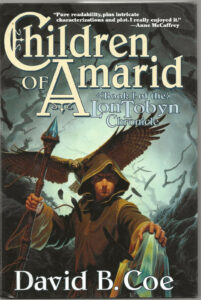
Children of Amarid, by David B. Coe (Hardcover -- Art by Romas Kukalis)I’m asked quite often if I still feel the thrill of seeing a new book in print, even after so many years and so many releases. And the truth is, I do. Sure, the very first time was unlike anything I’ve experienced since. I still remember getting a call from the local bookstore here in our little college town. My author copies hadn’t arrived yet, so when the store manager reached out to let me know the hardcover edition of Children of Amarid was in stock, I rushed over to see it. I’m pretty sure Nancy came with me.
And, typical of me, I was so excited to see the book, to hold it in my hands, to see my name right there on the cover, right below the gorgeous artwork. I was over the moon. But I also recall thinking, “Hmmmm, the image is a bit too dark, and the colors don’t pop the way they should.” I have long been Glass-Half-Empty Guy . . . . Which doesn’t change the fact that I was right. The cover did come out too dark, something Tor corrected with the mass market paperback edition a year later. Just sayin’.

Those competing impulses, though, are fairly typical for me, and, as I gather from conversations I’ve had with other authors, for many of my colleagues as well. Yes, the thrill is real. So is the worry about sales and critical response, the hyper-sensitivity to anything that might be even slightly off with the new product, the certainty that the excitement will prove fleeting while the concerns linger.

We authors notice things others don’t — the darkness of the images is a perfect example. No one else thought the jacket art for the hardcover of Children of Amarid was anything other than cool. But I picked up on the (very mild) flaw immediately. That said, I have been fortunate with my book art throughout my career, and have liked the cover images that appear on almost all my books. There are a couple of exceptions, but I won’t say more than that. The point is, I have never actually hated one of my covers. I know plenty of authors who have. I can’t imagine how difficult that would be.

There can be other problems as well. Sometimes the maps we put in our books are split in an awkward way in order to fit them in the front pages. Sometimes there are typos. I know authors who have had their books published only to find that the print editions begin or end with the wrong chapter or scene!! Oh. My. God. I would lose my freaking mind. All sorts of things can go wrong.

And, as I mentioned before, even if all goes as it should with the published version of the book, and even if the jacket looks great, sales can disappoint. So can reviews. Releases can coincide with economic downturns. Or national tragedies. Or global pandemics. We have no control over such things, of course, and in the context of world events, the fate of our book release is pretty insignificant. Except to us. For us, it’s more than a book release. It’s the realization of years of work and hope and passion.

The Chalice War: Stone, by David B. CoeWith all this in mind, I am happy to say that the releases of The Chalice War: Stone and The Chalice War: Cauldron have gone great. No new pandemics. The stock market is up. The art work looks marvelous. All the chapters are just where they should be. (I think — I should probably check to be sure . . . . Yep, they look great!) Sales? I have no idea at this point. It’s too early to know. Reviews? We’ll see about those as well. I worry, of course. I want these books to succeed. I want you to like them. And, if you do, I would love for you to tell the world.

Thanks for reading this.

Keep writing!

Professional Wednesday: Marketing Strategy, a New Release, and an Excerpt!!

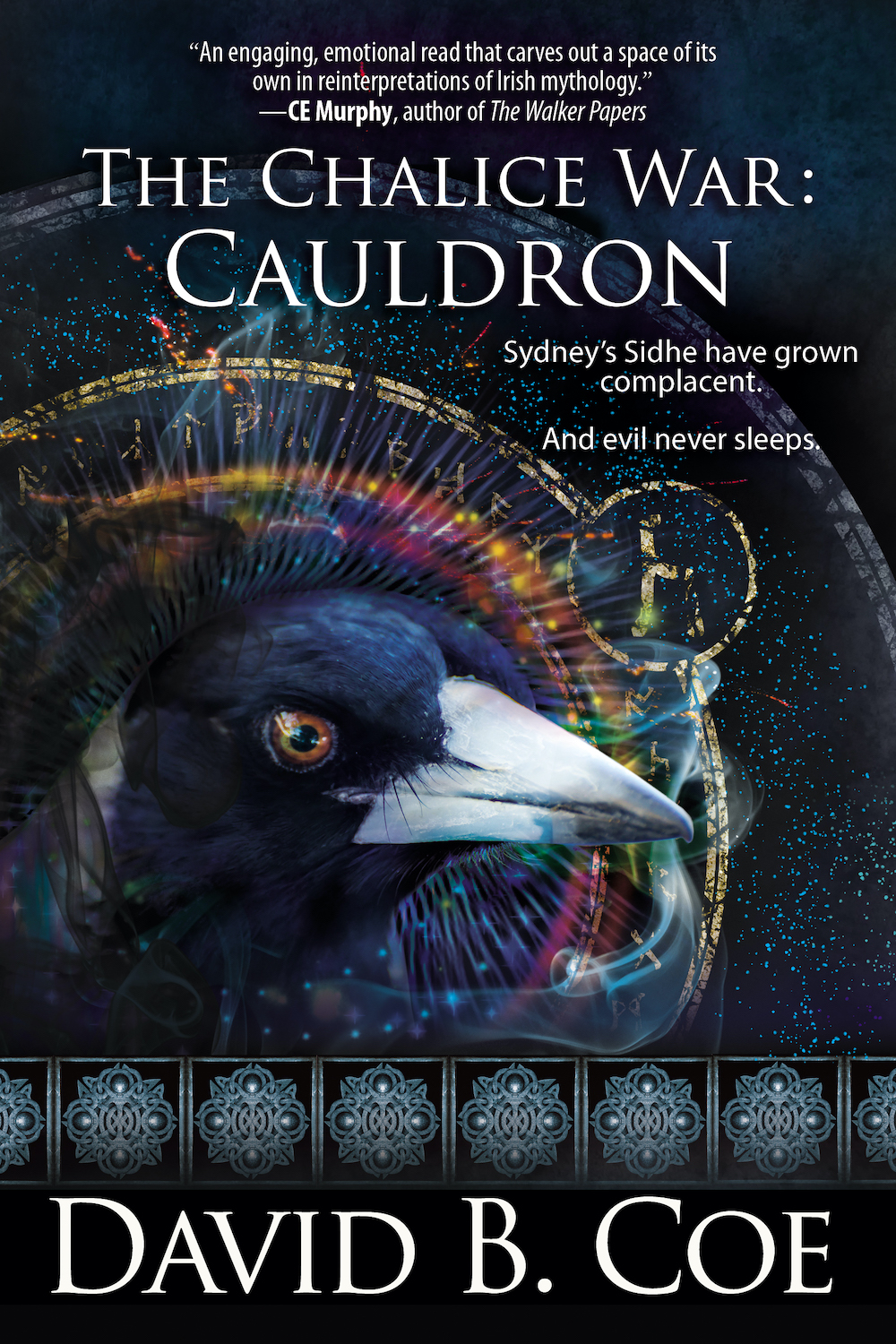
The Chalice War: Cauldron, by David B. CoeThis Friday — the day after tomorrow!! — The Chalice War: Cauldron, the second book in my new Celtic-themed urban fantasy series, will be released by Bell Bridge Books. For those of you thinking, “Wait, didn’t you JUST have a release in this same series?” you’re right, I did. The Chalice War: Stone came out May 5, four weeks before this week’s release. And the final book in the series, The Chalice War: Sword, will be out in July or August. (And wait until you see the jacket art: Spoiler Alert — it’s spectacular!)
The thinking behind rapid-fire releases of this sort is pretty simple: If the first book interests readers, and if they fly through that opening volume, they will be eager for more and won’t want to wait. I can’t tell you how many times authors hear from readers, “Oh, I hate waiting for each book in a series to come out, so I wait until the last book is published before I buy any of them.”

This is deeply frustrating for those of us who write and sell books for a living. I get it, of course. Sometimes, fans have to wait a year or more for subsequent volumes in a series to be released. And on occasion, those subsequent volumes never appear at all. The series is dropped by the publisher, or the author simply never gets around to completing the story. Writers aren’t the only ones who can find the publishing schedule frustrating.

Here’s the thing, though: Quite often, the publication of second and third and fourth volumes in a given series is dependent on the sales of the first book. If sales of Book I disappoint, some publishers will decide to drop the series, rather than go to the trouble and expense of putting out the later volumes. And so the reluctance of readers to buy that first book, lest the others don’t find their way to print, becomes self-fulfilling.

The rapid release model is relatively new in the publishing world, but it is intended to prevent this sort of thing from happening. If readers see the second and third books coming out so soon after the first, they will be more willing to buy that initial installment, and might go ahead and just grab all three as they appear. This is certainly my hope.

So, in the spirit of marketing and piquing your interest, let me tell you a bit about Book II, Cauldron. In book I, Stone, we meet Marti Rider, a Sidhe conjurer, and Kelsey Strand, two strangers who are bound to each other by a powerful magical artifact. They are attacked and pursued across the country by Fomhoire demons and their allies, who are intent upon killing them, claiming the artifact as their own, and using it to conquer our world. Along the way, we encounter a host of Celtic immortals who help our heroes or hinder them, depending on their shifting alliances.

In Cauldron, the pursuit of these magical chalices shifts to Australia, where we are introduced to Riann Donovan and her friend (and perhaps more) Carrie Pelsher. Riann is a Sidhe sorcerer who has fled the States to Australia to escape a tragic past. Carrie is a journalist with a strange affinity for magic. When the Sidhe community in Sydney is devastated by a coordinated Fomhoire assault, the two women find themselves in a race against time and a dance of intrigue among gods, Furies, and demons. And yes, for those wondering, Marti and Kel will find their way to Australia to join the fun.

As I’ve said before, I love all of these books. Writing Cauldron allowed me to draw upon experiences and memories from the year I spent Down Under. Many of the locations described in the book are places Nancy, the girls, and I visited. It was a special book to write. And I hope you enjoy it.

And, to whet your appetite for the book even more, here is a short excerpt! Enjoy!

*****
The train had just pulled out of Redfern station when the first frisson of magic brushed across Sara’s skin. She shivered, tasting darkness in its touch.

Fomhoire. Here, in the middle of Sydney. Nearby and closing in, accompanied by . . . by what? Wight? Demon? Yes, demon. All this she read in that initial contact. More, she sensed the Fomhoire had already found her, was intent on her and closing the distance between them.

Sara stood, crossed to the nearest of the sliding doors, and stared out into the inky black of the railway tunnel, desperate for the light of the next station. Never had the distance between Redfern and Central felt so great. The train car rocked, and she grabbed hold of the steel pole beside her to keep from tumbling into the lap of a young businessman.

“Pardon me,” she whispered.

His gaze flicked to her. He answered with a nearly imperceptible nod and turned his attention back to the Herald.

Morning commuters crowded the CityRail trains and stations. Surely Fomhoire assassins wouldn’t attack her here, in front of so many.

A small voice in her mind replied, Why not?

She wore work clothes, carried her briefcase, was on her way to her office in the CBD. Roger, her tabby, her conduit, was at home, safe in her flat, too far away to help her with spells. She was powerless, defenseless.

The train slowed—finally!—and the train guard announced their arrival at Central Station.

“Change here for Northern, Carlingford, North Shore, Cumberland. . . .”

The moment the doors opened, she pushed her way out, heedless of the men and women in front of her and those on the platform waiting to board. People shouted after her; a few muttered obscenities. She didn’t care. She hurried to the nearest stairway, one that would take her to the concourse. The magic followed, aimed like a weapon at her back.

By the time Sara reached the top of the stairs, she was breathing hard, sweating through the blouse she wore beneath her blazer. She switched her briefcase to the other hand, wiped her slick palm on her skirt.

She kept to the crowd, surrounding herself with people, using them as shields and searching frantically for anyone who might give off enough glow to let her defend herself.

How can there be Fomhoire in Sydney?

She and the others maintained a network, a web of magic. Like Sidhe in other parts of the world, they watched for portals and Fomhoire incursions from the Underrealm. As far as she knew, they had sensed nothing.

For decades, Sara and her fellow Sidhe had protected one another, warned one another. These last several years had been quiet, peaceful. She knew other Sidhe in countries far from Australia had battled Fomhoire recently. Harrowing reports had reached her from the States, from Europe and Africa and Asia. But here . . . . Relative peace had reigned for so long, she had grown comfortable, lax. Caution needed to be a routine, like exercise. And she had grown lazy. How many mornings had she left her flat without taking the simple precaution of warding herself? This morning had been no different from yesterday, from the day before, from the one before that. Except it was entirely different. And she might well die because of it.

She exited the gates, threaded her way through the throng in the concourse, hoping to lose her pursuers among the masses. She would exit the station onto Pitt Street and grab a taxi. That was her plan anyway.

As she neared the doors at the west end of the concourse, she sensed more magic. Wights probably, but without Roger, she wouldn’t stand much chance against them, either. She slowed, halted. People flowed around her on either side, as if she were a stone in a stream.

Eddy Street then—the nearest exit.

After a single step in that direction she stopped again. More magic. They had her surrounded.

Another train perhaps. If she could return to the gates and get to a North Shore platform, or maybe the Illawarra line . . . .

A spell electrified the air and made the hairs on her neck stand on end. Sara could do nothing except brace herself for its impact.

Magic fell upon her an instant later, obliterating thought, will, consciousness. She couldn’t say if she remained standing or fell to the floor or ran in circles like some ridiculous child’s toy. Time was lost to her.

When next she became aware of her surroundings, she was still upright in the middle of Central Railway Station’s Grand Concourse. A woman stood before her radiating so much power Sara had to resist an urge to shield her eyes.

“Hello, Sara,” she said in a cool alto and an accent that would have convinced any native Aussie.

“Who are you?” Sara asked, surprised she could speak.

The woman smiled. She was beautiful, of course. The Fomhoire always were here in the Above, regardless of how they appeared in the demon realm. Pale blue eyes, flawless olive skin, golden brown hair that fell in a shimmering curtain to her shoulders. As brilliant and superficial as a Carnival mask. She wore jeans and a long sleeve Sydney FC T-shirt; nothing that would have made her stand out in a crowd.

A second form hovered at her shoulder, as hideous as the woman was lovely, as ethereal as she was solid. It appeared to be little more than a cloud; shapeless, smoke grey, undulating. What might have been eyes shone dully from within the shadow, like stars partially obscured by a nighttime haze. Its lone substantial feature was a mouth at its very center, nearly round and armed with several rows of spiny teeth.

Two demons. One ghastly, the other lovely. Both deadly, no doubt.

None of the people passing by took note of them. Sara sensed that she, the Fomhoire, and the cloud demon were invisible to all.

Professional Wednesday: Another Letter To My Younger Self

Dear Younger Me,

Yes, it’s me again — Middle Aged David. Upper Middle Aged David, actually. I know I wrote to you earlier this week. I remember doing so. I’m not so far gone quite yet. But I thought you might benefit from a second letter focused on the professional side of things. As I told you on Monday, we did wind up having a career in writing, just as we dreamed when we were a kid. And, also as I told you, our professional life hasn’t followed precisely the path we envisioned. That’s fine. We’ve had a good ride so far. But there’s stuff you should know, stuff I wish I had known.

I suppose all of it can be summed up in two words — and I hate to resort to cliché, in a writing post no less, but it really is true. Shit happens. It does, it does, it does. And it has happened to us. More than once.

The biggest mistake I made — we made — early on was assuming our career trajectory would be linear, a progression toward greater and greater success, higher and higher advances, bigger and better sales numbers. That may be true for a select few, but for most writers a career follows a meandering, uncertain path. Some books and series are more successful than others — commercially and critically. I call that early expectation of ever-improving circumstance our biggest mistake not because it somehow led to a disappointing outcome for one project or another, but because it caused me — us — so much pain. When our career hit that first speed bump, I took it personally. I felt I had failed, and also that the industry had failed me. I was confused and angry and sad and, most of all, terrified at the thought that this first disappointment would mean the end of our professional journey. I didn’t yet understand the nature of a creative life.

And so I say to you, Younger Me, learn resilience. Grieve for those lofty unmet ambitions, but then move on and try again. Learn moderation. Don’t let commercial and critical success carry you too high, and don’t let poor results drive you too low. Success will follow failure, which will follow success, and so on. If you can — and I know it’s so, so hard — learn to let go of expectation entirely. We don’t know which books will soar and which will flop. We love them all, which is why we go to the extreme trouble of writing them in the first place. And finally, learn contentment. Love the stories you create on their own terms. Find success in the completion of a good tale, in the realization of an artistic vision.

Take every promise made to you by an editor and publisher with a grain of salt. It’s not that they don’t mean what they say. Okay, SOME of them don’t mean what they say. But mostly, they simply can’t anticipate all that might happen. Producing a book is no small feat. A thousand things can go wrong. Editors and publishers often tell us, as if gospel, that a certain thing is going to happen on a given date. And that is, at the moment, their best guess of what will happen. Pencil in the date. Don’t commit it to ink. Because, as we have established, shit happens.

Thieftaker, by D.B. Jackson (Jacket art by Chris McGrath)All those great ideas you have for jacket art? They’re not as great as you think they are. Seriously. We are a writer. And we’re very, very good at that. We are NOT a graphic artist. We are NOT a marketing expert. I remember when the first Thieftaker novel went into production, I had what I thought was SUCH a wonderful idea for the jacket art. A can’t miss idea. PERFECT for the book. It wasn’t any of those things. The moment I saw Chris McGrath’s image for the book, which WAS brilliant and wonderful and perfect, I understood that no one should ever put me — us — in charge of selecting jacket art.

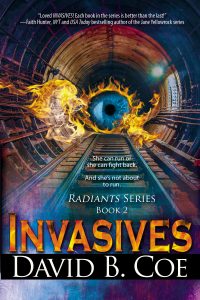
INVASIVES, by David B. Coe (Jacket art courtesy of Belle Books)On the other hand, do trust in your story ideas. All of them. Even the old ones that haven’t yet gone anywhere. At some point, you’ll have an idea for a story about three kids living in the subway tunnels beneath New York City. And you won’t have any idea what to do with it. You’ll give up on it. Don’t. It will become Invasives. At another time, you’ll write a story about two women interacting with Celtic deities and trying to protect an ancient, transcendently powerful magical artifact. That one, too, will seem to languish. Trust the story. That book just came out. It’s called The Chalice War: Stone. Believe in your vision.

If a publisher promises more than you think they can deliver, under terms that seem way too good to be believed, be skeptical. Very, very skeptical. Chances are, they CAN’T deliver. Chances are those terms can’t be met. We’ve been burned a couple of times. ’Nough said.

Over the past twenty-five-plus years, I have tried to thank Nancy every single day for making our career possible. And I’ll continue to thank her. But I might have missed a few days. Fill in the gaps, will you?

Most of all, keep doing what you’re doing and I’ll do the same. No, we haven’t gotten all we wanted, we haven’t achieved every goal. But we’re doing okay, and as much fun as you’ve been having early in our career, I’m having even more now. It keeps getting better.

And yes, the rumors are true. We’re editing now, and we like it. The dark side really is more powerful . . . .

Best wishes,

Older David

Monday Musings: A Letter To My Younger Self

Dear Younger Me,

Yes, that’s really our hairline now. Calm down. It’s not— Would you please calm down? Thank you. What did you expect? Seriously. Dad was bald. Bill and Jim had lost their hair by the time they were thirty. You thought we’d make it through middle age with hair like George Clooney’s? We didn’t make it through middle age with ANYTHING like George Clooney’s. On the bright side, our beard finally filled in, so there’s that . . . .

But this isn’t about how we look, thank goodness. This is a letter to you, my younger self, about other things I wish I had known when I was your age (whatever age that might be exactly). So read on, Younger Me, and if you happen to run across a time machine at some point, remember this stuff, okay?

Let’s start with this, because really nothing is more important: You know how you feel most of the time that you’ll always be alone, that you’ll never meet the right person? Well, I can assure you, you won’t be and you will. She is brilliant, caring, funny. She shares many of your interests and, more important, she shares your values. She is strong and insightful, charming and generous. And . . . What’s that? Yes, she actually loves you. I know: I couldn’t believe it either.

What?

[Sigh]

Yes, Younger Me, she’s also hot.

And together, we have two brilliant, strong, funny, beautiful daughters. You will be blown away.

More good news — and we can discuss this more on Wednesday: You will have that writing career you’ve been dreaming of since you were six. There will be a few detours along the way, some bumps and bruises. It won’t be exactly the career we imagined; it might not reach the heights to which we’ve aspired. But it’s our career. We made it, we sustained it (with the support and encouragement and love of the aforementioned life partner and children), we earned it. We should be proud of it.

Don’t know if you can do much about his one, but I should mention it — if, around 1993 or so you have a chance to get the rookie card of a Yankee prospect named Derek Jeter, go ahead and pick one up. Or ten. Or fifty. Slide it (them) into a nice plastic sleeve for protection and put it (them) away. Trust me, you’ll be glad you did.

You know those episodes we go through, and have since we were little — nausea, shaking hands, extreme ill-defined terror? Those aren’t normal. I know Dad used to tell us he experienced them, too, and he might well have been telling the truth. But that doesn’t mean they were routine or natural. He meant to reassure. He loved us and wanted to help. But by normalizing them, he kept us from doing something about them at a younger age. Along the same lines, you know how for so very long we brushed off our tendency toward unexplained worry and stress, saying that we were “high strung,” or some such? Turns out, that’s not high strung.

We have Generalized Anxiety Disorder, and we have Panic Disorder. And we didn’t need to suffer with either for nearly so long. Do something about them. Soon. Please. For our well being. Friends have encouraged us to try therapy. I finally did when we were 58. I wish we’d done it forty years sooner.

For your sake and mine, please work harder at the guitar. Yes, we still play. Yes, I’m better than you are, which is as it should be. But with work and practice, with less laziness and self-satisfaction, we could have been so good. I can’t have expected us to work at guitar the way we did at writing — one was a hobby, the other a profession — but a bit more work would have brought us such joy.

Never ever ever take your car to Toyota of Palo Alto. Just don’t.

Look at your book shelf, the one with all the fantasy novels on it. You’re going to wind up meeting nearly every author represented there. Many of them will become good friends. Yes, including Guy Gavriel Kay. Pretty cool, right?

Spend as much time as you can with Mom and Dad. Be as tolerant as you can be of Bill’s flaws and idiosyncrasies. Love them. Cherish them. We won’t have nearly as much time with them as we deserve, and we will miss them every day for the rest of our lives. I know, Mom and Dad can be annoying now and then, and occasionally Bill infuriates us. They’re family, and sometimes family is like that. But the hole their absence leaves in our life dwarfs these temporary frustrations. Extend to them the grace and forgiveness you would want from all those we love.

Those amazing friends we made at Brown, the ones who enriched our life there and made it the most memorable time of our early life? Yeah, they’re still our dear friends, still enriching our life. Treasure them.

The rest is pretty much common sense. Dial back the weed — we will later anyway; might as well preserve a memory or two. Don’t drink too much — you don’t hold your booze as well as you think you do. Exercise. Eat right. Take care of yourself. Life is precious, and we don’t want to miss a thing. Read more. Yes, we read a good deal. Read more. Trust me. No one ever looked back from the vantage point of their dotage and thought, “I wish I’d put all those books aside and watched more TV.” Be good to the people we love. Slow down and savor all those things we enjoy doing. Let go of grudges and jealousy and regrets. They do us no good.

Oh, and along the lines of that Derek Jeter thing — those people at Apple who early on made all those weird-looking, quirky computers? Turns out they were on to something. If you get a chance, buy a few shares . . . .

Best wishes,

Older David