








My muse, on the other hand, is a peripatetic tramp who can’t be counted on to show up at any given time on any given day. If I had to wait for that bastard to show in order to write something, I’d still be working on my first novel.
I feel stuck. Have for a while now. It’s nothing too alarming; I’ve been here before. But it is frustrating, and I am ready — past ready — to be, well, unstuck.
I’ve been doing a lot of editing recently, and I enjoy that. It keeps my mind busy. It forces me to think creatively, to consider my craft while also making certain to respect the vision and voice of my client. But it’s not the same as writing.
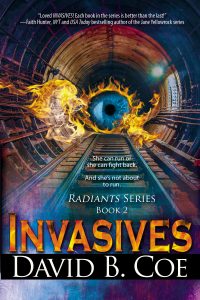 And when it comes to writing, I am in something of a rut. The last novel-length piece I wrote beginning to end was Invasives, the second Radiants book, which I completed (the first draft at least) eleven months ago. Eleven months!
I’ve written some short fiction since then. A Thieftaker story, a story for the Silence in the City anthology. I had to revise and polish Invasives, and I have done work on the new Celtic series I’ve recently sold. But the first two of those books were already written. I’ve been revising those, too. I’ve started book 3, but only just.
 Mostly, as I say, I’ve been editing. My work. Other people’s work. The Noir anthology. I’ve been plenty busy, but I have not been as productive creatively as I would like. And I wonder if this is because of all the emotional pressure we (my family and I) have been under over the past year-plus.
Recently, I wrote a couple of what you might call audition chapters for a project I cannot talk about. (There was actually an NDA. I really can’t talk about it.) And I enjoyed that process. I had a tight deadline, a quick turnaround from when I got the information on what I needed to write to when the chapters were due. I met the deadline with ease, and was pleased with the results.
As I say, I’ve been here before. I’m not worried that I’ll never write again. At least not too worried.
I wonder, though, if there is a lesson in that experience with the sample chapters. Maybe what I need is a deadline, one that’s hard and fast and not too far away. Maybe I need that sort of kick in the pants to get going again. I’ve long said that when I go too long without writing, I get cranky.
Well, I’m cranky.
I don’t know if I’ll get the gig I auditioned for. I’m certainly not counting on it. But if I don’t, I need to make myself work on something else. According to the contract, that third Celtic book isn’t due for a long time, but I am thinking I should start writing it now. And I should set a hard deadline for myself, well before the actual due date. I have lots of editing projects looming, so I can easily justify forcing myself to write the book now and quickly.
I don’t know. I need to do something.
Creativity is a strange beast. Often it’s thought of as something that comes to us in sudden sparks of inspiration. It can’t be forced, we’re told. But when it strikes, the feeling is euphoric. And some of that is true some of the time.
Inspiration can be abrupt and unexpected, and those moments can be euphoria-inducing. The thing is though, if we want to make our living as creatives, we can’t afford to wait for the muse, or whatever, to strike. We have mortgages to pay, groceries to buy, bills arriving in the mail each day. This is our job, damnit!
Which means creativity can be forced. Most times it has to be forced. I write pretty much every day. My muse, on the other hand, is a peripatetic tramp who can’t be counted on to show up at any given time on any given day. If I had to wait for that bastard to show in order to write something, I’d still be working on my first novel.
What does this have to do with me being stuck? Honestly, I’m not certain; I’m working this out as I go. But I think the answer is this: Being stuck is as much a part of making a living as a creator as being inspired. It’s the back half of that shining coin. Fields need to lay fallow for a time before they can be productive again. Writers (and other artists) sometimes need to go through periods of creative dormancy before we can dive back into the projects we want to complete.
This is not an excuse. As I said earlier, I’m cranky. I want to be writing again. But I have also learned over the years that beating myself up because I’ve been unproductive accomplishes nothing. On some level, I believe, the creative brain knows what it needs. Just as a body can crave different sorts of food to meet nutritional needs, the artistic mind can seek out times of rest and times of activity.
I have been in the former for long enough, thank you very much. I am ready for the latter.
Keep writing!
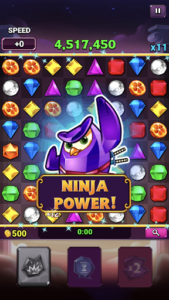 Confession #1: I play Bejeweled Blitz on my phone. I play it a lot, and I have been addicted to it for years. I have enough gold bars and coins piled up to make Warren Buffett envious. I have so many free gems wracked up that I could play for weeks straight, without pausing for meals or sleep, and never have to pay for a gem with any of those hoarded coins. It’s a bit of a sickness, actually. But I do enjoy it.
 It’s not enough to create my worlds and magic systems. I have to explain them to my readers in a manner that is entirely natural and unobtrusive. And — my own preference — I also have to complete my stories and my character arcs in ways that utilize my fantasy elements without allowing them to take over my story telling. My heroes may possess magic, but in the end, I will always choose to have them prevail by drawing upon their native human qualities — their courage and resolve, their intelligence and creativity, their devotion to the people and places they love. Magic sets them apart and makes them interesting. It is often the hook the draws readers to my books. But those human attributes — those are the ones my real-world readers relate to. They form the bond between my readers and my characters. And so if those are the qualities that allow my characters to prevail in the end, then their triumphs will feel more personal and rewarding to my readers. It is the simplest sort of literary math.
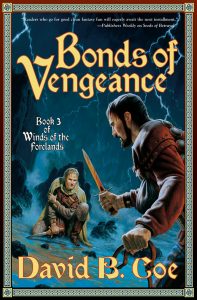 Honestly, I think “trust yourself” is good advice for life in general, but for me, with respect to writing, it has a specific implication. It’s something I heard a lot from my first editor when I was working on my earliest series — the LonTobyn Chronicle and Winds of the Forelands.
 You won’t get your best ideas sitting at your desk. You’ll get them in the shower. Or, when you’re driving your car, or taking a walk on a snowy day.
 It’s happened to all of us. It happened to me writing my new book, Demon Kissed, and the next two in The Summoner’s Mark trilogy, coming from
 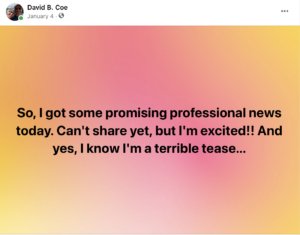 Nearly two months ago, early in the new year, I posted on social media that I had some exciting professional news I couldn’t share quite yet. I was thrilled, and wanted to let people know. But I also didn’t want to say anything before all the details had been settled. So I posted my little teaser, forgetting the one immutable rule of the publishing business: Things always happen slower than one thinks they will.
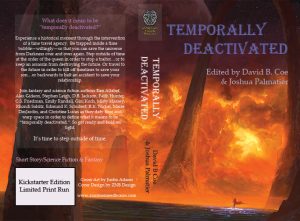 Since writing it, though, I have become sort of fixated on the idea. I am editing my fourth anthology, and already looking at the possibility of editing another. My freelance editing business is attracting a steady stream of clients — I’m booked through the spring and have had inquiries for slots later in the year.
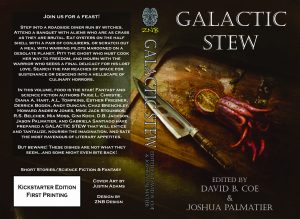 I am not an acquiring editor. I do decide, along with my co-editor, whose stories will be in the anthologies I edit, so I suppose in that way I am determining the fate of submissions and, in a sense, “buying” manuscripts. But, for now at least, I don’t make decisions about the fate of novels, and so I don’t have to go toe-to-toe with agents. Good thing. They scare me. (Looking at you, Lucienne Diver.)
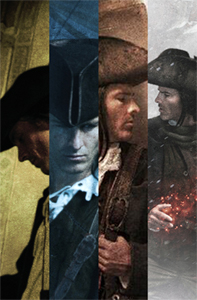 I am not the most talented writer I know. Not by a long shot. I am good. I believe that. My character work is strong. My world building is imaginative. My prose is clean and tight and it flows nicely. I write convincing, effective dialogue and I have a fine eye for detail. My plotting and pacing, which were once just okay, have gotten stronger over the years. I think writing the Thieftaker books — being forced to blend my fictional plots with real historical events — forced me to improve, and that improvement has shown up in the narratives of the Islevale and Radiants books.
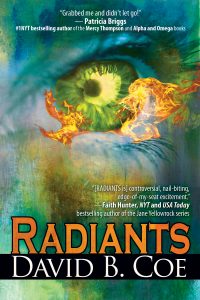 8. You read
 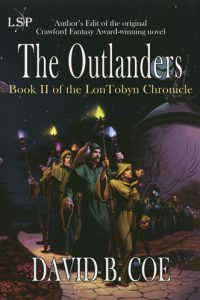 The Outlanders, my second book, may well be the most significant of all the books I’ve published. I knew I had it in me to write one book. But when I finished The Outlanders, and realized it was even better than CofA, I knew I was more than a guy who could write a novel. I was an author. And when Children of Amarid and The Outlanders together were given the Crawford Fantasy Award by the IAFA (International Association for the Fantastic in the Arts), for best fantasy by a new writer, I knew I would have a professional career beyond that first series.