Tag Archives: family

Monday Musings: Baseball, Opening Day, and Childhood Dreams

Baseball season opens this week. That might not seem like a big deal to you. And in truth, it’s far less of a big deal for me now than it used to be.

But once upon a time, Opening Day was Christmas morning and my birthday all rolled into one. It was the best day of the year that didn’t involve me getting presents. It was a day of possibility, of dreams deferred finally having their day in the sun. And, yes, quite often, it was also the day those dreams and possibilities were doused with icy water.

When I was a kid, baseball was everything to me. Sure, I had other interests, but I lived and died with the Yankees (mostly died, for the first twelve years of my life) and I dreamed of being a major league baseball player. I remember a first grade class assignment in which we were supposed to draw a picture of ourselves in whatever job we expected to do when we grew up, and then write a few sentences about that job. I drew myself playing center field for the Yankees.

I should pause here to say that I must have been truly delusional. I was a TERRIBLE baseball player as a kid. I was terrified of getting hit by the baseball. My little league at-bats were panic-inducing affairs that saw me swinging at any pitch within four or five feet of the plate so that I could strike out more quickly. The strikeout itself was a foregone conclusion, right? So why prolong the encounter and risk devastating physical injury? Every once in a while, I would screw up the courage NOT to swing and would manage a walk.

And as I trotted down to first base, marveling at the mere fact that I was still alive, my father would clap from the stands, calling “Nice going, Charlie [his nickname for me — he did, in fact, know my real name]! Walk’s as good as a hit!”

Kind, but untrue. Walks are great — on average, players who walk a lot help their teams far more than players who walk infrequently. Still, hits are better. There are stats to back this up. But I digress . . .

What about my fielding, you might ask. Well, I was already a birdwatcher by the time I was playing little league, and I spent a lot of time out in right field, watching for interesting fly-overs, and running after hit balls that were safely on the ground and decelerating, and therefore far less of a threat . . .

[I did get a little better as I grew older. I spent three summers at sleepaway camp when I was eleven, twelve, and thirteen, and during my last year there had a pretty good season. I batted over .300 — yes, I kept track; yes, I still remember — fielded well, and generally acquitted myself quite well. But I should also say that this was a camp for well-to-do Jewish kids. Not exactly the training ground for future Major Leaguers. The pitchers I faced were more likely to wind up as orthodontists than as professional athletes.]

And still, I insisted year after year that I would someday play for the Yankees. And not just at any position. I would play center field. The realm of Joe DiMaggio and Mickey Mantle. As I said: delusional. My parents tried, gently, to steer me away from this dream, pointing out that baseball players — and most professional athletes — had certain skills and attributes that I lacked. Like hand-eye coordination. And height.

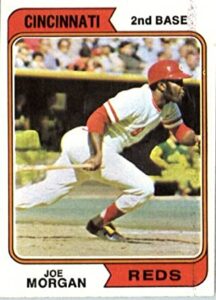
Joe Morgan, 1974 Topps“Aha!!” I was able to reply. “What about Joe Morgan? Two time Most Valuable Player, perennial All-Star, World Series champion. He’s five foot seven!” Besides, I assured them. I didn’t expect or need to be six feet tall. I would be perfectly happy with five foot ten, like my hero, Roy White.
Amazingly, it was this statement that my father couldn’t abide. God bless him, he was willing to put up with my elephantine blind spot when it came to my playing ability. But me growing to be five foot ten? No. This was the bridge too far. “Charlie, I’m sorry. But you are never, ever going to be five foot ten . . .”

Spoiler alert: He was right.

I did eventually get over my baseball-playing dreams. Mostly. But baseball’s Opening Day still elicits from me a different sort of dream. “This is the year!” I tell myself, literally every year. “This is the year the Yankees will dominate the American League. The Mets will dominate the National League. The two will meet in an epic seven game World Series! I won’t even care which team wins!”

So maybe I’m still delusional.

But did you know that in 1991, when the Minnesota Twins faced the Atlanta Braves in the World Series, both teams were just one year removed from last-place finishes in their respective divisions? True story. In 1969, the Miracle Mets won 100 games and the World Series, after spending their first seven years of existence at or near the basement of the National League.

And while we’re at it, did you know that Freddie Patek, shortstop for the Pittsburgh Pirates and Kansas City Royals, three time All-Star, was only five foot five??

Anything can happen!

And that really is the point.

Look, baseball is no longer the game I worshiped as a child. Games have gotten too long and boring. Batters swing for the fences in every at-bat. Pitchers try to strike out every batter they face. The nuance and strategy that I loved — it all seems to be gone. And yet, with Opening Day approaching, I find myself dreaming of a season in which smart baseball returns, in which the obsession with power-hitting and power-pitching fades, and this amazing game returns to the subtle brilliance I remember so fondly.

Call me delusional.

Have a great week.

Professional Wednesday: Why Fantasy, Why Magic?

My oldest brother, Bill, who we lost several years ago, was an avid reader. He loved books of all sorts. Every year, he made a list of the National Book Award nominees — finalists and books on the long list — and read them all. He read fiction and non-fiction, his interests as reflected in the latter ranging from baseball to natural history to military history. He was a poet in his own right, and he revered literature of every stripe.

And yet . . .

He was always quite proud of my career, and he had a shelf among his many book cases that he reserved for my novels. But he felt on some level that I was wasting my ability by writing fantasy. Many times over the years, he suggested I try my hand at writing so-called literary fiction. Every time he did, I cringed just a little.

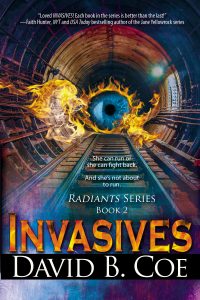
INVASIVES, by David B. Coe (Jacket art courtesy of Belle Books)The bias against genre fiction (fantasy, science fiction, mystery, Westerns, romance, etc.) among those who consider themselves devotees of “true” literature, is something I have encountered again and again throughout my career. Not surprisingly, I don’t believe it has any basis in reality. Fantasy (to address my speciality) like literary fiction, runs the gamut in terms of quality. One can find in all literary fields examples of brilliance and also of mediocrity. No genre has a monopoly on either. I write fantasy because I enjoy it, because I love to imbue my stories with magic, with phenomena I don’t encounter in my everyday life. I wasn’t shunted to this genre because I wasn’t good enough to write the other stuff. I don’t hide in my genre because I fear I can’t cut it in the world of “real” literature.
I said before that I cringed whenever my brother raised the issue with me. I also told him in no uncertain terms that I was writing what I enjoyed, and enjoying what I wrote, which remains true to this day. Writing fantasy demands that I create coherent, convincing magic systems. Often it requires the creation of entire alternate worlds, complete with their own histories and cultures, politics and religions, economies and social structures. These are not distractions from the fundamental elements of narrative — character development, plotting, pacing, clear and flowing prose, etc. Quite the contrary. These fantastical elements enhance those fundamentals and present unique and rewarding challenges.

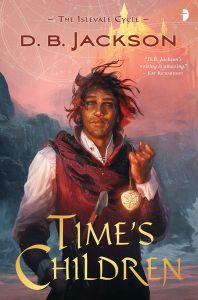
Time’s Children, by D.B. Jackson © Angry Robot. Art by Jan Weßbecher.It’s not enough to create my worlds and magic systems. I have to explain them to my readers in a manner that is entirely natural and unobtrusive. And — my own preference — I also have to complete my stories and my character arcs in ways that utilize my fantasy elements without allowing them to take over my story telling. My heroes may possess magic, but in the end, I will always choose to have them prevail by drawing upon their native human qualities — their courage and resolve, their intelligence and creativity, their devotion to the people and places they love. Magic sets them apart and makes them interesting. It is often the hook the draws readers to my books. But those human attributes — those are the ones my real-world readers relate to. They form the bond between my readers and my characters. And so if those are the qualities that allow my characters to prevail in the end, then their triumphs will feel more personal and rewarding to my readers. It is the simplest sort of literary math.
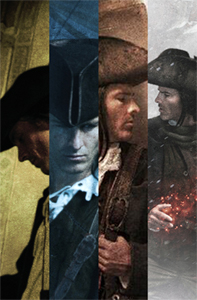
I believe part of the bias against genre fiction is based in the erroneous belief that the trappings of these literary types — magic, imagined technology, romantic tension and conflict, the ticking clock of a murder investigation — somehow serve as substitutes for character development and good writing fundamentals. In truth, they are complements to solid narrative work. Genre fiction, when well done, has all that extra stuff we love AND great story telling.

I expect I am preaching to the choir a bit with this post. That’s okay. It’s not just those of us who write genre fiction who have to put up with the biases of others. Readers of our genres deal with the same sort of prejudices all the time. Fine. Those other people don’t know what they’re missing.

Plus, their book jackets aren’t nearly as cool as ours.

Keep writing. Keep reading.

Monday Musings: “Time, Time, Time, See What’s Become of Me…”

The other day, as I was shaving (yes, I shave, despite the beard — I like to keep it trim and neat) I paused, taking in how very white my beard looks these days. There is almost no brown left in it. My temples are graying, my thinning hair is frosted with more white than I had realized. I am grizzled. That’s the polite way of saying it.

I suppose I should pause here to make a confession: I had a birthday last week.

To be sure, I am feeling my age. But this post is about more than just a guy of advanced middle age staring down the barrel of his sixtieth trip around the sun (my next birthday is A Big One). Time seems to be rushing past in an alarming way. We’re more than halfway done with March and I have no idea where the first two-months-plus of this year have gone. Each week, I set work goals for myself, and generally speaking I meet them. But then I have other things I want to get done — personal things; a song I want to learn on my guitar, photos I want to process from a recent shoot, a walk I’d like to take — but the week is already gone, and I am no closer to getting those things done.

I remember when I was college I spent a lot of time fighting the passage of time, which is a losing battle if ever there was one. I don’t know if I was hyper-conscious of how brief those four wonderful years would wind up feeling, or if I was struck by a growing awareness of my parents’ aging, or if I was merely anxious to get on with my life — with my search for direction, for love, for confidence and contentment. Whatever the reason, I struggled with a sense that my life was speeding past me, and I needed to slow it down somehow.

I have that sense again now, but it’s my own aging that has me thinking this way. Life is hard right now. It’s hard in a macro sense — the pandemic, the war in Ukraine, the existential threat our own actions pose to our planet. It’s hard in a personal sense — my daughter’s health, end-of-life issues impacting Nancy’s parents, the difficulties of maintaining a writing career in this publishing climate, my own struggle with anxiety.

And yet, despite these difficulties, I am enjoying life as much as I ever have. Nancy and I are empty-nesters and, as much as we love our daughters, we also love our life together. We are deeply proud of the adult human beings our girls have become, and we savor our time with them. The literary landscape is fraught, but I love the stuff I’m writing, and I have been enjoying my new career as an editor. Nancy has just reached a career milestone and is finally receiving the recognition and attention she has deserved for so long. Life is good. But it is speeding by. Again. Still.

When I was a kid, I would express impatience for one thing or another — my next birthday, a baseball game for which we had tickets, a family trip in the offing — and invariably my mom or dad would say, “Don’t rush it. It’ll be here before you know it.” Years later, I found myself saying the same thing to my girls. Each successive year of life represents a smaller percentage of the time that has come before. Of course the years feel shorter and shorter. Put another way, time snowballs. It is relentless, immutable. It is the advance and retreat of the tide, the rotation and orbit of the earth. Sunrise and sunset. Waves upon sand. Pick your cliché.

The title of this post comes from Simon and Garfunkel’s “Hazy Shade Of Winter” — Paul Simon is a musical hero of mine. James Taylor, another of my musical heroes, famously sang “The secret of life is enjoying the passage of time.” He may well be right. I wouldn’t know. It’s not a skill I’ve ever mastered.

I’m just back from a week in Florida with Nancy, Erin (our younger daughter), and Erin’s boyfriend. I’d been looking forward to the trip for weeks, months even. As my parents would have warned, it was here and done before I knew it. I have learned nothing. Erin is preparing for a move westward. She has a job waiting, the promise of a new life with her love, the anticipation of the unknown, of something new and different and exciting.. She is counting the days. I can’t blame her.

Time, she likes to tell me, is a human construct. Like money. It doesn’t really exist except in our own minds. It has units and meaning and definition because we give it those things. And yet, it is the defining characteristic of life, of existence.

On a recent trip north, I spent a morning with two close friends from high school, guys I hung out with, was in theater with, got high with, played music with. We three hadn’t been together in probably thirty-five years. We had a great time. Truly. The years melted away. Except they didn’t. We were, all of us, wiser, calmer, kinder, more tolerant, less competitive. Time is a cudgel, but also a balm. It tests us, but it also smooths our edges. When my friends and I were making our plans to get together, the time since our last encounter felt like a chasm. It turns out it was anything but. Maybe Erin is right, and it doesn’t exist except in our heads.

I honestly can’t tell you what my point is. I’ve had a few posts like this recently. There’s a reason I call them “Monday Musings” . . . This is what I’m thinking about right now. Time. Age. Life. And I wish the flow of days and weeks and months would slow down a little, especially with spring coming. There are things I’d like to do.

Have a great week.

Monday Musings: The Things We Care About, a #HoldOntoTheLight Post

#HoldOnToTheLight

I honestly don’t know where this post is going, and so please bear with me as I work through my tangled thoughts.

I am struck today — as I ponder a life that is both fraught and wonderful, complicated and strikingly simple, weighted with deep worries and buoyed by simple yet profound pleasures — by the oddity of the things we choose to care about minute to minute, day to day, year to year.

As many of you know, last year our daughter was diagnosed with cancer. Her initial treatments went well, her maintenance regimen has been harder to pin down and she recently had a small setback — minor, but with cancer nothing is truly minor.

I suffer from anxiety anyway, and so any change for the worse in her situation can send me into a tailspin. The truth is, lots of things, big and small, can send me into a tailspin, but I am hardly unique in that regard. And when it comes right down to it, I am not convinced my anxiety explains the emotional phenomena with which I’m grappling in today’s post.

Perhaps an example will help me clarify my topic and allow you to follow along as I muse and ponder. I find — and this is nothing new — that one moment I can be focused on my daughter’s health, or something else of equal importance and solemnity, and the next I can be completely put out by my inability to solve the day’s Wordle puzzle in four guesses instead of five. A frivolous, even absurd, example to be sure, but I offer it in all seriousness. The frivolity is kind of the point.

This has been a difficult couple of years to say the least. I often begin my morning walks mired in dark thoughts, consumed with worry about my kid, or the state of the world, or, for a long time, the persistence of the pandemic. And then I will spot a hawk along the trail, or a warbler will pop up and start to sing in plain view, and I will be filled with happiness. Fleeting perhaps, but not any less powerful for its brevity.

We can be resilient creatures, we humans. And I do think some of what I’m writing about is resilience. Part of it might be as well the simple reality that our emotions demand respite. It can be exhausting living with worry or with grief. Many of us, myself included, live with anxiety or depression or other mental health issues, and these conditions can compound that weariness. Many of us struggle to find those moments of pleasure, those glimpses of resilience.

But the fact is, our minds — or at least my mind — seem to seek out breaks from the toughest issues. How else can I explain being consumed with the threat of global climate change one moment, and truly caring who wins the Tottenham v. Manchester City soccer match the next? How can I worry about my children, or the health of my in-laws, and also care whether I solve the puzzle on my phone in the allotted sixty seconds?

Do our minds do this to preserve our sanity? Ophthalmologists tell us that we can ease strain on our eyes when sitting in front of our computers by taking a few minutes periodically to focus on something farther away. Isn’t that what our brains do, too?

Okay, so I’m nearly six hundred words in to this post, and I still haven’t figured out what the hell I want to say. I suppose I am trying to explain to myself how my own coping mechanisms work. I know that for me, constant worry is debilitating. The intrusions of the frivolous save me from myself. I care about Wordle not because it matters, but because in making it matter, I force myself to look elsewhere, to focus on something other than the hard stuff right in front of me. I allow myself the pleasure of a bird sighting — or a song well played on my guitar, or a successful photograph — because without such pleasures my world would be a bleaker place.

I suppose I am merely describing distractions, which all of us have. And perhaps what I’m actually doing, in public, and in a roundabout way, is giving myself permission to be distracted. Because, I have to admit, in the depths of my legitimate worries, I am embarrassed by the trivial things I care about. Resilience. Distraction. Fun. Pleasure. Joy. When we confront serious matters — including life and death matters — these things can feel wrong, like violations of self-imposed gravity. How dare I take pleasure in a new music CD when my kid is dealing with cancer. How dare I care about a soccer match, or a Wordle puzzle, when the world is in crisis.

The thing is, though, without all those pursuits that delight and distract and bring joy, why does anything else matter? We help no one when we deny ourselves simple pleasures. Because they not only are born of resilience, they also promote it. And without resilience we are of no use to the people who need us, to a world that demands our attention and our compassion.

Perhaps this post is one long rationalization, a way to convince myself it’s okay for me to have fun now and then. But I think it’s more. In the depths of difficult times, I believe we need to remind ourselves to take joy when and where we can. Life is hard. We face no shortage of excuses to be sad or frightened or angry. Our humanity demands we also create opportunities to find happiness and peace, even if just for a short while.

Wishing you wonderful week.


Monday Musings: Some Weird Occurrences Have Me Thinking About Technology

This past week, I had a couple of weird experiences that made me feel like I was an extra in Poltergeist or Enemy of the State. And I thought I would share them with you because if I’m freaked out, I feel strongly that you should be as well. You’re welcome.

Let’s start with the Enemy of the State incident. I think it was Tuesday night — we spoke with our younger daughter and, as always, covered a lot of topics. She has a birthday coming up, so one of those topics, of course, was what she might want from us as a gift. She mentioned something and I suggested a place she might shop for the item and then we would pay her back whatever it cost. This is not a brand of store at which I usually shop, but it specializes in what she wanted, so…

Again, this was a phone conversation. We weren’t texting or emailing. There was no physical or electronic record of our discussion.

And yet, the next day, advertisements for the store in question, suddenly and for the first time ever, began to show up in the browser on my phone. It was so creepy. I mean, someone or something is obviously “listening” to our phone conversations. I don’t imagine there are people with earphones and recording equipment in the walls, or anything like that. But the same algorithms that track our internet browsing and then recommend products and stores, must track phone conversations for recognizable brands and the like. That’s the only explanation that makes any sense to me. As I say, creepy.

Moving on to Poltergeist

This actually happened the same night — which I suppose is a little freaky in its own right.

Nancy and I had made stuffed poblano peppers for dinner, and we finish our preparation of them by placing them under the broiler in our oven, to melt and brown the cheese. So we did that and sat down to eat. After a few minutes, the oven started beeping at us. It was getting too hot.

Nancy, thinking we had forgotten to turn off the broiler, got up to do that. But it was already off. She pressed off again, just to make sure. The broiler remained on. We turned the broiler on, waited a few moments, then turned it off again. It remained on.

At this point, I went to the circuit breaker and switched the oven off from there. After a few seconds, I threw the breaker back on. The clock had reset, of course, and everything else seemed normal. But the broiler came on again. I turned the oven off at the fuse box again and left it that way. At this point, we were afraid to sleep in the house, or leave the house, with the oven plugged in.

Now, sometimes electric appliances and such will reset if left disconnected from their power supply for long enough. So the next day, I switched the fuse again, just to see. And, yes, the broiler turned on immediately, even though it was turned off.

We’re replacing the oven, though with supply-chain issues and such, we won’t have a new one for a few weeks.

But this was creepy as well, not to mention scary. And Nancy reminded me that a few weeks ago she was baking a loaf of bread and somehow the broiler turned on during the bake and burned the top of the loaf. It was almost like our oven was already in the process of developing a mind of its own.

We (and I mean Nancy and me, but also the collective “we” — society at large) are so dependent on technology that it’s easy to take that dependence for granted. Because it’s more than just a reliance on the machines, appliances, and devices we use on a daily basis. It’s also the trust we place in them.

Sure, we understand that we sacrifice a bit of our privacy when we go on line (or walk down a crowded city street in the age of facial-recognition), but I assume — foolishly, it would seem — that my phone calls are private. Not so long ago, an organization I worked for last year asked for my social security number, so they could issue me a 1099 form. I didn’t feel comfortable sending that information via email, so I asked for a number to call. Now, after the conversation with our daughter and what happened next, I wonder if I wasted my time and that of the person on the other end of the call.

We expect some things to need periodic repairs. When our cars break down, for instance, we’re annoyed, but not entirely shocked. These are inconveniences that we factor in when making a decision to buy. Cars need service periodically. Appliances need replacement parts and will fail now and then. But our oven’s odd behavior could have put our home at risk. It could have cost us our lives if it started a fire at the wrong time.

The creepiness of these incidents is, on one level, fun to talk about. I have shared the stories a few times already, and always they’re good for a laugh and jokes about the rise of our automated overlords. The fact is, though, there is something decidedly unfunny about all of this. Like so many things, it’s funny until we really think about it. And then it’s just disturbing.

Have a good week.

Monday Musings: How I Started Writing — A Case Study of Dubious Worth, Epilogue

This week I conclude my series of posts on how I came to be a professional writer. You can read the previous posts before moving on with this one. We’ll wait. [Part I, Part II, Part III, Part IV]

There! Now you’re all caught up. Feel better?

I’m calling this an Epilogue, because it seems foolish to go through every step of my career, when much of it has been fairly public and thus easy to trace through my publications, reviews of my work, con appearances, social media and the like, and my own blog posts about various experiences. Far more valuable, I believe, will be a discussion of a few key points about what I have learned in my twenty-five-plus years as a professional.

I’ll start with this. Recently, while giving a talk to the Apex Writer’s Group, I was asked what I know now about writing that I wish I had known from the start. My answer: I wish I had known then that career trajectories are not linear, they are not smooth, they are not simple. I have said a thousand and one times that writing is hard. A couple of weeks ago I went on a little rant about how we writers should handle adversity without just giving up on the whole thing. But the fact is, I have contemplated quitting more than once. My career followed a nice, upward trajectory for a time, but then, due both to circumstances beyond my control, and to poor decisions I made myself, my march toward bigger and better things halted, stumbled, took a few steps back. My sales numbers dipped. I reinvented myself. Things improved, but then more events I could not control (and a few I could) knocked me back again. Things seemed to be righting themselves and then they fell apart once more, this time through no fault of my own.

Yes, this is vague. Some of the stories that have impacted my career are not mine to tell. Others are, but they involve me casting light on questionable behavior and choices by others and I won’t go there. Another lesson: This — fantasy, writing, publishing — is a relatively small community and we need to be careful about the stories we tell, the actions of others we expose, the decisions we question publicly.

And really, the specifics are beside the point. Because what I’m talking about — the unpredictability of one’s writing fate — is something nearly all writers experience. I know precious few authors whose careers have followed a smooth, ever-rising trajectory. Most of us are knocked on our butts again and again and again.

What separates the professionals who enjoy long careers from those who don’t is the willingness of the former to get up off their rear ends each time they’re knocked down. As I said, I have contemplated giving up multiple times. But I never did quit.

The Thieftaker Chronicles, by D.B. JacksonI am not the most talented writer I know. Not by a long shot. I am good. I believe that. My character work is strong. My world building is imaginative. My prose is clean and tight and it flows nicely. I write convincing, effective dialogue and I have a fine eye for detail. My plotting and pacing, which were once just okay, have gotten stronger over the years. I think writing the Thieftaker books — being forced to blend my fictional plots with real historical events — forced me to improve, and that improvement has shown up in the narratives of the Islevale and Radiants books.
But there are plenty of other writers who do all those things as well as I do if not better. I have been helped throughout my career, though, by a few other qualities. I am disciplined and productive. I work every weekday and at least one day on weekends. I consistently hit my word counts and meet my project goals. I never miss a deadline. I have developed a thick skin — mostly — and have learned not to take to heart criticism and rejections and bad reviews. (Mostly.) I am resilient. And, with effort and practice, I have learned to take to heart the advice I often give to self-define success.

I’m writing and editing for small presses now. I don’t know when or if I’ll go back to the bigger ones. I love my current publishers, and see little need to switch back to the high pressure relationships I once had with big-name houses. I’m writing books I love, and that is, I believe, a key to being successful as I define the word. I don’t expect any one project to make me a ton of money, and that’s okay. I’m happier in my career right now than I have ever been. Partly this is due to my enjoyment of my relatively new career as an editor. This year will see the release of my fourth co-edited anthology with Zombies Need Brains. And I will also continue to expand my freelance editing business. At this point, I expect I’ll spend more time in 2022 editing than writing.

This is not at all where I envisioned myself when I started my career. Back then, I was filled with dreams of bestselling books and a shelf (or two) filled with World Fantasy Awards. Okay, that’s an exaggeration. But I did hope my commercial performance, which has always been a bit disappointing, would match my critical success, which has always been a point of pride. The fact is, though, the business today is greatly changed from where it was when I began. Back then no one had ever heard of e-books. I built myself a web page when my first book came out, and just having a web page conveyed more legitimacy than the publication itself. Seriously.

“I have a book out!”

“Meh.”

“I have a web page!”

Oooooooh! You have a web page!!”

It is a changed world, and it is also now a much harder market. An ever-growing universe of authors are seeking the attention of a fairly static universe of readers, meaning sales for each writer are harder to come by. Advances are smaller if they’re offered at all. Many authors are working harder and harder just to maintain a level of income that is, nevertheless, lower than it used to be. Commercial success means something different now than it did when I began. I count as a triumph the mere fact that I continue to get writing contracts.

I once thought I would reach a point where I stopped worrying that my career would tank, forcing me to give it up as a full time profession. I was disabused of that notion early on by a writer who was very successful and who told me, “Oh, you never stop worrying.” And it’s true. I have been able to continue writing full-time because my partner in love and life has a good job that provides not just the bulk of our income, but also our health care and retirement funds.

The hard truth is, on some level my mother was right when she and I had our big fight about whether I should teach history or write fantasy. As a history professor I would have made a decent living. I would have had job security, retirement accounts, health benefits. And yes, that would have been success as defined a certain way.

But I believe I also would have been miserable.

Again, I find myself struck by my good fortune. Throughout my professional life, I have had the luxury of pursuing a career I love and choosing to define my success not just in terms of earnings, but also in terms of joy. It’s a cliché, but there is no way to put a price tag — or a royalty statement — on that.

Have a great week.

A Little News To Share!

So for the people in the little college town where I live, this is old news. But for the rest of you . . .

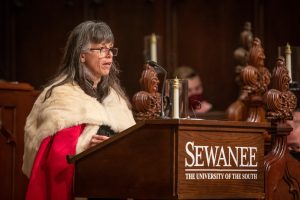
The former president of the university here (officially called the Vice Chancellor) has moved on to a new opportunity (it’s not really my place to say more, except that when the President of the United States asks you to serve, you serve . . .) Next in line for the university presidency is the University Provost, who happened to be my wife, Nancy. And so, I am thrilled to say that she is now acting president of the university, the first woman in the history of the school to assume the office. My sweetie has made a little bit of history. I could not be more proud.

Here is a photo of her presiding at the recent winter convocation. The red ermine robe is the traditional garb of the University Vice Chancellor.

Nancy at Winter Convocation

Professional Wednesday: Throw Nothing Away — A Writing Lesson Courtesy of INVASIVES

INVASIVES, by David B. Coe (Jacket art courtesy of Belle Books)February has begun, Punxsutawney Phil has done his schtick, and time seems to be moving at breakneck speed. In a little over two weeks, Invasives, the second Radiants book, will be released by Belle Books.

Like Radiants, this is a supernatural thriller. This time, though, I have set my thriller in New York City, and a good deal of the story takes place in the New York subway tunnels. My lead characters are a trio of homeless, runaway teens — Mako, Bat, and, my main protagonist, Drowse. They live off what they can make by scrounging and, yes, stealing, and they take shelter in a house built of cardboard and shower curtains, tape and rope and plastic ties.

Bat is blind. He comes from money, but had to leave his home. When the book opens, we don’t know why.

Mako was involved in gang activity for a time, but eventually went straight. Or tried. Did I mention they have to steal?

Drowse ran away from a terrible home situation. She turned tricks for a time. Ran drug money. Now she’s trying to hold their small “family” together and survive in the Below. And, as it happens, she’s a Radiant, whose power is invaluable to their business.

But her abilities, and the business they do, have now attracted the notice of some of the most powerful people in New York’s financial world. They want something Drowse has, and they are willing to do anything, kill anyone, to get it.

Intrigued? I hope so. I love, love, love this book. Yes, I know, I say that about all my books when they come out. Because it’s true.

Invasives, though, is special to me in a couple of ways.

First, this is the book I was writing when we first got my daughter’s cancer diagnosis last March. At first, I put my writing on hold. I could barely function. I could barely think. How the hell was I supposed to write a novel? Well, as it turned out, writing this book was just what I needed. It is a fraught narrative, filled with suspense and tension. It focuses on these three characters, on their love for one another, on their bonds, and the forces trying to tear them apart. It wasn’t about cancer at all, and that was a good thing. But the story gave me an outlet for all the emotions churning inside me. As I have said before, I could not have gotten through the ordeal of last spring and summer without this novel.

And second, Drowse, Mako, and Bat were with me, lurking in my imagination, for more than a decade before I finally started work on this book. I had the idea for them, for their circumstances and relationships, long before I knew what story to build around them. I knew only that I loved the characters, and their dynamic. I had one idea for a novel, but I could never quite figure out the storyline, the world, the ending. I did write a kick-ass opening chapter for it, though.

Then, two years ago, I began writing the first Radiants book, and as I thought about subsequent volumes, Drowse and her friends popped back into my head. This was their story. Finally. This was the perfect world in which to place them. I even was able to use an updated version of that opening chapter.

I have said before, half in earnest, half in jest, that writers are packrats. We keep everything. Or at least we should. When I figured out that Drowse et al. would be the perfect protagonists for my second Radiants book, I knew just where to find the original character sketches, the original opening chapter, the original storyline for their caper. Because even that wound up factoring in to the creation of Invasives.

I never lost faith in the groundwork I did for their story all those years ago. I knew there was a novel there, somewhere. It was just a matter of placing it.

That happens to me a lot, and I know it happens to other authors as well. Sometimes we have an idea, and we are ready immediately to write and publish it. Other times, stories and characters take a while to steep, like good, strong tea. For ten years, Drowse, Mako, and Bat waited in a file on my computer desktop. It wasn’t that the original idea was bad or lacking in some way. It just wasn’t ready. Or rather, I wasn’t yet ready to write it in a way that did justice to the power of the original notion.

And that made the final realization of their tale in this novel all the more satisfying.

Keep writing. And don’t throw any idea away!

Monday Musings: How I Started Writing — A Case Study of Dubious Worth, part II

Last week, in the first of what I expect to be a three or four part series on how I got started in writing, I posted about my early creative efforts and the teachers who were so influential in encouraging and inspiring me. I titled that first installment “A Case Study of Dubious Worth” and I think the title holds for this week as well. This entire exercise — the writing and posting of these essays — might be interesting, I certainly hope it’s entertaining, but I’m not at all sure how illustrative it will be or whether it’s at all relevant. Not to put too fine a point on it, but I’m pretty old, and the world is a different place from what it was when I was getting started. And yet, I continue . . .

My last semester in high school, I was in a creative writing workshop class, taught by one of those outstanding teachers I mentioned last week (Phil Restaino), and populated by a remarkable, talented, close-knit group of fellow students. Many of them remain friends to this day. What I wrote in that class was, overall, pretty mediocre. But I learned so much about writing, about the creative process, about critiquing others and building a safe, productive space for having those intimate, at times difficult conversations.

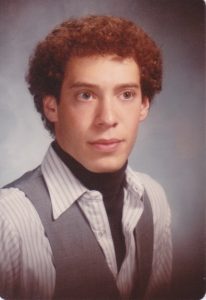
My Brown graduation pic.

And so I went off to college thinking I would be a creative writing major, and fully expecting that I would find at Brown University a similarly nurturing creative environment.

[Cue sound of screeching brakes…]

Talk about rude awakenings.

Even then, I knew I wanted to write fantasy, and I had an idea for a novel. This idea would eventually morph into Children of Amarid, my first published book, which won the Crawford Award, but this early incarnation was a long, long, long way from that finished product. It was not very good. I know this. But that doesn’t excuse what I encountered in the very first creative writing class I took at Brown. Our professor was a writer of stature, well known in academic fiction circles. I’m willing to believe that early in his career he was a fine teacher. When I had him, he was a year or two away from retirement. His classes meandered, and he left most of the important work, including the facilitation of the critique sessions, to his graduate assistant.

But he did make clear that, in his view of the world, there was “Literary Fiction,” and then there was the genre stuff that didn’t really count because it was, well, genre stuff. And so, perhaps taking their cues from him, or perhaps responding to the fact that my work still needed a good deal of refinement, my fellow students savaged my manuscripts in the critique sessions. No one had taken time to teach our class the rudiments of critiquing. There was no “start with what’s good, move to what needs work, return to what is good and can be built upon.” There was just “this is bad.” After the wonderful experience I had in that high school workshop class, I found the experience devastating.

I should say that I did get one bit of good advice from that class. It came from the graduate assistant, who was unable to steer the critique discussion, but who went out of her way afterward to assure me there were strong elements to my writing, my storytelling, and even my world building. And she said, “I know that session was hard, but don’t retreat into rewrites. Keep moving forward with your book and revise these early chapters when you’re finished.”

It was, and still is, sound advice for any writer, and to this day I offer it to writers I work with. But the fact is, the graduate assistant’s kindness and wisdom were not enough to overcome the negative experience. I never took another workshop class at Brown. I did continue thinking maybe I would be a creative writing major, but I moved away from fiction toward journalism, where I had some better experiences. Sadly, though, that terrible first class pushed me away from writing fiction for a decade.

As I say, I was still thinking about a creative writing major as I began my sophomore year. But then I had a conversation with my mom and dad. Now, as I mentioned last week, my parents were very supportive of my writing. They were also my mom and dad and they worried a creative writing major would have little or no value in the real world. So they gently but persistently encouraged me to channel my interest in writing toward something more practical. Looking back, I am not sure how wise their advice was, but at the time, I found it compelling. I liked nice guitars and nice stereo equipment, and I had figured out that those things cost money . . .

I wound up choosing as my major American Studies, an interdisciplinary program combining (among other things) literature, political science, and history. I found these subjects and their intersections quite interesting, and, to my delight, I found as well that all my classes in the field were writing intensive. By the end of my second year at Brown, I was on the trajectory that would lead me to get my Ph.D. in history.

More on that as I continue this story next week.

But here are the most important things I would like you take away from this post. First, a badly run writing workshop, one in which critiques are done without sensitivity, without compassion, without pairing encouragement with criticism, can do irreparable harm to the aspirations of beginning writers. Dreams are powerful, but they can also be fragile. And just as last week’s post emphasized the importance of pedagogical excellence, this week’s ought to highlight the potential harm that can come of slipshod and lazy teaching.

Second, the literary prejudice that favors “literary” fiction over other sorts of storytelling is as poisonous as it is misguided. Writing is hard, whether our stories are about our world or another, whether they are firmly rooted in realism and “now” or imbued with magic and cast in different timelines. Quality work can be found in any genre; so can mediocrity. And lest we forget, some of the best and most important writing happening today is being done by writers in fantasy and science fiction. Ask N.K. Jemisin.

And third, stuff happens for a reason. I truly believe this. Yes, I was discouraged from writing fiction by a bad class and also by my parents’ overly developed sense of what was pragmatic. It would be easy for me to look at the changing trajectory of my life during my college years, and look as well at where I am now, and decide I had wasted that decade of my life when I didn’t write any fiction at all. But if I hadn’t gone to graduate school in history, I would have missed out on academic training that taught me so much about crafting prose, about doing research, about writing with discipline. If I hadn’t gone to grad school in history, where I developed a real interest in the American Colonial Era, I doubt I would have wound up writing the Thieftaker books. Most important, if I hadn’t gone to grad school, I never would have met Nancy and I wouldn’t have my two brilliant, beautiful daughters.

So maybe that class I hated so much was the best thing that ever happened to me.

More next Monday.

In the meantime, have a great week.

Monday Musings: How I Started Writing — A Case Study of Dubious Worth, part I

I’m often asked how I became an author, and by way of answering, I point to a book I wrote when I was all of six years old — “Jim, the Talking Fish.” Written and illustrated by yours truly, bound between two pieces of blue construction paper and tied with yellow yarn, it was my first novel. I crack a few jokes about the “book,” but then make clear that so early in my life, storytelling was already in my blood. What I usually leave out, for brevity’s sake, is that this was hardly the only book I wrote, illustrated, and bound at that age. There were several. I don’t talk about those others, because I can’t remember all the salient details.

There’s something else I leave out as well, and I really shouldn’t. Ever.

I wrote those books because I had a first grade teacher who encouraged me, and all of my classmates, to write. To create. To dive into our imaginations and explore. And I kept on writing because all through elementary school, and middle school, and high school, I had opportunities to write. I had teachers who encouraged us to write, who required us to write. And not just reports and such. We were required to write fiction, or to write about ourselves, or to journal.

When I was in seventh grade, I was in a team-teaching program at my middle school. Five teachers taught a group of about 100 students on a rotating basis. We were divided into classes of twenty, and we were with our cohort throughout the day, moving among the team of teachers, who covered English, Social Studies, Math, Science, and French. It was an amazing program. All the teachers were excellent. And for the second half of the school year, we 100 students were assigned to keep a journal as part of our regular homework. We could write whatever we wanted, but we had to write pretty much daily.

I still have the journal I kept that semester, in its original folder. I wrote poetry. I wrote about my life. But mostly I wrote stories. Every night before bed, I would put on my favorite music, and write for a half hour, or forty-five minutes, or, if a story really took hold of me, an hour. On some of those nights, my mother or father would come into my room wanting to know why I was still up. And seeing that I was writing, they would quietly retreat from my room and let me keep working.

That’s another thing I tend to leave out when asked about how I got started. I became a writer, in part, because when I was young my parents encouraged me. They loved my stories and kept nearly everything I wrote throughout grade school. They also held on to that journal.

My public high school, in our admittedly privileged town in the suburbs of New York City, was remarkable in many respects, and we had great teachers in many subjects. But no academic department was more impressive than our English Department. Starting my sophomore year, I had one outstanding teacher after another, including one man of incredible energy and passion and creativity who taught every one of us Coe kids — from my oldest sibling, my brother Bill, to me — spanning an age gap of fifteen years. All of those amazing teachers, who I name here — Duke Schirmer, Rose Scotch, Michael DiGennaro, and Phil Restaino — because they deserve to be named, encouraged us to write and spent as much time critiquing our prose as they did the substance of what we wrote. They held us to exacting standards, but did so with humor and compassion and a sense of mission that made us appreciate the importance of the written word.

I write because I love it, because I’ve been passionate about crafting stories for as long as I can remember. And because when I was young, the most important adults in my life — my parents and my teachers — encouraged to me to feed that passion, to follow it wherever it might lead me (to a point — more on that in next week’s post).

Today, we live in a world driven by science and technology, and the recognition of this has, by necessity, changed so much about how we educate our children. Math and science have taken primacy in school curricula. Language skills remain important, of course. But the arts have become afterthoughts. We also live in a time when school budgets have been slashed and teachers and school administrators alike have seen their opportunities for career advancement shackled to student performances on standardized tests. Education professionals have no choice but to devote more and more time to preparing students for those tests, leaving less and less room for passion and creativity in American classrooms.

I believe this is a tragedy, and I hope for a day when test scores will cease to matter so much, and once more students will have ample time during their school day to write — and paint and sculpt and sing and play instruments and act and dance. I fear, though, that this day will be a long time in coming. In the meantime, in today’s education environment, even the most dedicated of teachers will be hard pressed to do for their students all that my teachers were able to do for me in a simpler time. And so it falls to us, as parents, friends, and mentors, to support and inspire the next generations of young creators.

Without such people spurring me on in my youth, I would not be an author today, and I assure you I’m not alone in that regard.

Have a wonderful week.