It’s been a while since I last posted on this blog, and while I don’t think I have much to say, I thought I should at least say something. So….
Hi. How’re’ya doin’?
Good, good…
How am I?
That’s…complicated. Generally, I’m okay. Life flows along. I had a birthday not so long ago. Never mind which one. But I saw friends and family. I heard from lots of people. And despite the inexorable march of time, I felt pretty good about the whole thing. Especially considering the alternative….
A few days later, though, I was feeling down, and I couldn’t explain it. As I say, I’d just had a nice birthday, and things seemed to be going along pretty well. Yet, I was just so very sad. Why? I finally said something to Nancy, and she reacted with something akin to, “Well, yeah, of course.” And then she reminded me that we were, almost to the day, five years removed from the day Alex called to tell us of her cancer diagnosis.
Suddenly, it made sense. As my therapist used to say, the body remembers. Even if the mind doesn’t actively, the body responds on a primal level to things like seasonal changes — the weather, the angle of sun, the awakening of trees and wildlife. My body remembered the trauma of that conversation, and more, it associated it with this time of year. And once I understood, I felt better. I was still sad, of course, but at least I understood why, and that I could handle.
So, yeah, ups and downs.
Speaking of seasonal changes… Spring insinuates itself daily into the landscape and weather. Spring in Tennessee was a frenzied affair. Temperatures rose quickly, everything seemed to bloom at once, and it wasn’t uncommon to go from winter to spring to days that felt like mid-summer in the span of a single month. Spring here in the Northeast is a far more gradual process, as if the land itself is savoring its rebirth. Fits and starts. Warm days give way to cold ones, which in turn are followed by warmer ones. The end of last week was downright cold. It snowed here yesterday. But earlier in the week, it reached 70. It’s supposed to do the same early this week. And then we could have more snow on Thursday or Friday. Nuts, right? Our crocuses are up. Tulips and daffodils are emerging, but not yet showing blooms. Tree buds are beginning to swell. A few more bird species are flocking to our feeders. The general trend is clear and heartening after a long winter.
With spring, of course, comes baseball, which is still my sport of choice. I love soccer (excuse me: football), but my connection to baseball goes back to some of the earliest memories of my childhood. Playing ball on our little dead end street with the neighborhood kids, playing stickball on my school playground, collecting baseball cards, poring over boxscores in the newspaper literally every day of the season, watching games on TV with my dad, listening to games on my radio on weeknights when I should have been trying to sleep.
I don’t watch as much as I used to. When I was ten, I didn’t have to justify wasting a couple of hours watching a televised game. These days, there always seems to be something else I ought to be doing. But MLB.com airs radio broadcasts of Major League games from all over the country, and because I’m a subscriber, they’re basically free. So, I intend to listen this summer. There is something magical about baseball on the radio, announced by someone who knows what they’re doing. Maybe it’s the slower pace of the sport that makes it work. Maybe it’s just my love of the game. Whatever. I’m looking forward to it.
What? Work? Yeah, I’m doing some work. I am editing stories for the upcoming anthology, Disruptive Intent, which I am co-editing with Sarah J. Sover for Falstaff Books. There have been a few hiccups along the way, but that is to be expected when working on a project with so many moving parts. I can’t wait to see the final product. We have a terrific set of stories from our roster of wonderful writers, and working with Sarah has been a joy.
When not working on those edits, I have been writing my new book. I am not setting any land speed records with my output, but that’s okay. I’m not in any rush. I’m making progress, and I continue to love the concept and the main character.
I did my taxes this past week (which is also part of “work,” since I’m self-employed). That’s really all I care to say on that subject….
Finally, this past weekend, I took part in downtown Albany’s small but passionate No-King’s Rally. The city hosted a couple of rallies, and the region hosted more than a dozen. The one I attended began in the shadow of New York’s statehouse and then marched through the streets surrounding the Capitol Plaza. We chanted and held signs and all that good stuff, and we joined the millions worldwide who called for an end to the war-of-choice in Iran, the extra-legal brutality of ICE, the weaponization of the Justice Department, the assault on voting rights, and the systemic protection of Jeffrey Epstein’s allies and enablers in the White House and elsewhere. It felt good to do something positive with my simmering anger at this Administration, and to be surrounded by so many like-minded people.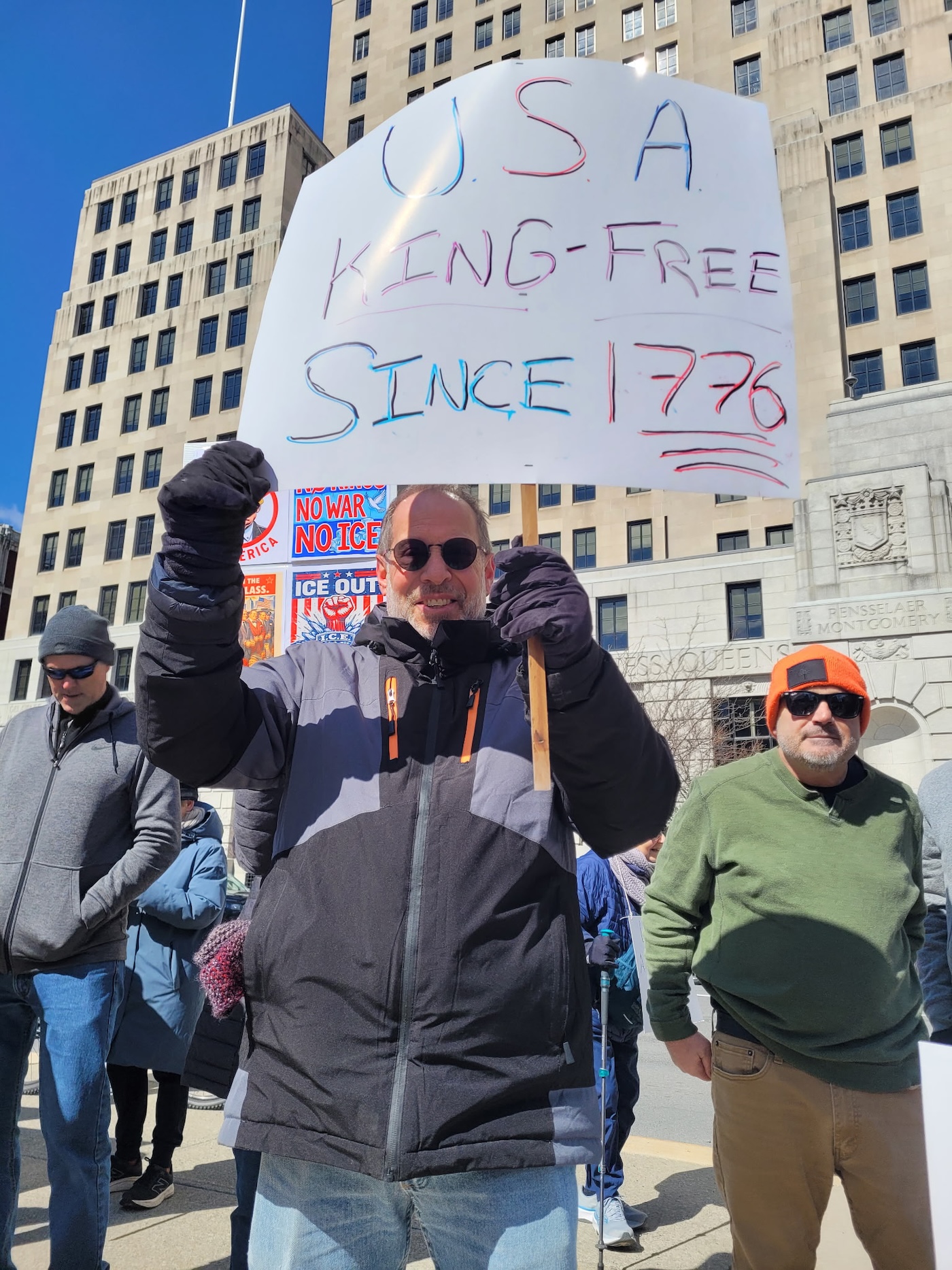
And that’s me right now.
I hope you are well, that the onset of spring brings you joy, and that you have a wonderful week.
 Until Pete Rose came along. For those you who don’t know the name, Rose was one of baseball’s biggest stars in the 1960s and 1970s. A winner of the Rookie of the Year Award in 1963 and the Most Valuable Player award a decade later, he was a key figure in the Cincinnati Reds’ dynasty of the mid-70s. He won several batting titles, finished his playing career as the Major League’s career leader in hits (as well as in games played and at bats), and was a shoe-in to be inducted into the Hall of Fame in his first year of eligibility.

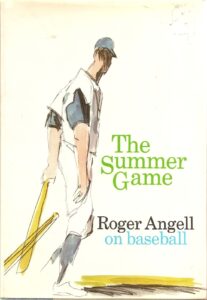 Beginning in 1962, and continuing through most of the next sixty years, Angell wrote about baseball, contributing articles to The New Yorker a couple of times each season, usually once during spring training, and once at the end of the World Series. Some seasons he added a mid-season essay. His articles were later collected in volumes — The Summer Game (1972), Five Seasons (1977), Late Innings (1982), Season Ticket (1988), and Once More Around the Park (1991). I own all of them, and have read them multiple times.
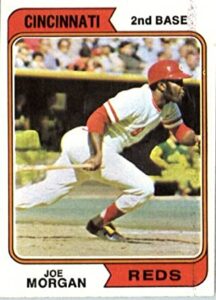 “Aha!!” I was able to reply. “What about Joe Morgan? Two time Most Valuable Player, perennial All-Star, World Series champion. He’s five foot seven!” Besides, I assured them. I didn’t expect or need to be six feet tall. I would be perfectly happy with five foot ten, like my hero, Roy White.
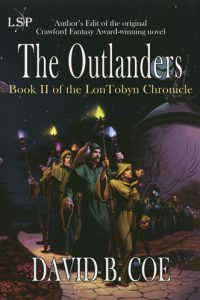 Favorite of My Books: The most recent one I’ve written, almost always. Which is a copout, I know. Invasives, the second Radiants book, comes out in February, so it is the most recent I’ve written, and it is my current favorite. But in another way, my favorite is probably The Outlanders, the second book in my LonTobyn Chronicle, and my second novel overall. Why? Simple. When I began my career, I knew I had one book in me, but I didn’t know if I could write for a living. Upon finishing The Outlanders, I realized it was better than my first book, Children of Amarid, a book of which I was quite proud. It was much better, in fact. And I understood then that I was not just a guy who wrote a book. I was an author. I could make a career of this.