








Dispensing writing advice when one is struggling a bit with one’s own work can be somewhat strange. Just ask . . . well, me.
I am more than 50,000 words into my current work-in-progress, the third book in my Celtic urban fantasy. (No, you haven’t missed any releases. Book I is in production and should be out later this year or early in 2023.) Some days, the writing comes smoothly and other days it’s a struggle. And, of course, I am closing in on the dreaded 60% mark, so at that point all bets will be off.
Over the past few years, I’ve offered advice on dealing with a whole host of problems. Stuck at 60%? Distracted? Unable to get started? Unsure of how to finish? Check the archives of this blog. Chances are, I’ve got some post somewhere that tells you how I have addressed the issue. All the posts are well-meaning. Some of them might even have helped someone somewhere at some point.
Sometimes, though, there is no cure. Sometimes the only way past the struggle is through the struggle.
I am not at my best right now, for any number of reasons. And I am doing all I can to write despite distractions small and large, personal and national, serious and foolish. Writing, though, is messy. Writing is not one smooth, free-flowing creative process that starts when we type “Chapter One” and completes itself when we type “The end.” (And just an aside here: Writers shouldn’t have to type “The end.” If we need to tell our readers when the story has ended, we haven’t done a very good job ending it. Just saying.)
Writing, as I have said too many times before, is really hard. Writing is fits and starts. It’s three steps forward and two steps back. It’s write, revise, delete, write some more, delete some more, write some more, revise some more, etc., etc., etc.
And here’s the thing. Or here are the two things. First, anyone who has ever devoted any meaningful portion of their life to writing knows this already. And second, everyone who has ever known this, has promptly forgotten it the moment they start their next book.
Because we want it to be free-flowing, smooth, easy, linear. We want it to be painless. And why wouldn’t we? Who in their right mind says, “I’m going to write a book and I hope it comes within a hair’s breadth of killing me?” Then again, who in their right mind says, “I’m going to write a book…?”
But I digress.
In all seriousness, we want the process to be simple, and so we forget what it’s like to be in the throes of creating. Every book I have written has been a struggle at one point or another. Some are worse than others, but every one has its moments. I’ll struggle with plot points, argue with my characters, second-guess my world building. I’ll doubt that the book is any good, I’ll question whether I can even finish it, I’ll go through periods, sometimes weeks long, when I have to force myself just to sit down in front of my computer. Because I. Don’t. Want. To. Write.
Until I do again. And then all is well with the world, and the book seems pretty good. Better than that. It’s very good. Hell it’s one of my best — maybe even THE best thing I’ve ever done. And it will only ever be eclipsed by the next one.
Put another way, writers are head-cases. I know I am. And there’s a reason my writer friends are my writer friends, if you know what I mean.
You may be surprised to learn that there really is advice embedded in this hot-mess of a post. It’s simply this: Keep working. Writing is a battle, like any creative endeavor, like any endeavor at all that is worth pursuing. It frustrates us and exhausts us. It challenges us by striking at those places where we’re most vulnerable — our confidence, our sense of self-worth, our ability to stare failure in the eye and say, “Not today, motherfucker.” But that’s also the beauty of it. If it was easy, finishing a book wouldn’t feel so damn good. And it will feel good. Because you will finish your book.
Wishing you smooth-flowing prose, fast-moving plots, and characters who surprise and delight you.






 I have to confess that I don’t remember when I first met Wayne McCalla.
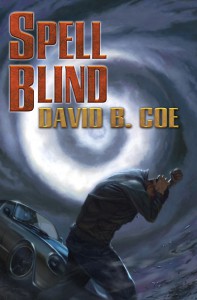 About seven years ago, I received out of the blue, an email from the actor Bronson Pinchot, who is probably best known for playing the role of “Balki” in the sitcom Perfect Strangers. He was, by then, enjoying a successful career as a voice actor, and he was writing to me because he was about to return to the studio to begin recording his reading of the second Justis Fearsson book, His Father’s Eyes. He wanted to know what I had thought of his treatment of the first book in the series, Spell Blind, and if there were things I wanted him to do differently with the second book.
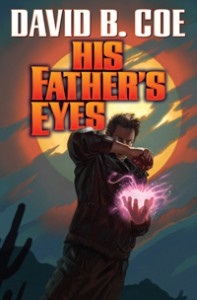 I was thrilled to get the email, and also impressed by the care he was taking with my books. But I wasn’t really able to give him the feedback he was after. “I have heard great things about your performance from friends, as well as from online reviews,” I told him. “I’ve listened to the sample on the Audible site and very much like your take on the character’s voice. The truth is, though, I am incapable of listening to others read my work. It has nothing to do with your performance, or any one else’s, for that matter, and everything to do with hearing the flaws in my own writing, which I find excruciating.”
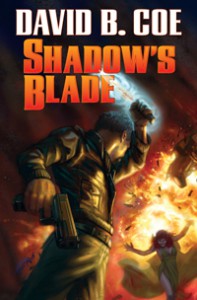 As it happens, I have from Audible the MP3 CD of the third and final book in the original trilogy, Shadow’s Blade. Since I also had in my immediate future two seven-hour drives, I thought I would go ahead and listen to the book. How bad could it be, right? Even if I hated what I heard (to reiterate, I wasn’t worried about Pinchot’s performance, but rather my writing), I could take solace in knowing that I was now seven years and at least eight novels more experienced than I was when I wrote the book.
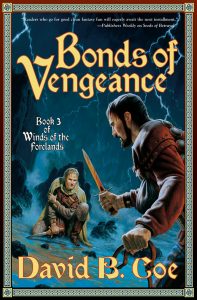 Many years back, while I was working on one of the middle books in my Winds of the Forelands quintet, my second series, I came downstairs after a particularly frustrating day of writing and started whining to Nancy about my manuscript. It was terrible, I told her. There was no story there, no way to complete the narrative I’d begun. The book was a disaster, and I might well have to scrap the whole thing.
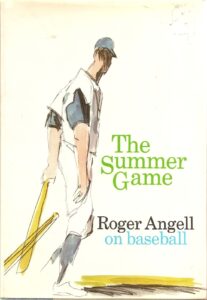 Beginning in 1962, and continuing through most of the next sixty years, Angell wrote about baseball, contributing articles to The New Yorker a couple of times each season, usually once during spring training, and once at the end of the World Series. Some seasons he added a mid-season essay. His articles were later collected in volumes — The Summer Game (1972), Five Seasons (1977), Late Innings (1982), Season Ticket (1988), and Once More Around the Park (1991). I own all of them, and have read them multiple times.