








As I discussed at length in last week’s Professional Wednesday post, I have recently completed a first draft of the third book in my contemporary Celtic urban fantasy, The Chalice Wars. The novel needs to sit for a while before I can do a final revise-and-polish and send it off to my editor — six weeks or so, I would think. And since the first book has not yet been copyedited and proofed, since the second book still needs to go through a round of revisions and then the entire production process, and since the third book is still wet behind the ears, I have plenty of work left to do on this series.
Thanks to the successful Kickstarter campaign Zombies Need Brains ran late in the summer, I also have a new anthology, Artifice and Craft, to co-edit with my good friend Edmund Schubert. We already have more than 150 submissions for the anthology, so that work is bound to keep me busy through the end of the year and well into 2023. I also have a short story to write for one of the other anthologies, and I have editing clients in my free-lance business queue.
But beyond the short story, which should only take me a week or two to complete, I have no idea what I am going to write next. None.
Yes, I have ideas. Many.
What are they? Funny you should ask.
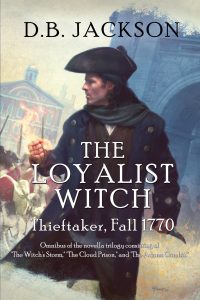 One idea is to write my next Thieftaker novel, either in the form of a trio of novellas, like I did with The Loyalist Witch, or as a simple novel. In the Thieftaker novel timeline, the Revolutionary War hasn’t even started yet. There is lots and lots more I can do with Ethan and Kannice and Sephira.
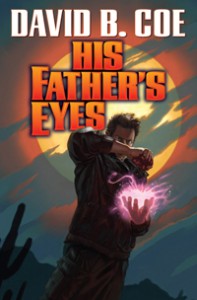
I have also considered going back to the Case Files of Justis Fearsson series, another contemporary urban fantasy that I began in the mid 2010s with Spell Blind, His Father’s Eyes, and Shadow’s Blade. I LOVE these books and have missed writing in Justis Fearsson’s world. I have several ideas brewing for that world.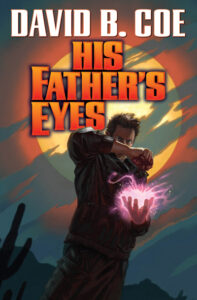
I have long wanted to return to my five book Winds of the Forelands series and the Blood of the Southlands trilogy, to revise and re-release those eight novels. They are among my best stories, and they have been out of print for far too long. I envision an “Author’s Edit” re-issue, along the lines of what I did with the LonTobyn Chronicle back in 2016.
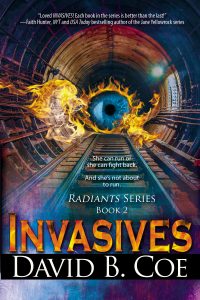 I want to write at least one more Radiants book. Actually, I would like to write several more. Radiants and Invasives are, to my mind, the two best books I’ve written to date, and I still would love to see these books gain come commercial traction so that I can justify writing more of them.
And then there are the new ideas . . .
I have one idea for a space opera series (yes, you read that right), set on a pair of terraformed planets. The plot involves intrigue, mystery, romance, and vengeance, and it is actually based on the work of a well-known, much-beloved, and for-now-secret 19th century novelist. I’m excited about this one. (Actually, I’m excited about all these ideas, which is why I’m considering them in the first place.)
I have a middle grade novel that I first wrote back in 2010 or so, when my kids were much younger. The idea still sings to me, though I know the book needs a good deal of work. But I love the concept and I adore the characters. And I think I would enjoy writing for kids.
My good friend A.J. Hartley has been trying for years to get me to write a non-fantasy, non-supernatural, straight-ahead thriller. He thinks I’d enjoy it. He thinks I’d be good at it. And I will admit I have some ideas percolating along these lines as well. Of all the projects I’m thinking about, this one probably has the most commercial potential, which is not the only consideration, but I do this for a living, so . . . .
And finally, I have considered taking all the Professional Wednesday and Writing Wednesday posts I have written since 2020 and collecting the best of them in a new writing how-to book. I have more than enough material, and I think some people would like to see the advice I have offered gathered in a single, convenient volume.
So there we are. Those are the things I’m thinking about right now. (I should add that I can’t guarantee I won’t have five more ideas tomorrow.)
What ideas appeal to you? Feel free to Tweet at me, or to comment in my Facebook Group! I look forward to hearing your thoughts.
In the meantime, keep writing!
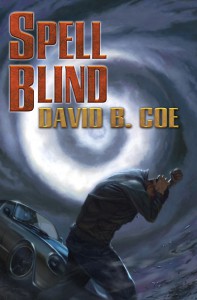 About seven years ago, I received out of the blue, an email from the actor Bronson Pinchot, who is probably best known for playing the role of “Balki” in the sitcom Perfect Strangers. He was, by then, enjoying a successful career as a voice actor, and he was writing to me because he was about to return to the studio to begin recording his reading of the second Justis Fearsson book, His Father’s Eyes. He wanted to know what I had thought of his treatment of the first book in the series, Spell Blind, and if there were things I wanted him to do differently with the second book.
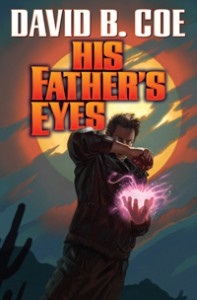 I was thrilled to get the email, and also impressed by the care he was taking with my books. But I wasn’t really able to give him the feedback he was after. “I have heard great things about your performance from friends, as well as from online reviews,” I told him. “I’ve listened to the sample on the Audible site and very much like your take on the character’s voice. The truth is, though, I am incapable of listening to others read my work. It has nothing to do with your performance, or any one else’s, for that matter, and everything to do with hearing the flaws in my own writing, which I find excruciating.”
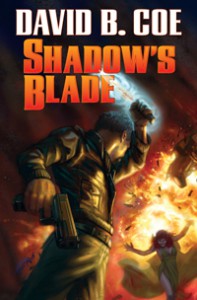 As it happens, I have from Audible the MP3 CD of the third and final book in the original trilogy, Shadow’s Blade. Since I also had in my immediate future two seven-hour drives, I thought I would go ahead and listen to the book. How bad could it be, right? Even if I hated what I heard (to reiterate, I wasn’t worried about Pinchot’s performance, but rather my writing), I could take solace in knowing that I was now seven years and at least eight novels more experienced than I was when I wrote the book.
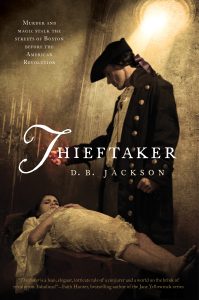 I would love to be a bestselling author. And with each new project I take on, I wonder if this might finally be the literary vehicle that gets me there. Thieftaker, Fearsson, the time travel books, the Radiants franchise. I had high hopes for all of them. All of them were critical successes. None of them has taken me to that next level commercially. So does that mean I should give up?
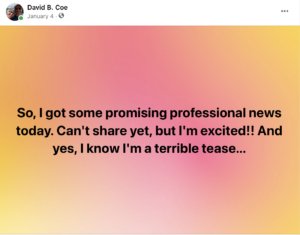 Nearly two months ago, early in the new year, I posted on social media that I had some exciting professional news I couldn’t share quite yet. I was thrilled, and wanted to let people know. But I also didn’t want to say anything before all the details had been settled. So I posted my little teaser, forgetting the one immutable rule of the publishing business: Things always happen slower than one thinks they will.
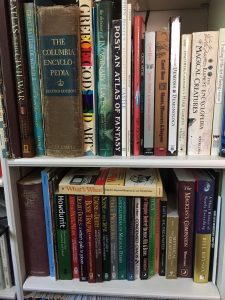 These are books I turn to again and again during the course of my work, and I expect the writer on your list will do the same. Not all of them are easy to find, but I assure you, they’re worth the effort. So here is a partial list:
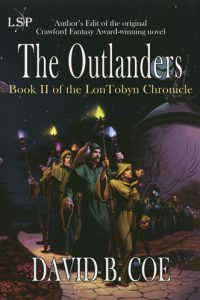 My first book, Children of Amarid, was a fairly standard epic fantasy, though it had the seeds of more within the nuances of its plot. It was my second novel, though, The Outlanders, that convinced me I could succeed as a writer. The reason was, that second book was different. It introduced a technological, crime-ridden world unlike anything I’d ever tried writing. It created an unusual dynamic among three of my lead characters — two of the characters, who were allies, spoke different languages, and they had to rely on the third for translation. But neither of them trusted that third character.
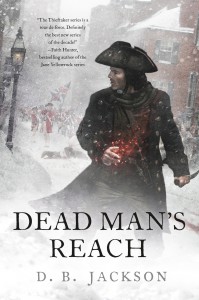 Still, I can say this: It’s easy to grow attached to one particular franchise, one particularly world and set of characters and style of story. Certainly I have written a good deal in the Thieftaker world, and will soon be coming out with new work about Ethan Kaille, Sephira Pryce, et al. The fact is, though, each time I have moved on to a new project, I have tried (admittedly with varying degrees of success) to challenge myself, to force myself to grow.
 After the LonTobyn books, I moved to Winds of the Forelands and Blood of the Southlands, which demanded far more sophisticated world building and character work. After those, I turned to Thieftaker, adding historical and mystery elements to my storytelling and limiting my point of view to a single character. I also started working on the Justis Fearsson books, which explored mental health issues and were my first forays into writing in a contemporary setting. Then I took on the Islevale books, time travel/epic fantasies that presented the most difficult plotting issues I’ve ever faced.
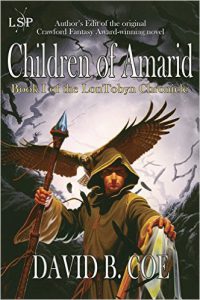 Let’s start with what I mean when I speak of multiple point of view characters. This is NOT an invitation to jump willy-nilly from character to character, sharing their thoughts, emotions, and sensations. That is called head-hopping, and it is considered poor writing. Rather, writing with multiple point of view characters means telling the story with several different narrators, each given her or his own chapters or chapter-sections in which to “tell” their part of the story. When we are in a given character’s point of view, we are privy only to her thoughts and emotions. In the next chapter, we might be privy to the thoughts of someone else in the story. This is an approach used to great effect by George R.R. Martin in his Song of Ice and Fire series. Martin goes so far as to use his chapter headings to tell us who the point of view character is for that section of the story. Guy Gavriel Kay uses multiple point of view quite a bit – in Tigana, in his Fionavar Tapestry, in many of his more recent sweeping historical fantasies. I have used it in my epic fantasy series – The LonTobyn Chronicle, Winds of the Forelands, Blood of the Southlands, The Islevale Cycle.
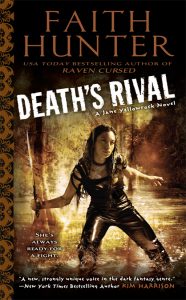 This is in contrast with single character point of view, in which we have only one point of view character for the entire story (and that point of view can be either first or third person). Think of Haith’s Yane Jellowrock series, or my Thieftaker or Justis Fearsson series, or Jim Butcher’s Harry Dresden books, or Suzanne Collins Hunger Games series, or even (for the most part) J.K. Rowling’s Harry Potter books.
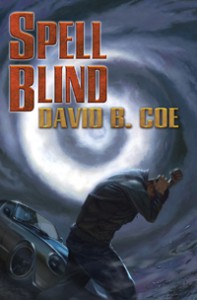 For single character point of view we have essentially two kinds of books: urban fantasies that have a mystery element, and YA novels that concentrate as much on the lead character’s emotional development as on external factors. Single character POV tends to be intimate. Readers form a powerful attachment to the narrators of these books. And, of even greater importance, readers learn things about the narrative at the same time the characters do. Even in books that begin with our narrator looking back on past events, we are soon taken back in time so that this older narrative has a sense of immediacy. This is why single character POV works so well in mysteries. The reader gets information as the “detective” does. Discovery happens in real time, as it were.