








Last week, I kicked off the latest Professional Wednesday blog post series, “My Best Mistakes,” with a humorous story about my behavior at a convention early in my career. I hope you enjoyed it.
This week, I turn to more serious matters, because the fact is certain mistakes can have serious consequences for our careers. Before I begin, let me reiterate something I wrote in last week’s post: Some of the stories I tell in this series of posts will include other people in the business and/or will touch upon published works of mine that I am still seeking to market. In the interest of discretion, I will be keeping some details purposefully vague.
The events I’m going to describe took place many years ago, as I was putting the finishing touches on one of my early epic fantasy series, and I was looking forward to my next project or projects. This is common for writers even today. We are often a book or two ahead of the publishing schedule, particularly if we publish traditionally. And so as we are waiting for the last book or two of a series to wend its/their way through the production process, we are usually turning to the new shiny. And this was especially the case back in the years I’m talking about here, when self-publishing was not yet a Thing, and big-house traditional publishing was excruciatingly slow.
I had recently met a small press publisher at a convention, and this person expressed interest in publishing my next work. This publisher was ambitious, articulate, charming, and seemed to know the business. Put another way, they talked a good game. They had some big name authors writing for them already and they made it very clear they wanted to add me to that mix. It was flattering really, and they probably knew it.
To that point in my career, I had only written for Tor Books. Tor was and is a great house. Their reputation is global, as is their marketing reach. They brought me out in hardcover with all of my early books, as they did almost all their writers. They put out a beautiful product, they took out big, glossy ads in Locus and the Science Fiction Chronicle. They hosted THE big party at WorldCon each year. There was, in short, a certain cachet that came with being a Tor author. And I liked that. On the other hand, even as my star was rising early in my career, I remained a small fish in the big pond that was Tor.
And so, being a relatively big fish in the pond of this small publisher had some appeal. Add to that the fact that this publisher offered to match or beat the numbers in my most recent contracts with Tor, which had been generous, and I was eager to give working with this person a try. Never mind that all of it sounded too good to be true. I wanted in.
I signed a contract for several books. And if the publisher needed a little extra time to come up with the promised advance . . . well, it was a small press after all. It was understandable, right?
No, not right. That was our first warning that all was not as it should be, although it shouldn’t have been.
So far, I have made it seem the only problem with the contract I signed was that the small press publisher couldn’t do all they promised financially. But there was more to this episode than that. The books I sold them weren’t ready either. The concept needed a ton of work, something I didn’t realize at the time, didn’t WANT to realize at the time. But it’s true. I would later publish a much-changed iteration of this concept with a different publisher, but back in the mid-2000s, when all of this took place, the books were a shadow of what they could and should have been. The publisher’s failure to see the flaws in the original concept should have been a warning as well.
All of that said, I eventually did get my initial advance, and I eventually turned in the first book. When I got it back from the publisher, who was now also my editor, the manuscript was very nearly unmarked. “Looks great. Found a few typos and phrases that don’t quite work. Get the revisions back to me as soon as possible.” That’s a paraphrasing of the feedback I received, but it’s an accurate one and it set off alarm bells in my mind. I knew the book needed more. I didn’t yet know how much work it needed, but I knew it wasn’t essentially publication-ready. As it turned out, this was another sign that my publisher’s resources — financial, yes, but also in terms of time and human resources — were spread way too thin.
Within eighteen months of my signing the contract, the small press was on the brink of bankruptcy. We managed to get back the rights to the series, but only because my agent and I acted quickly and decisively. The series could have gotten caught up in the bankruptcy proceedings and then we might never have been able to sell the later iteration of the books to a different publisher. The publishing company folded not too much later. As far as I know, the publisher/editor I worked with briefly is no longer connected to the publishing world.
So, what are the lessons here? Let me start by saying that the lesson is NOT to avoid working with small presses. I have worked with several in recent years and, with one other notable exception, have had great experiences. Small presses are, to my mind, the future of the industry and a wonderful option for writers of every experience level.
No, the lessons are these:
1) If the promises made to you by a publisher (or, for that matter, by an agent) sound too good, too optimistic, too perfect, take a long, close look at the contract and at all the information you can find about the enterprise. Talk to other authors who have worked with them. Learn all you can. We all like to be told what we want to hear. We all want to feel wanted by our publishers. But flattery and rosy scenarios are no substitute for solid information. Because the old adage holds true: If it seems too good to be true, it probably is.
2) Don’t rush into anything. Don’t rush to get that first contract signed, unless you’re truly confident you’re a good match for the publisher. Don’t rush to bring a book or series to press unless you’re certain it’s ready. Don’t hurry into any publishing arrangement because you need the money quickly. Actually, that’s probably good advice for any business venture in any field. But it’s particularly important when we’re peddling our intellectual and creative property. If we rush into selling, say, a car, we might not get as much as we should. But if we rush into a publishing contract we can lose access to our artistic creation. If my agent and I had waited another month or two, that’s what would have happened with this series of books. Better to be patient. Better to delay the realization of our ambitions than to destroy any chance of realizing them.
And 3) Beware, beware, beware. The vast majority of the people I know in the publishing industry — writers, editors, agents, publishers — are honest and hardworking. They are in the business because they’re passionate about books and stories, and they want to do good by the people with whom they work. But there are a few — yes, I could drop names; I won’t — who are in it to make a buck, and don’t care who they hurt along the way. There are others who through malign intent or sheer incompetence seem to turn to shit everything they touch. Before you sign to work with anyone, make certain you know what category they fall into.
Keep writing!
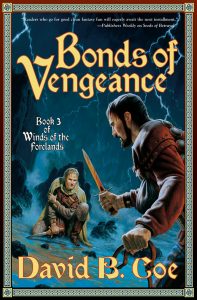
 What matters to me? Professionally, for this coming year, a few things. I have a series debuting in February. I want to promote the hell out of it. I want to feel at the end of the release windows — the weeks immediately preceding and following the releases of the three books — that I have done all I could to make the series successful. I also have an old series that I want to re-release. I’ve been talking about doing this for several years now, and each year I have found other projects to take up my time and energy. But this series, Winds of the Forelands, is one about which I am passionate. This is the year I bring it out again. It matters to me. And I want to start something new, a series that will take me in a new direction, I have resisted starting it for a couple of years, I believe because I am intimidated by the magnitude of what I’m taking on. It’s time to get over my hesitation.
 What about you? I’m not merely asking what you wish to accomplish, though obviously that’s part of the equation. I’m asking as well what you care about. Sure, maybe you want to be published — or at least contracted — by year’s end. That’s a laudable goal. But what project will get you there? What story is burning brightest inside you? What work will bring you joy? What project is most likely to tap into your greatest creative passion? That ought to be part of the equation as well.
 So far, we have received some very good stories. We have also received far, far more that won’t make the first cut. And so I thought I would go over again, briefly, the things that can make or break a story submission, at least for this editor.
 Will I reject a story simply because it is single-spaced instead of double-spaced? No, I’m not quite that mean. But when reading a story, knowing I have literally dozens more waiting in the queue, I will only tolerate so many flaws before I reject it. Remember, I have 500 stories to choose from. I can and will find what I’m looking for. No story is ever perfect, so ask yourself, do you want to expend one of your flaws on formatting? Or do you want to present your story correctly so that I can judge it on its artistic merits? The answer seems self-evident to me.
 1) I abhor the cliché, but think outside the box. As
  I first met Joelle Presby several years back at a convention, and I was struck straight off by a number of things. 1) She’s just plain nice. That’s certainly not unheard of in the publishing world, but it’s also not routine. Many people are in the game for themselves. Others pretend to me something other than what they are. Not Joelle. She is genuine, kind, funny. 2) She is also crazy smart. Read her bio. Read her post. She is SMART. And 3) Everyone I talked to at that convention who was familiar with her work had come to the same conclusion: She was a rising star. A few years later, she continues to dazzle with the release of her first solo novel.
 We were both naval officers in the nuclear power pipeline, trained in engineering and managing complex technical projects, but my degrees were in math and his were in physics and spacecraft design. I got sick (nothing terminal) and had to accept a medical discharge. But my next job required fewer hours, so I could write more. And we could attend science fiction conventions and meet up with authors as long as I did the arranging and accepted that Andy might be at sea. Conventions were a lot more fun when Andy came too. Science fiction authors tend to be significantly more interested in chatting with folks who have space craft engineering backgrounds than talking to another would-be writer who happens to have only a math and engineering background.
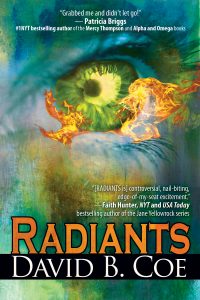 My editor at Belle Books is a woman named Debra Dixon, and she is a truly remarkable editor. This first book in the Celtic series is our third novel together, after Radiants and Invasives. In our time together, I have never once felt that her responses to my work were intrusive or unhelpful. With each book it’s been clear to me that her every observation, every criticism, every suggestion, is intended to help me tell my story with the greatest impact and in the most concise and effective prose. A writer can’t ask for more. This doesn’t mean I have agreed with every one of her comments. Now and then, I have felt strongly enough about one point or another to push back. And she’s fine with that. That’s how the editor-writer relationship is supposed to work, and she has always been crystal clear: In the end, my book is my book. But even when we have disagreed we have been clear on our shared goal: To make each book as good as it can be.
 My struggle right now is simply this: Her feedback on this first book is quite extensive and requires that I rethink some fundamental character issues and cut or change significantly several key early scenes. And she’s right about all this stuff. No doubt. This first book has been through several revisions already, and the second half of the book — really the last two-thirds of the book — just sings. I love it. She loves it. The first third is where the problems lie. To be honest, the first hundred (manuscript) pages of this book have always given me the most trouble. I wrote the initial iteration of the book more than a decade ago, and in some ways those early chapters still reflect too much the time in which they were written. They feel dated.