








Dear Younger Me,
Yes, that’s really our hairline now. Calm down. It’s not— Would you please calm down? Thank you. What did you expect? Seriously. Dad was bald. Bill and Jim had lost their hair by the time they were thirty. You thought we’d make it through middle age with hair like George Clooney’s? We didn’t make it through middle age with ANYTHING like George Clooney’s. On the bright side, our beard finally filled in, so there’s that . . . .
But this isn’t about how we look, thank goodness. This is a letter to you, my younger self, about other things I wish I had known when I was your age (whatever age that might be exactly). So read on, Younger Me, and if you happen to run across a time machine at some point, remember this stuff, okay?
Let’s start with this, because really nothing is more important: You know how you feel most of the time that you’ll always be alone, that you’ll never meet the right person? Well, I can assure you, you won’t be and you will. She is brilliant, caring, funny. She shares many of your interests and, more important, she shares your values. She is strong and insightful, charming and generous. And . . . What’s that? Yes, she actually loves you. I know: I couldn’t believe it either.
What?
[Sigh]
Yes, Younger Me, she’s also hot.
And together, we have two brilliant, strong, funny, beautiful daughters. You will be blown away.
More good news — and we can discuss this more on Wednesday: You will have that writing career you’ve been dreaming of since you were six. There will be a few detours along the way, some bumps and bruises. It won’t be exactly the career we imagined; it might not reach the heights to which we’ve aspired. But it’s our career. We made it, we sustained it (with the support and encouragement and love of the aforementioned life partner and children), we earned it. We should be proud of it.
Don’t know if you can do much about his one, but I should mention it — if, around 1993 or so you have a chance to get the rookie card of a Yankee prospect named Derek Jeter, go ahead and pick one up. Or ten. Or fifty. Slide it (them) into a nice plastic sleeve for protection and put it (them) away. Trust me, you’ll be glad you did.
You know those episodes we go through, and have since we were little — nausea, shaking hands, extreme ill-defined terror? Those aren’t normal. I know Dad used to tell us he experienced them, too, and he might well have been telling the truth. But that doesn’t mean they were routine or natural. He meant to reassure. He loved us and wanted to help. But by normalizing them, he kept us from doing something about them at a younger age. Along the same lines, you know how for so very long we brushed off our tendency toward unexplained worry and stress, saying that we were “high strung,” or some such? Turns out, that’s not high strung.
We have Generalized Anxiety Disorder, and we have Panic Disorder. And we didn’t need to suffer with either for nearly so long. Do something about them. Soon. Please. For our well being. Friends have encouraged us to try therapy. I finally did when we were 58. I wish we’d done it forty years sooner.
For your sake and mine, please work harder at the guitar. Yes, we still play. Yes, I’m better than you are, which is as it should be. But with work and practice, with less laziness and self-satisfaction, we could have been so good. I can’t have expected us to work at guitar the way we did at writing — one was a hobby, the other a profession — but a bit more work would have brought us such joy.
Never ever ever take your car to Toyota of Palo Alto. Just don’t.
Look at your book shelf, the one with all the fantasy novels on it. You’re going to wind up meeting nearly every author represented there. Many of them will become good friends. Yes, including Guy Gavriel Kay. Pretty cool, right?
Spend as much time as you can with Mom and Dad. Be as tolerant as you can be of Bill’s flaws and idiosyncrasies. Love them. Cherish them. We won’t have nearly as much time with them as we deserve, and we will miss them every day for the rest of our lives. I know, Mom and Dad can be annoying now and then, and occasionally Bill infuriates us. They’re family, and sometimes family is like that. But the hole their absence leaves in our life dwarfs these temporary frustrations. Extend to them the grace and forgiveness you would want from all those we love.
Those amazing friends we made at Brown, the ones who enriched our life there and made it the most memorable time of our early life? Yeah, they’re still our dear friends, still enriching our life. Treasure them.
The rest is pretty much common sense. Dial back the weed — we will later anyway; might as well preserve a memory or two. Don’t drink too much — you don’t hold your booze as well as you think you do. Exercise. Eat right. Take care of yourself. Life is precious, and we don’t want to miss a thing. Read more. Yes, we read a good deal. Read more. Trust me. No one ever looked back from the vantage point of their dotage and thought, “I wish I’d put all those books aside and watched more TV.” Be good to the people we love. Slow down and savor all those things we enjoy doing. Let go of grudges and jealousy and regrets. They do us no good.
Oh, and along the lines of that Derek Jeter thing — those people at Apple who early on made all those weird-looking, quirky computers? Turns out they were on to something. If you get a chance, buy a few shares . . . .
Best wishes,
Older David
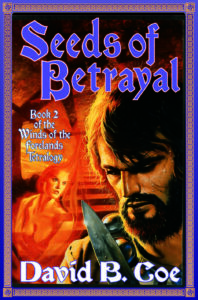
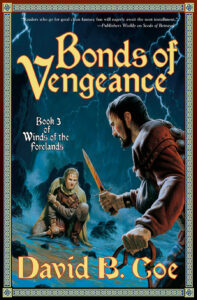
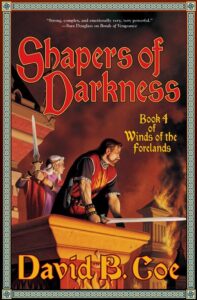
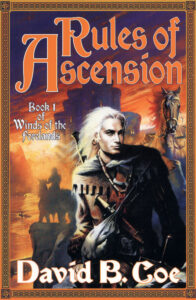 I continue to read through and revise the books of my Winds of the Forelands epic fantasy series, a five-book project first published by Tor Books in 2002-2007. The series has been out of print for some time now, and my goal is to edit all five volumes for concision and clarity, and then to re-release the series, either through a small press or by publishing them myself. I don’t yet have a target date for their re-release.
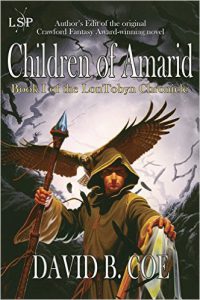 We are often our own most unrelenting critics. This is certainly true for me in other elements of my life. I am hard on myself. Too hard. And, on a professional level, I am the first to notice and criticize flaws in my writing. So reading through old books in preparation for re-release is often an exercise in self-flagellation. It was with the LonTobyn reissues that I did through Lore Seekers Press back in 2016. And it is again with the Winds of the Forelands books.
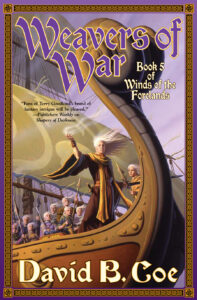 As I have read through this first book in the story, polishing and trimming the prose, I have rediscovered that narrative. I remember far less of it than I would have thought possible. Or rather, I recall scenes as I run across them, but I have not been able to anticipate the storyline as I expected I would. There are so many twists and turns, I simply couldn’t keep all of them in my head so many years (and books) later.
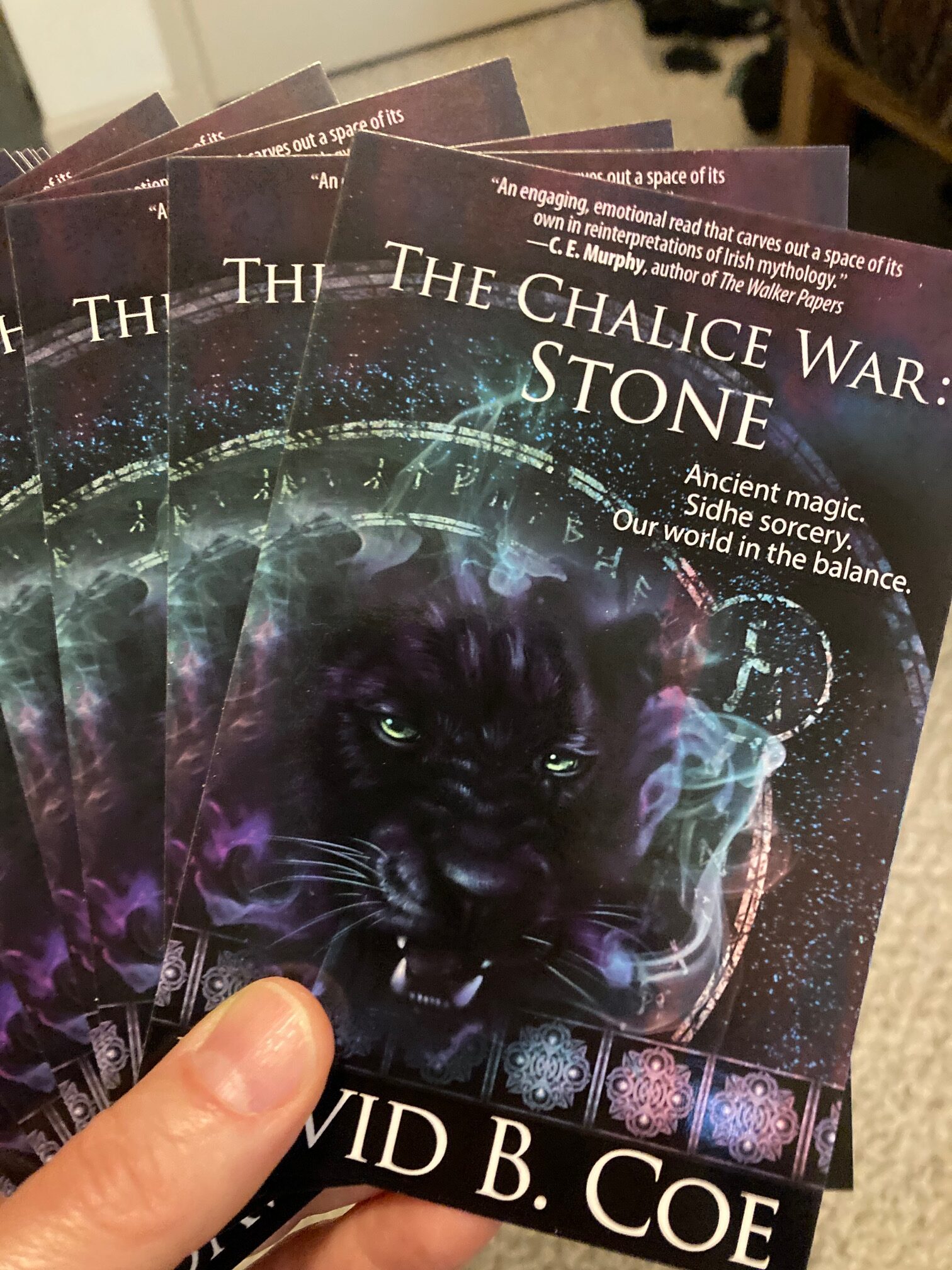 I gots swag!!!
 As I say, “trust your reader” is essentially the same as “trust yourself.” And editors use it to point out all those places where we writers tell our readers stuff that they really don’t have to be told. Writers spend a lot of time setting stuff up — arranging our plot points just so in order to steer our narratives to that grand climax we have planned; building character backgrounds and arcs of character development that carry our heroes from who they are when the story begins to who we want them to be when the story ends; building histories and magic systems and other intricacies into our world so that all the storylines and character arcs fit with the setting we have crafted with such care.
 And because we work so hard on all this stuff (and other narrative elements I haven’t even mentioned) we want to be absolutely certain that our readers get it all. We don’t want them to miss a thing, because then all our Great Work will be for naught. Because maybe, just maybe, if they don’t get it all, then our Wonderful Plot might not come across as quite so wonderful, and our Deep Characters might not come across as quite so deep, and our Spectacular Worlds might not feel quite so spectacular.
 Okay, yes, I’m making light, poking fun at myself and my fellow writers. But fears such as these really do lie at the heart of most “trust your reader” moments. And so we fill our stories with unnecessary explanations, with redundancies that are intended to remind, but that wind up serving no purpose, with statements of the obvious and the already-known that serve only to clutter our prose and our storytelling.
 I should have enjoyed last week. We had the release of The Chalice War: Stone, the first book in my new Celtic-themed urban fantasy. Lots of spring migrants (talking ’bout birds here) moved through our area of the Cumberland Plateau, so I had plenty of good bird sightings. The weather was cool and clear (mostly), and my morning walks were crisp and golden. As I say, it had all the makings of a fine week.
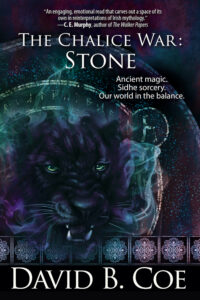 Another teaser, to get you excited for tomorrow’s release from
 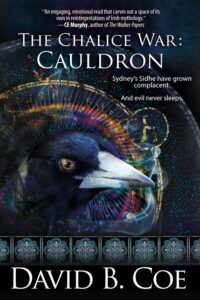 So, for about what you might give to a Patreon, you could have all the blog posts AND all three books in the new series.