 Right around the holidays, I was shouting from the virtual rooftops about my new Celtic urban fantasy trilogy, The Chalice War, which would be coming out early in 2023. The first book, I bellowed (virtually), would be coming out in February, and it would be called The Chalice War: Stone. It would be followed, a month or so later, by The Chalice War: Cauldron, and then a couple of months after that by the finale, The Chalice War: Sword.
So, about all that . . . .
Life happens. Lately it’s been happening to me. A lot. In this case, though, it happened to my editor/publisher at Bell Bridge Books, through no fault of hers, or really anyone’s.
The books are still coming. Really. Stone will be out in May. That’s the current plan. It will be followed a month or so later by Cauldron. Sword should be out by midsummer. The first book is ready to go. We have art; the manuscript has been revised, copy edited, polished to a high shine. We’re just scheduling it in a way that allows us to follow it quickly with Book II, which has now been through revisions and will soon be copy edited.
I apologize for the delay, but I assure you the books are on their way. And, as a way of thanking you for your patience, I offer another teaser from Book I. Enjoy!!
*****
While the woman’s heels still clicked on her walkway, Marti sensed a second source of power. The energy from this one was as turbid as the woman’s was clear, as tied to darkness as hers was wild. It took Marti several moments to spot this second presence, and when she did, she had to bite back a shouted warning.
A large animal—a cat of some sort from the look of it—crouched by the side of the woman’s house, partially concealed by the bushes growing there. It followed the woman with its eyes and the gentle swivel of its massive head, but it made no move to attack her.
Marti watched them both, motionless, holding her breath. The cat had to be a conduit, bound to a Fomhoire sorcerer. She swept the street with her eyes, not daring to turn her head, wondering if the sorcerer was close by or had sent the cat to scout. Or to hunt. If that last, was it after the woman or Marti herself?
After watching the cat for another few seconds, Marti convinced herself the creature was intent on her neighbor, not her.
For now, Marti had no access to her magic, and the stone was shielded. Power called to power, Alistar used to say. That cat—a panther by the look of it—would be drawn to a conduit as potent as itself, not to an unbound Sidhe sorcerer.
Marti stood smoothly, taking care not to make any sharp movements. She picked up the bottle and cup, tiptoed into the house, and locked and bolted the door. She lingered by the window, eyes on the cat. Her neighbor had made it inside; lights went on downstairs and, minutes later, on the second floor. Marti didn’t think the woman was in danger, at least not this night. But she had drawn someone’s interest, which promised to make Marti’s life even more complicated than it was.
After some time, the panther emerged from the bushes, padded out into the street, and with one last backward glance at the house next door, prowled off into the night. Marti remained at the window until the creature had reached the corner and trotted off of Fairlea.
Then she retrieved her protective herbs and stones, and went after it.
She understood the risks, but she wanted to find out who the cat belonged to. Having no conduit herself, and carrying the sachet and crystals, she didn’t think another sorcerer, even a Fomhoire, would sense her. Of course, having no conduit, if she was wrong about this, she would die.
She slipped back outside, locked the door behind her, and eased down the road. She made not a sound, kept to shadows, avoided the light that pooled beneath streetlamps the way she would patches of quicksand. At the corner, she caught a glimpse of the panther loping off the road into what appeared to be another yard.
Marti followed, and soon realized the cat had led her to the community playground she’d passed when driving in earlier. It was darker here; there were no streetlights or houses near the play area. But by the light of a half moon, she spotted two figures standing near the swings, one a good deal taller than the other.
The panther trotted to the shorter of the two, lay down at this person’s feet, and began to lick one of its paws. Marti crept closer, hoping to overhear something of value. She placed each foot with care, eyeing the ground in front of her for dry leaves, twigs, children’s toys—anything that might give her away. With fewer shadows here, she had to follow a line of trees—a less direct route than she would have liked. At one point, the cat raised its massive head and stared in her direction. She froze, deciding she had gotten close enough.
She couldn’t hear their conversation, but as her eyes adjusted to the darkness, she was able to see the two figures in greater detail. The cat had lain at the feet of a man. He had dark hair and wore dark slacks and a pale dress shirt. The other figure was murkier, as if obscured by a black veil. She couldn’t imagine why, at least not until it raised an elongated arm to point at something above them. Marti suppressed a cry.
The moonlight revealed a translucent membrane of flesh underneath its arm, broadest at the shoulder, tapering to the wrist. No wonder it appeared to swallow light; no wonder it was so freaking tall. A Sluagh.
With nightfall, the air had grown stagnant, but in that moment, the smell reached her and her stomach heaved. Decay, disease, death. Smells, she’d read somewhere, could kindle memories that transported a person to different times, different places. This stench carried her to the old house, to Alistar’s brutalized corpse in the garden, to Burl’s blood-matted carcass in the kitchen.
Marti searched the sky and street for more of the demons—they rarely traveled alone. She saw none, but that did nothing to put her mind at ease. She resisted the urge to run—if the demon didn’t hear her, the cat would. Either would kill her.
Indeed, if not for the Fomhoire and his cat, the demon would have found her already. The panther couldn’t sense her talent for magic because she didn’t have a conduit, but the Sluagh could. It hadn’t because—only because—the Fomhoire stood beside it, no doubt reeking of magic. She shuddered.
A moment later, matters grew far, far worse. The Sluagh pointed skyward again and let out a rasping screech that made Marti flinch. From above came two answering cries, as harsh and chilling as the first. Two more Sluagh circled over the playground, their wings luminous with moon glow, the webbing between their long legs making them look like huge swallows. They wheeled, swooped toward the ground, and pulled out of the dive at the last instant, cupping their wings like billowing sails and landing near the other Sluagh.
The cat scrambled to its feet and bared its teeth. The Fomhoire caressed his conduit’s head and said something to the creature. The panther nuzzled the side of his leg, but it kept its bright eyes on the Sluagh and remained standing. For his part, the sorcerer had shifted his stance so that he could watch all three of the demons. He had also edged away from them; he would be no more immune to the fetor than Marti was. Likely he had a spell at the ready, just in case. Sluagh might serve the Fomhoire, but they would prey on any magical creature.
She almost hoped they would turn on the man and his conduit. Almost. The problem was, when they finished with him, they would sense her magic, and have her for dessert.
The Sluagh didn’t linger for long. The Fomhoire and the first demon spoke for another few seconds before the three demons leapt skyward and soared off.
The sorcerer watched them go, absently petting the panther’s head. When the Sluagh had vanished from sight, he glanced around and left the playground.
He headed straight toward Marti.









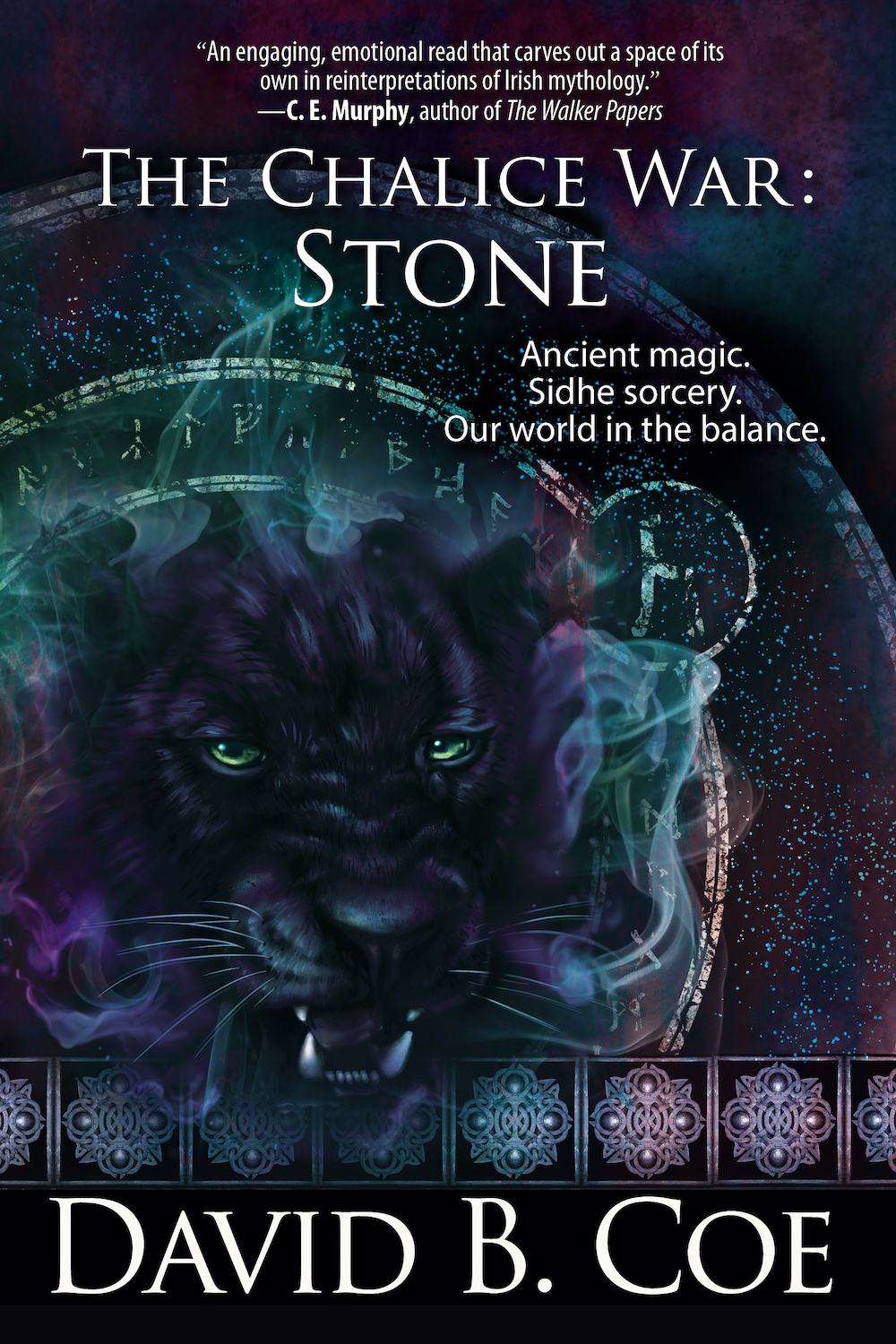 As I have mentioned previously, the release of the first book in my upcoming Celtic urban fantasy, The Chalice War (Bell Bridge Books), has been delayed. We had hoped for February. It will be May.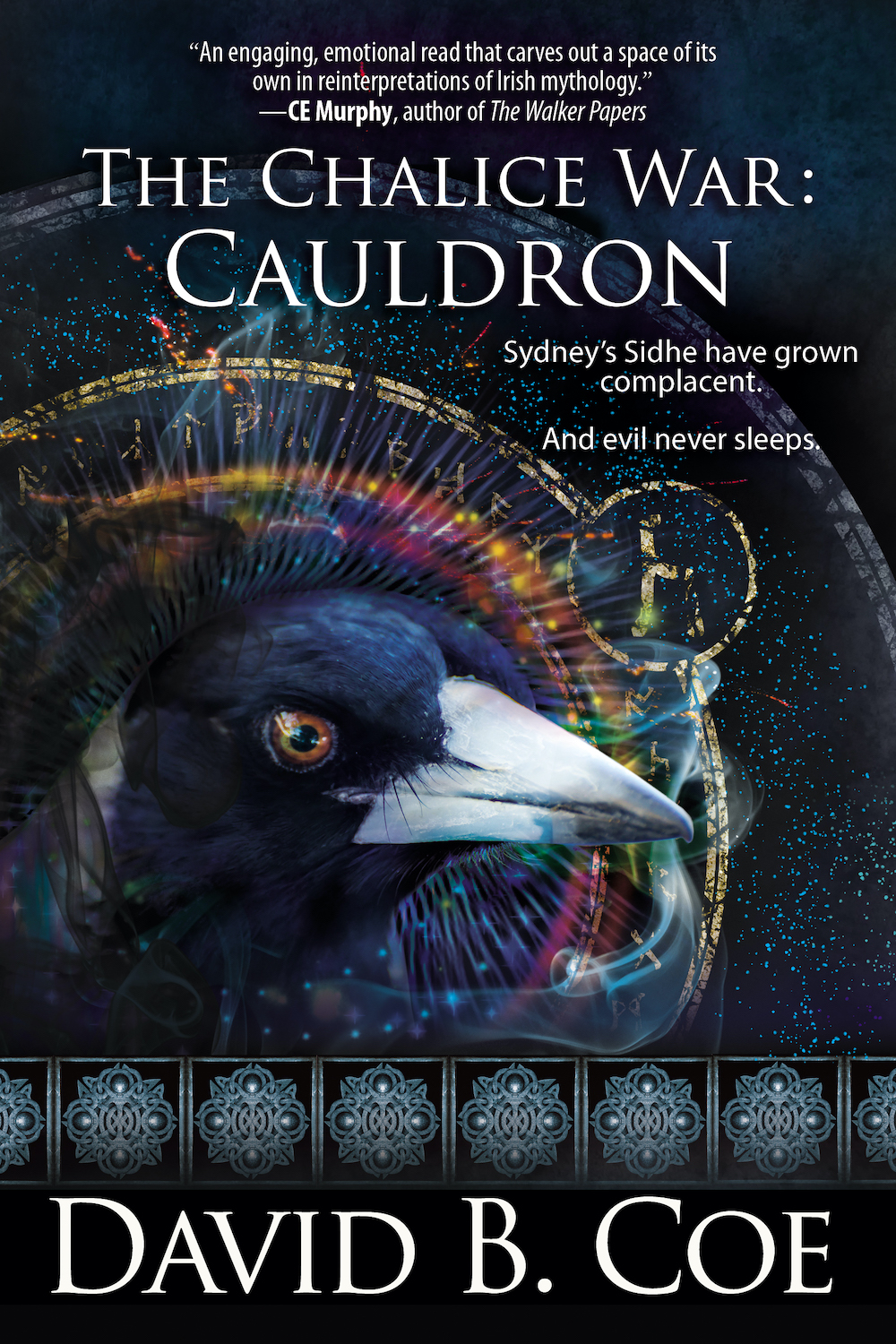
 I’ll preface this discussion with the obvious: I’m old. I’ve been in this business for a long time — it’s been nearly three decades since I signed my first contract. When I got started in the business, publishers were just beginning to expect that writers would maintain websites. Websites! Facebook and Twitter and the rest didn’t even exist. And when we signed contracts, writers could rightfully expect that our publishers would handle the bulk of the necessary publicity, which consisted mainly of taking out ads in journals, sending review copies to print magazines (kids, ask your parents) and other critical venues, setting up newspaper, radio, and television interviews, and arranging signing tours and individual store events.
 Blogging and social media are extras. Yes, in this day and age, they are important extras. Crucial, some might say. We have to publicize our books, or no one will buy them or read them. But as vital as this part of the job might seem, I would once again turn the previous phrase on its head: We have to publicize in order to be read? Yes, we do. But more important by far is this: We have to write the books in order for any of that publicity to be worth a damn.
 And I did. The book was Invasives, by the way. It contains the best character work I’ve ever done, and that is no coincidence.
 For the past several weeks, I have been sharing “My Best Mistakes,” which have included
 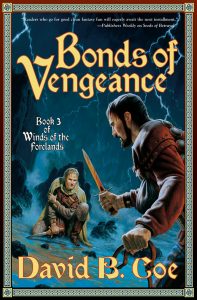 My first series, the LonTobyn Chronicle, did well. It won the Crawford Award as the best fantasy by a new author, and my sales grew steadily. Children of Amarid would eventually go through six printings. When I signed contracts for my second series of novels, Winds of the Forelands, Tor gave me significantly higher per-book advances.
 In 1976, I was thirteen years old. I couldn’t vote, obviously, but I could work for candidates I liked, passing out pamphlets and such. That’s what I did in my little (at the time) moderately conservative (at the time) hometown in suburban New York. I stood on street corners in the commercial district of our village and I handed out leaflets for the Carter-Mondale ticket. “Leaders For A Change,” they read. A message that resonated after Watergate and the hapless administration of Gerald Ford.
 Some years later, soon after the release of Spell Blind, the first book in The Case Files of Justis Fearsson, another Amazon reviewer panned the book because my book was “a blatant rip-off” of Jim Butcher’s Harry Dresden books, “a ludicrous case of copycatting.” For the record, I didn’t copy Dresden at all. I had only read the first two books of the series, and the “copycatting” the reviewer claimed I’d done amounted to using tropes of the genre, not elements of Butcher’s work. And so I responded to the review, wanting to set the record straight.