








Just keep swimming
Just keep swimming
Just keep swimming…
Yes, I am a Pixar fan. Sue me. My kids were the perfect age for the magical first generation of Pixar movies — Toy Story (1 and 2); Monsters, Inc., Finding Nemo, Cars (the first one) — and Nancy and I loved them, too.
But Dory’s little don’t-give-up song is more than cute and annoyingly catchy. It also offers a valuable lesson every writer should take to heart.
Today, I continue my “Most Important Lessons” feature, which I began a couple of months ago. In this installment I intend to give a few pointers about what we can do to keep ourselves moving forward in the middle of the slog that is novel-writing.
Because here’s the thing: We writers love to talk about the big events in our professional lives. We shout from the hilltops when we sign a contract or have a new book come out or complete a manuscript. Those are the golden moments, the ones we live for and love to celebrate. But, of course, those moments make up a teeny-tiny fragment of our professional lives. The achievements themselves are significant and worth marking, but they are fleeting and painfully brief. The vast majority of our time is spent working toward those milestones — slogging through the initial drafts of our books and stories, revising and reworking the manuscripts, marketing ourselves and our writing, developing new ideas, or maybe worrying about when we might have a new idea that’s worth a damn.
Of all of these, the first one — slogging through the initial draft of our manuscripts — might be the most difficult. I think it’s safe to say that’s the place where most nascent careers founder. And so that’s where I’m going to focus today.
How do we keep going? How do we avoid becoming one of those aspiring writers who has started ten books but finished none of them, or has started one passion project but stalled at about the 60% mark and cannot move forward from there?
Here are some strategies I have used over the years.
1. Set and internalize your own deadlines. As I mentioned a couple of weeks ago, I’ve been very fortunate throughout my career, and have sold several series to publishers large and small. That means I have often written to deadlines imposed upon me by my editors. But most writers in today’s market, even established professionals, have to write the first book in a series before they can sell the project, and so I have also written a lot of books that had no deadline, at least no official one (including Thieftaker, Spell Blind, Time’s Children, Radiants, and the first two books of the new Celtic urban fantasy I’m working on). The deadlines for those books are ones I gave myself. And I can tell you that writing to an external deadline is much easier than writing to a self-imposed one. When we miss an external deadline, we risk angering our editor, giving up our place in the publishing schedule, and even endangering our contract. When we miss a self-imposed deadline, there are essentially no consequences.
And so, we need to internalize our deadlines, to make them feel as real and absolute as the external ones. For me, the best way to do that is to map out my project schedule for an entire calendar year. “Jan. 1-April 15, work on Novel X. April 16-May 31, work on editing projects 1 and 2. June 1-September 15, work on Novel Y. Etc.” This way, missing that first deadline has the potential to set back my entire year. Suddenly, missing my own deadline puts something I care about at risk. These are still all artificial deadlines with artificial consequences, but the more I put at stake with each deadline, the more likely I am to take them seriously, which is the point.
2. Keep your deadlines realistic and achievable. Yeah, I know. That hypothetical calendar in the paragraph above includes two novels, each of which I’m writing in about 3 1/2 months. For me, at this stage of my career, that is realistic and achievable. I’ve been doing this for 27 years. I’ve written a lot of books and a lot of stories. You should not necessarily expect the same of yourself. When I first started, I took a good deal longer to complete each novel. When you make your deadlines, you need to be realistic about what you can get done, and you need to set your timetable accordingly. When we set deadlines that are unachievable, we set ourselves up for failure. The purpose of deadlines is to keep us on task and on schedule. The moment we miss our first deadline, that purpose is blown. We become discouraged. Our projects languish. Before we know it, our next deadline is shot as well, and suddenly we’re back where we don’t want to be, struggling to complete the novel we’ve already been working on for too long. So be realistic (and that includes factoring in travel, family and work obligations, and anything else that might slow you down). Set yourself up for success.
3. If necessary, divide large tasks into smaller, discreet, manageable ones. For some writers, the very notion of writing a novel can be intimidating. For these folks, nothing is scarier than typing “Chapter One” on a page. I get that. To this day, I am somewhat daunted each time I begin a new book. It’s a bit like painting the entire interior of our house. That seems like too huge a job to take on. But when we look at the big project as a series of more limited tasks, we remove some of that pressure. “I might be thinking of painting the entire house, but for now I’m just going to paint this room.”
I approach writing books the same way. I don’t fixate on the big project. I think in terms of chapters. How does the book start? What comes next? What do I need to do after that? And so on. I don’t tend to set deadlines for each chapter, because I write my chapters in one or two days. But again, that is something I can do now that I couldn’t have imagined when I began my career. So by all means, if it feels like it would be helpful, establish a schedule for your writing on a chapter-by-chapter basis. Set realistic, achievable deadlines for their completion and stick to the timetable.
This is already a long post, so I’m going to stop here for this week. Next week, dealing with the curse of the 60% stall!!
Until then . . .
Just keep writing
Just keep writing
Just keep writing…
 And when it comes to writing, I am in something of a rut. The last novel-length piece I wrote beginning to end was Invasives, the second Radiants book, which I completed (the first draft at least) eleven months ago. Eleven months!
 Mostly, as I say, I’ve been editing. My work. Other people’s work. The Noir anthology. I’ve been plenty busy, but I have not been as productive creatively as I would like. And I wonder if this is because of
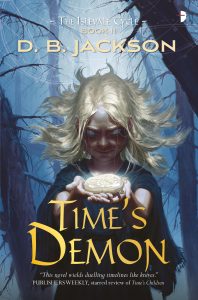
  But at the very least, we need to see our main heroes grappling with what they have endured and setting their sights on what is next for them. We don’t need this for every character but we need it for the key ones. Ask yourself, “whose book is this?” For me, this is sometimes quite clear. With the Thieftaker books, every story is Ethan’s. And so I let my readers see Ethan settling back into life with Kannice and making a new, fragile peace with Sephira, or something like that. With other projects, though, “Whose book is this?” can be more complicated. In the Islevale books — my time travel/epic fantasy trilogy — I needed to tie off the loose ends of several plot threads: Tobias and Mara, Droë, and a few others. Each had their “Louis” moment at the end of the last book, and also some sense of closure at the ends of the first two volumes.
 Why do I do this? Why am I suggesting you do it, too? Because while we are telling stories, our books are about more than plot, more than action and intrigue and suspense. Our books are about people. Not humans, necessarily, but people certainly. If we do our jobs as writers, our readers will be absorbed by our narratives, but more importantly, they will become attached to our characters. And they will want to see more than just the big moment when those characters prevail (or not). They will want to see a bit of what comes after.
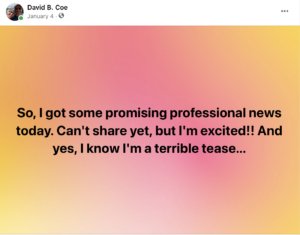 Nearly two months ago, early in the new year, I posted on social media that I had some exciting professional news I couldn’t share quite yet. I was thrilled, and wanted to let people know. But I also didn’t want to say anything before all the details had been settled. So I posted my little teaser, forgetting the one immutable rule of the publishing business: Things always happen slower than one thinks they will.
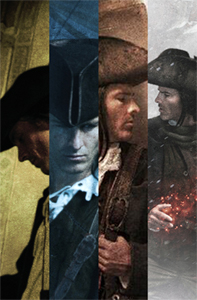 I am not the most talented writer I know. Not by a long shot. I am good. I believe that. My character work is strong. My world building is imaginative. My prose is clean and tight and it flows nicely. I write convincing, effective dialogue and I have a fine eye for detail. My plotting and pacing, which were once just okay, have gotten stronger over the years. I think writing the Thieftaker books — being forced to blend my fictional plots with real historical events — forced me to improve, and that improvement has shown up in the narratives of the Islevale and Radiants books.
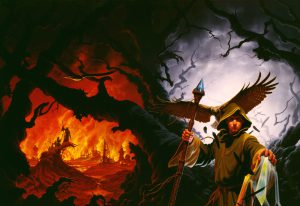 For the Thieftaker novels, Tor hired the incomparable
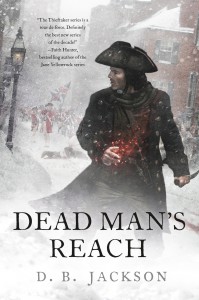
 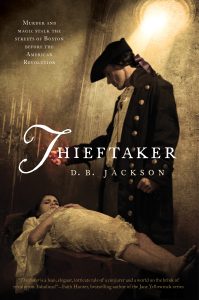 The thing to remember about artwork, though, is that it’s not enough for the covers to be eye-catching. They also need to tell a story — your story. The Thieftaker covers work because they convey the time period, they offer a suggestion of the mystery contained within, and they hint as well at magic, by always including that swirl of conjuring power in Ethan’s hand. The Islevale covers all have that golden timepiece in them, the chronofor, which enables my Walkers to move through time. All my traditional epic fantasy covers, from the LonTobyn books through the Forelands and Southlands series, convey a medieval fantasy vibe. Readers who see those books, even if they don’t know me or my work, will have an immediate sense of the stories contained within.
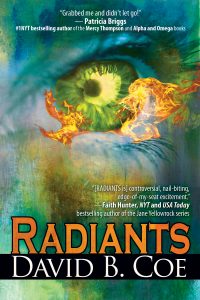 And that’s what we want. Sure, part of what makes that Invasives cover work is the simple fact that it’s stunning. The eye, the flames, the lighting in the tunnel. It’s a terrific image. But it also tells you there is a supernatural story within. And while the tunnel “setting” is unusual, the presence of train tracks, wires, electric wiring, and even that loudspeaker in the upper left quadrant of the tunnel, combine to tell you the story takes place in our world (or something very much like it). And for those who have seen the cover of the first book in the series, Radiants, the eye and flames mark this new book as part of the same franchise. That’s effective packaging.
 I discussed the Thieftaker books in last week’s post, and I mentioned how my love of U.S. history steered me toward setting the series in pre-Revolutionary Boston. But I failed to mention then that upon deciding to set the books in 1760s Boston, I then had to dive into literally months of research. Sure, I had read colonial era history for my Ph.D. exams, but I had never looked at the period the way I would need to in order to use it as a setting for a novel, much less several novels and more than a dozen pieces of short fiction. Ironically, as a fiction author I needed far more basic factual information about the city, about the time period, about the historical figures who would appear in my narratives, than I ever did as a doctoral candidate.
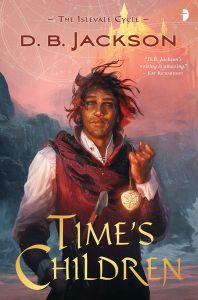
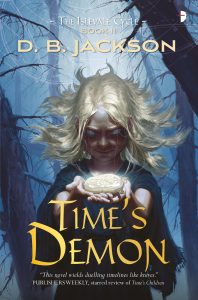 The same is true of the worlds I build from scratch for my novels. My most recent foray into wholesale world building was the prep work I did for my Islevale Cycle, the time travel/epic fantasy books I wrote a few years ago. As with my Thieftaker research, my world building for the Islevale trilogy consumed months. I began (as I do with my research) with a series of questions about the world, things I knew I had to work out before I could write the books. How did the various magicks work? What were the relationships among the various island nations? Where did my characters fit into these dynamics? Etc.
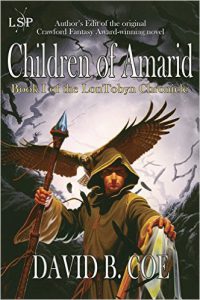 As many of you know, my first series, the LonTobyn Chronicle, had as its narrative core, a magic system in which mages formed psychic, magical bonds with birds of prey: hawks, owls, eagles. To this day, fans of the series mention those relationships between mages and their avian familiars, as the element of the books they enjoyed most.
 The thing is, we writers do and must “write what we know.” But we understand that “what we know” does not equal “what we have lived.” Writing is all about emotion, about delving into the thoughts and feelings and visceral reactions of our point of view characters. I may not have ever traveled through time (for example), or investigated a murder in pre-Revolutionary Boston, or discovered that I possess supernatural powers and then been pursued by rogue government agents intent on killing my family and making me their weapon. (If you haven’t read Radiants, it’s really time you did.) But even if I haven’t done those things, I have lived the gamut of emotions my characters experience. I have known fear. I have been in love. I adore my children and have been frightened for them. I have been enraged. I have experienced physical pain and illness, exhaustion and hunger, desire and pleasure. I have known joy and confusion and shock, the thrill of ambition realized and the bitter disappointment of expectation thwarted. I can go on, but I think you get my point.
 These are books I turn to again and again during the course of my work, and I expect the writer on your list will do the same. Not all of them are easy to find, but I assure you, they’re worth the effort. So here is a partial list: