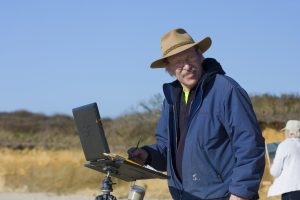
As some of you may remember, back in March I pulled away for a time from all social media. And, as you may have noticed, even now my social media presence remains limited. I haven’t been blogging regularly. I haven’t been sending out my newsletter. I have been far less “chatty” than usual. And there is a reason for all of this.
In March, our older daughter was diagnosed with cancer.
The months since have been the longest and most difficult of my life, and our ordeal is far from over. She is undergoing treatment and has responded well so far. Her spirits are good — remarkably so. She is, as I already knew, one of the bravest, wisest, strongest, most positive people I’ve ever encountered. Even in this most difficult time, I am so very proud of her. And I know that her attitude has been and will continue to be a most potent weapon in her battle. That said, though, the cancer had progressed significantly before it was discovered and she still has a long road ahead of her. We are hopeful in the long-term — we believe we have every reason to be — but again, this is hard.
We are grappling with fear, uncertainty, the sadness that comes with knowing our child — yes, our adult child, but nevertheless — is suffering and there’s not a damn thing we can do about it. We are grieving for all we’ve lost as a family. Not because we doubt that she’ll recover. But because, even after she is cancer-free, we will, all of us, live for the rest of our lives fearing a return of the illness. We as a family — not just Alex, not just Nancy and me, but also Erin, our beloved younger daughter — have lost our innocence in a way. We’ll never be the same.
There was a time, early on, when I was exchanging texts with my brother about one development or another, and I wrote something about “Alex’s oncologist.” And I had to pause to say to myself and to him, “Fuck, my daughter has an oncologist.” The past several months have been filled with moments like these. Times when I catch myself saying things no parent ever wants to say and thinking of things I never in my darkest dreams thought I would have to consider.
At times, work has been a balm, and I have been able to lose myself in my writing or the freelance editing I’ve been doing recently. At times, I can’t do anything at all. I have started therapy, which has been wonderful for me. I have continued to exercise and eat well. I have managed not to drink myself into oblivion even once, though I will admit to being tempted on more than one occasion. I sleep moderately well, but often wake up feeling utterly devastated and sick to my stomach. Nancy and I still manage to have fun when we can. We also take turns comforting each other. One day one of us will be okay and the other will be a wreck. The next day we’ve reversed roles.
Mostly, though, we move through life and work and quiet time feeling like we’re wearing those leaded bibs they use at the dentist’s office when you’re getting x-rays. Everything is weighed down. Everything is harder, more wearying. Our tempers are a bit more frayed. Even our best days are only so-so, and our worst days are bleak and seemingly endless.
Before now, I hadn’t wanted to make this sort of public pronouncement. I’m not entirely sure why. Alex has been very open about being sick and has made it clear to the rest of us that she doesn’t consider her illness a secret to be guarded. Maybe I feared “announcing” it would make it feel more real. Though honestly, I don’t know how it could be any more real. Maybe I just wanted to put off the exchanges of messages and comments that will inevitably follow a post like this one. Maybe I wanted to avoid the tears I’ve shed while writing this.
Whatever the reason, I felt that with everything else I’ve pulled back from this year, my cancellation of my appearance at DragonCon warranted an explanation. The fact is, even with all the precautions the convention has taken — and the con committee has been terrific in this regard — I fear exposing myself to the Delta Variant of Covid-19 in advance of a visit with our immunocompromised daughter. I am sorry to miss the convention. I am sorry to disappoint those of you who looked forward to seeing me there. I hope and plan to attend in 2022, when this latest surge in the pandemic is a distant memory, and our daughter is on the mend.
Many of you, I am sure, will want to help in some way. The fact is, there is not much anyone can do right now. I welcome and am grateful for your expressions of support and friendship. I would, however, ask two things of you: 1) Please respect our privacy. I have shared what’s going on with our family. I have no intention of filling in additional details. And 2) Please do not share your cancer stories with me. I know they are kindly meant, and I thank you for your good intentions. I also know they will do nothing to help me, and will in fact increase my anxiety.
Otherwise, I ask only that you spare a positive thought for my daughter, my family, and me.
Thank you so much for reading this. Take care of yourselves. Be kind to one another. Hug the people you love.
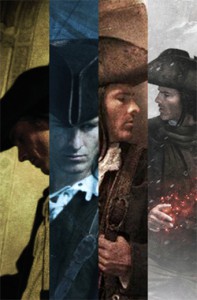
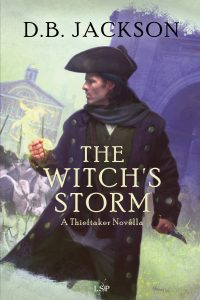 Today is release day for “The Witch’s Storm,” the first installment in my new trilogy of Thieftaker novellas,
 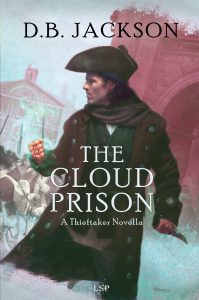 The fact is, though, as many of you already know, this release comes at a difficult time for my family and me. I have only recently returned to social media after a much-needed hiatus, and while I have adjusted to the new realities we face, they weigh on me still. And so I find myself in the position of wanting to be enthusiastic about the new stories, but also NOT wanting to be falsely positive and happy-go-lucky.
 There is, of course, a larger point here. As I say, other writers deal with these questions, too. Really, all of us do. Part of being a professional in any field is being able to set aside the personal to meet our work obligations. We compartmentalize. Our emotions have their time and place, as do the qualities that make us good at our jobs. I am married to someone who excels at compartmentalizing. I am just okay at it. I can set aside my worries, fears, sadness, etc. and write for hours at a time. As long as I remain alone, in my office, with just my plot lines and worlds and characters, I’m fine.
 DBJ: There was a lot to work with actually. On the one hand, the trials of the soldiers and their captain were a huge deal. Think of all the big trials we’ve had in recent history — the way they captivate the public — and then magnify that about a hundred times. The Boston Massacre was a huge, huge deal throughout the colonies, but in Boston in particular. It’s easy to forget that the population of the city was only about 15,000 at this time. So while “only” five people died that night in March, chances are that if you lived in Boston, you’d had some contact with at least one of the victims. Add to that the fraught political climate of the time and you have a recipe for a lot of tension. Plus, as the title of the first novella suggests, right before the trial began, Boston was hit by a hurricane. Now, I have adopted the storm for my own narrative purposes and added a magical element. But the fact is, there was a ton going on, historically speaking, and I was able to work most of it into the novellas.
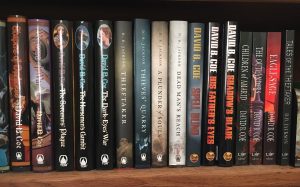
 DBJ: Definitely. The fact is, I’m probably better known for Thieftaker than I am for anything else I’ve published, either as D.B. Jackson or as
  As you might expect, I did a great deal of prep work for my various classes — I wouldn’t dream of entering settings like those if I weren’t armed to the teeth with talking points, notes, topics for discussion, etc. For one thing, I have a responsibility to my students, and I take is seriously. And, though I don’t think most people would know it to look at me and listen to me, I suffer from profound stage fright. That preparation is my armor, my spell of warding. If I prepare well, my thinking goes, I’m less likely to make a complete fool of myself. This doesn’t always work — I’m perfectly capable of looking and sounding like an idiot even when I’ve done my homework. Still, I think my strategy is sound, at least in theory…
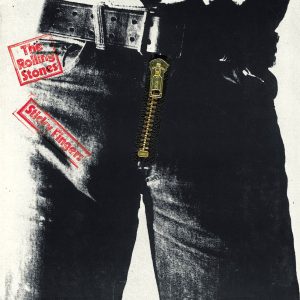 Music isn’t meant to be sold song by song. We’re supposed to buy albums. We’re supposed to put up with the bad songs in order to enjoy the good ones. That makes the listening experience better. For every “Eleanor Rigby” and “For No One” we should have to endure a “Doctor Robert.” For every “Brown Sugar” and “Can’t You Hear Me Knockin’?” we should have to suffer through a “You Gotta Move.” It’s only fair. No one is entitled to a perfect listening experience, and songwriters deserve the chance to have their crappy songs heard alongside the good ones. This is America, damnit!