








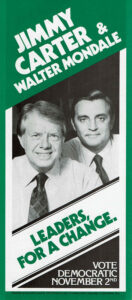
 In 1976, I was thirteen years old. I couldn’t vote, obviously, but I could work for candidates I liked, passing out pamphlets and such. That’s what I did in my little (at the time) moderately conservative (at the time) hometown in suburban New York. I stood on street corners in the commercial district of our village and I handed out leaflets for the Carter-Mondale ticket. “Leaders For A Change,” they read. A message that resonated after Watergate and the hapless administration of Gerald Ford.
Four years later, as a more rebellious seventeen-year-old, I made phone calls for the insurgent primary campaign of Teddy Kennedy. My father didn’t approve.
I would be the first to admit that Jimmy Carter’s presidency was not a successful one. I won’t go so far as to say he was a bad President, because he did some very good things while in office, including trying to move the country toward energy independence and setting aside huge swaths of wilderness for preservation. He brokered the Camp David Accords with Anwar Sadat and Menachem Begin, ending the state of war between Egypt and Israel. And he created the Department of Education, which, despite right-wing complaints, has done much in the four decades since to improve education in the United States.
But Carter could be prickly with the press and with other politicians. He refused to play the sort of games Washington likes to impose on new Presidents. Unlike Ronald Reagan, who defeated him, and Bill Clinton, who would win back the White House for the Democrats in 1992, Carter could be pedantic, taciturn, moralizing. Rather than being a happy warrior, he was more a grim crusader, deeply convinced of his own righteousness and uncompromising in his principles. In a way, he was too honorable a person, too unwilling to mince words, and also too nuanced in his thinking to be an effective leader. He came to office in the midst of an economic crisis that he was unable to ease, and he could do nothing to prevent the seizure of the American embassy in Teheran, Iran. The subsequent hostage crisis really wasn’t his fault, but it made him appear weak and ineffectual. It’s not surprising that he lost the 1980 election in a landslide, nor is it surprising that he’s remembered as a failed President.
Carter only began to flourish as a national leader after he left office. First, it should be noted that he never disputed his electoral loss or attempted to subvert in any way the transition to the Reagan Administration. A few years ago, that wouldn’t have been noteworthy. Now . . . .
More to the point, freed by his defeat from the constraints of electoral politics, he was able to focus on what he did best: advocating for social justice and casting himself as the moral conscience of an increasingly divided nation. The Carter Center, a non-profit founded after he left office, has worked across the globe to alleviate poverty, advance health care in under-developed economies, and advocate for human rights. Carter and his wife, Rosalynn, have been steadfast supporters of Habitat for Humanity, working tirelessly to build homes for those in need. And he has helped several of his successors in the White House by serving as a roving diplomat.
While many (but not all) of our ex-Presidents have spent their post-Presidential years playing golf or painting or burnishing their legacies or even trying to redeem themselves and repair their reputations after repeated failures, ignominious electoral defeats, and illegal and immoral assaults on our republic, Carter has devoted himself to the humane causes in which he believes. He is a crusader for social and economic equity. He speaks his mind, calling out those in power who fail to live up to their oaths of office. He carries himself with dignity, humility, and grace. And he has set an example every day, showing us all what it means to be a public servant.
I believe a case can be made that regardless of who the best President in our nation’s history might be, Jimmy Carter has been the best former-President we’ve ever had.
Last week, the Carter Center announced that Carter, now 98 years old, was going into Hospice Care rather than continue to pursue medical treatments for his various ailments. He has lived a full and incredible life, realizing lofty ambitions, traveling around the world, and touching literally millions and millions of lives. In the time he has left, I have no doubt he will continue to speak on behalf of those whose voices don’t reach the ears of the wealthy and powerful.
And when he is gone, when we no longer hear his gentle Georgia drawl speaking truth to the better angels in each of us, he will leave a void in America’s ongoing political and social dialogue.
Wishing you all peace, the comfort of loved ones, and a good week ahead.
 Right around the holidays, I was shouting from the virtual rooftops about my new Celtic urban fantasy trilogy, The Chalice War, which would be coming out early in 2023. The first book, I bellowed (virtually), would be coming out in February, and it would be called The Chalice War: Stone. It would be followed, a month or so later, by The Chalice War: Cauldron, and then a couple of months after that by the finale, The Chalice War: Sword.
 Very early in my career, when my first book, Children of Amarid, was the only one I had out, I responded publicly to a online review from a less-than-delighted reader. Amazon was still a novelty (no pun intended) as was the notion of online reader reviews. (Hard to imagine, right? That the idea of readers offering reviews of the books they’d read should have been new and different and even a bit odd?) I don’t remember what the reader in question objected to about the book, nor do I remember what I said in my public response. The original book is out of print now — only the 2016 reissues are available on the site, so our exchange is lost to the ages. All I know is that someone criticized the book, I didn’t take the criticism well, and I took it upon myself to write a reply and post it to the Children of Amarid Amazon page.
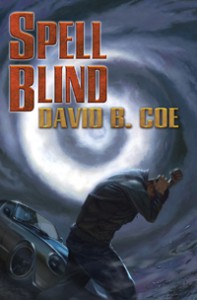 Some years later, soon after the release of Spell Blind, the first book in The Case Files of Justis Fearsson, another Amazon reviewer panned the book because my book was “a blatant rip-off” of Jim Butcher’s Harry Dresden books, “a ludicrous case of copycatting.” For the record, I didn’t copy Dresden at all. I had only read the first two books of the series, and the “copycatting” the reviewer claimed I’d done amounted to using tropes of the genre, not elements of Butcher’s work. And so I responded to the review, wanting to set the record straight.
 During our tour, we encountered many people selling pottery in front of their homes. And at one table, a mother displayed her wares beside those of her young daughter. I think the girl must have been around 7 or 8, give or take a year, and she had made a few small bowls, seed pots, and dishes. And she had made a tiny storyteller. As one would expect, it was quite crude compared to those we had seen for sale back in Albuquerque (we hadn’t yet been to Santa Fe or Taos), but something about the figure spoke to me. Maybe is was just that the storyteller was so cute. Or maybe it was that the girl herself was so proud of it. Or maybe I saw in this child’s early effort to follow in her mother’s footsteps something akin to my dream of becoming a professional writer. Whatever the reason, I asked the girl how much it cost.
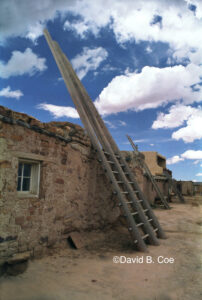 That was a magical day in many ways. Acoma was as beautiful as we had been told, the pale red stone of the Pueblo seeming to glow beneath a deep azure sky, wooden kiva ladders rising above their structures and reaching toward the clouds. At one point, I spotted a rainbow in the clouds overhead — there was no rain, just the prismatic color, which appeared for a moment and then vanished. I think I was the only one on the tour who saw it. I believed that, together, the rainbow and my little storyteller were omens, signs that my dream would, in fact, come to pass.
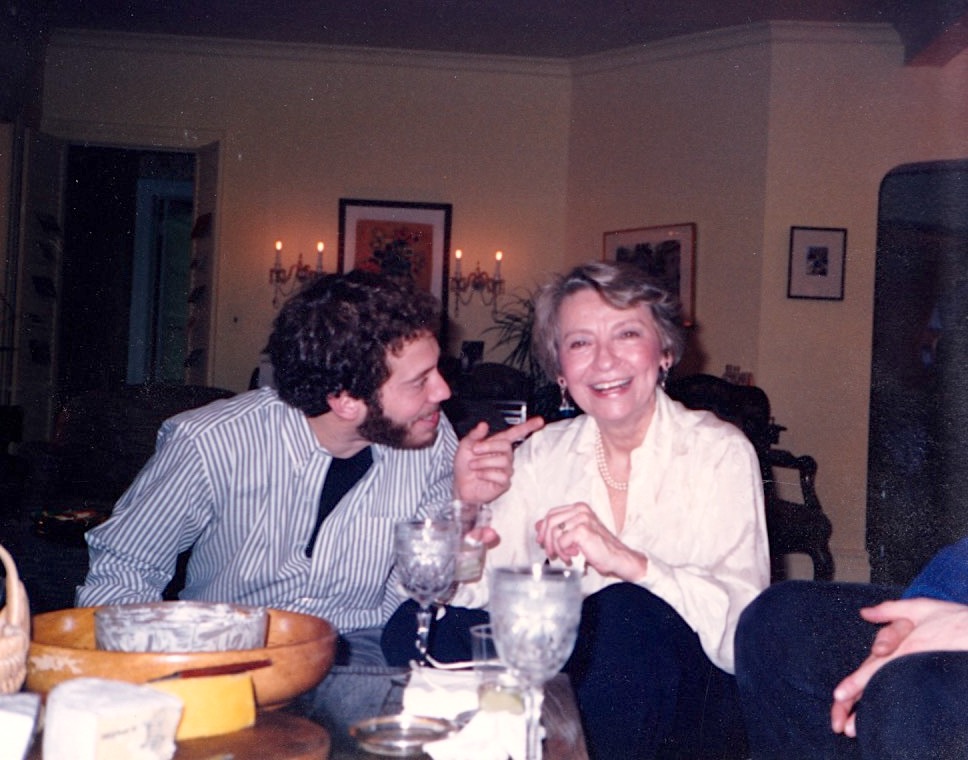 Yesterday would have been my mother’s birthday — her 101st. I’ve written about her, and my dad, quit a bit in this space, though I haven’t written about my mother in a couple of years. She was smart and funny, classy and beautiful, quietly ambitious and deeply accomplished. She doted on her children and was, in turn, doted on by my father. She loved to travel and was passionate to the point of reverence about literature and the arts.
 We built our house in 1998. Or, to be more accurate, we paid other people to build our house in 1998. We took a pre-made design that we found in a book of house floor-plans, and with some help from a local architect, customized it to meet our needs. At the time, our older daughter was three and Nancy was pregnant with our younger daughter. We needed a kid-friendly home that would give the girls space to play, and us room to watch them but also cook dinner and such.
 The first deadline I missed was on my second novel, The Outlanders, the middle book of the LonTobyn Chronicles trilogy. And I had good excuses. Between the time I started writing the book, and the day the first draft of the manuscript was due to Tor, our first child was born, my mother died, my father died, and my siblings and I had to settle my father’s estate.
 Yes, sometimes we think we’re going to miss a deadline, and then we make it. And if we alert our publisher prematurely, we could lose our spot in the queue. So be it. That’s the price of acting professionally. When our older daughter first was diagnosed with cancer, I told my editor and my agent what had happened, and let them know I was probably going to be late with the novel I was writing. As it turned out, writing that book — Invasives, the second Radiants novel — was a wonderful escape, and I met my deadline. But I had given up my publishing spot and so the book was released later than I had hoped. It wasn’t that big a deal. As I say, the most important thing is be up front about the situation with those who need to know.