








For the last couple of weeks, I have written my Professional Wednesday essays about the old writing adage, “write what you know.” In my first post on the topic, I wrote about tapping into emotions and our reactions to experiences to get past the limiting implications of “write what you know.” Last week I focused on working into our stories the things we love in real life, be they areas of study, hobbies, or passions.
For this week’s post, my last (for now) about this subject, I build on something said by my good friend, editor and writer Joshua Palmatier, for whose publishing imprint, Zombies Need Brains, I’ve been doing anthology editing the past several years. The other day, he and I talked about this series of posts and he told me that when he hears “write what you know,” he thinks of genre. He takes the advice to mean that if writers want to write fantasy, they should read lots of fantasy and familiarize themselves with its traditions, its tropes, its major works, its newest trends. Same with writing mystery, or SF, or anything else. Writers should know the literary terrain before they start to write.
This makes a tremendous amount of sense to me, and adds a dimension to the “write what you know” conversation that I hadn’t considered.
Indeed, expanding on this, it seems to me that when we look at the old advice from this perspective we start to consider all sorts of things. Yes, genre. But also research. World building. Character. In this construction, “write what you know” can almost be turned around to read “know what you write.”
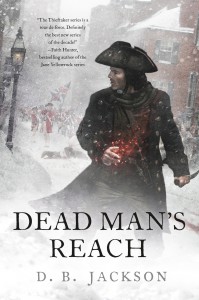 I discussed the Thieftaker books in last week’s post, and I mentioned how my love of U.S. history steered me toward setting the series in pre-Revolutionary Boston. But I failed to mention then that upon deciding to set the books in 1760s Boston, I then had to dive into literally months of research. Sure, I had read colonial era history for my Ph.D. exams, but I had never looked at the period the way I would need to in order to use it as a setting for a novel, much less several novels and more than a dozen pieces of short fiction. Ironically, as a fiction author I needed far more basic factual information about the city, about the time period, about the historical figures who would appear in my narratives, than I ever did as a doctoral candidate.
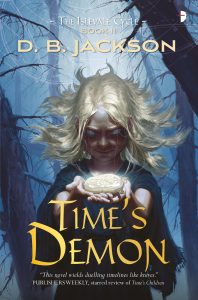 The same is true of the worlds I build from scratch for my novels. My most recent foray into wholesale world building was the prep work I did for my Islevale Cycle, the time travel/epic fantasy books I wrote a few years ago. As with my Thieftaker research, my world building for the Islevale trilogy consumed months. I began (as I do with my research) with a series of questions about the world, things I knew I had to work out before I could write the books. How did the various magicks work? What were the relationships among the various island nations? Where did my characters fit into these dynamics? Etc.
“Write what we know/Know what you write” means having a sense from the beginning of a project of what the book ought to look like when it’s complete. I’m not suggesting that we have to outline (if outlining is your thing, great; if it’s not, that’s all right, too) or plan our narratives. But we should be able to visualize our worlds. We should know what sort of technology they have, what sorts of magic systems are at work. And we should know how we might market our stories — where they fit in the pantheon of whatever genre we’re writing.
Put another way, we need to be familiar with the work we’re about to do, both on a structural level and a publishing industry level. And we need this not because some guy with a blog said so, but because we want to sell our books. We want to interest agents and editors in them. We want to interest readers. And we don’t always have the luxury of waiting until the thing is finished to have these conversations. Again, I’m not saying we have to know everything that happens in the book ahead of time. I’m a dedicated outliner, and even I can’t do that. I am saying, though, that we should understand how to place our books in the marketplace. And we should know before we begin writing what world building we need to do, or what research we have to master, before we can tell the story we want to write.
Write what you know. Know what you write. As it turns out, the old advice makes a lot of sense in several different ways. It may not mean exactly what was intended when the phrase was first coined. But it still is valuable advice for today’s writer.
Keep writing!
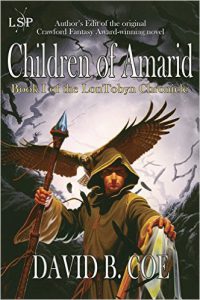 As many of you know, my first series, the LonTobyn Chronicle, had as its narrative core, a magic system in which mages formed psychic, magical bonds with birds of prey: hawks, owls, eagles. To this day, fans of the series mention those relationships between mages and their avian familiars, as the element of the books they enjoyed most.
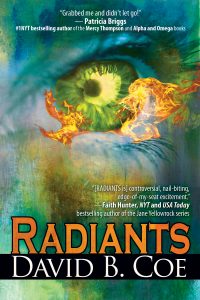
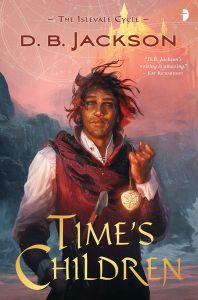 The thing is, we writers do and must “write what we know.” But we understand that “what we know” does not equal “what we have lived.” Writing is all about emotion, about delving into the thoughts and feelings and visceral reactions of our point of view characters. I may not have ever traveled through time (for example), or investigated a murder in pre-Revolutionary Boston, or discovered that I possess supernatural powers and then been pursued by rogue government agents intent on killing my family and making me their weapon. (If you haven’t read Radiants, it’s really time you did.) But even if I haven’t done those things, I have lived the gamut of emotions my characters experience. I have known fear. I have been in love. I adore my children and have been frightened for them. I have been enraged. I have experienced physical pain and illness, exhaustion and hunger, desire and pleasure. I have known joy and confusion and shock, the thrill of ambition realized and the bitter disappointment of expectation thwarted. I can go on, but I think you get my point.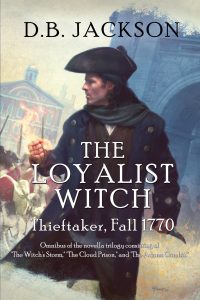
 This is a topic to which I intend to return next week and in the weeks to come. Because when we start to think of “write what you know” as an invitation to think more about what our lives, despite their mundanity, have in common with the lives of our characters, we find new ways to enrich our storytelling and world building.
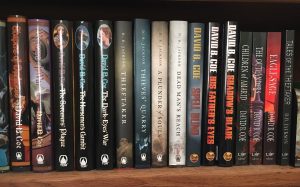
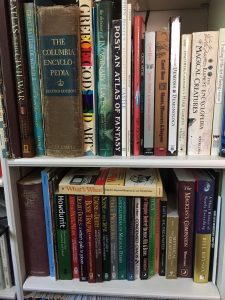 These are books I turn to again and again during the course of my work, and I expect the writer on your list will do the same. Not all of them are easy to find, but I assure you, they’re worth the effort. So here is a partial list:
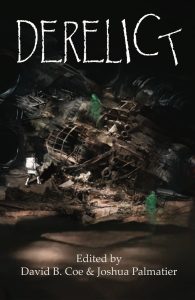 Last year, I co-edited Derelict. We received more than four hundred stories. The year before, I co-edited Galactic Stew. We received more than four hundred stories. The year before that, I co-edited Temporally Deactivated. We received more than two-hundred and fifty stories. Again, these are submissions for a total of six or seven slots.
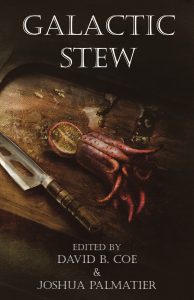 Along similar lines, ZNB anthologies are themed, which means that all the stories are about something in particular. Galactic Stew was about food. Derelict was about abandoned or lost ships. Noir is about detectives, in SF, fantasy, horror, or paranormal settings, investigating mysteries. As with the GLs, anthology themes are not suggestions. We’re not saying “If you feel like writing about detectives, feel free, but we’ll take any story about anything.” We’re saying, “For this anthology, we want detective stories with a speculative fiction element.” I can’t tell you how many stories we get that have nothing at all to do with our theme. I CAN tell you that we reject every last one of them. If you send to a themed anthology open-call a story that is off theme, it will not be accepted. Ever. Full stop.
 As you might expect, I did a great deal of prep work for my various classes — I wouldn’t dream of entering settings like those if I weren’t armed to the teeth with talking points, notes, topics for discussion, etc. For one thing, I have a responsibility to my students, and I take is seriously. And, though I don’t think most people would know it to look at me and listen to me, I suffer from profound stage fright. That preparation is my armor, my spell of warding. If I prepare well, my thinking goes, I’m less likely to make a complete fool of myself. This doesn’t always work — I’m perfectly capable of looking and sounding like an idiot even when I’ve done my homework. Still, I think my strategy is sound, at least in theory…