








The hard part of getting back into posting isn’t the first post. It’s the second, and the ones after that. In part, I retreated from social media six or seven weeks back because I couldn’t imagine carrying the emotional load I had shouldered while simultaneously producing essays about things that mattered less to me, which was pretty much everything else. At the same time, I also knew that I didn’t want to post every Monday about our family problems or my mental health issues. Nobody wants to read that guy week after week after week.
I touched on this a bit back in May, at a time when I was also struggling to come up with essay ideas for these Monday Musing entries.
So, what to do this time around . . . .
In truth, right now there is lots to write about. And the world is a far more promising place today than it was in May. Which makes this blogging thing a little easier. Consider:
Our former Felon-In-Chief is twisting slowly, slowly in the wind (that’s a Watergate reference, for those of you too young to remember), and I will admit that I’ve enjoyed watching him flop about like a hooked fish on a pier (yeah, I know, I’m mixing metaphors — deal with it), searching for any defense that might save his sorry ass. “The documents were planted! It’s a hoax.” “I declassified the documents ages ago.” (Quite a neat trick — knowing to declassify documents that would be planted on his property without his knowledge years later . . . .) “This is all legal under the Presidential Records Act.” (Spoiler alert: It’s not.)
At the same time, our current President (legally and fairly elected) is having a summer to remember. Tumbling gas prices, inflation starting to come under control, continued historic strength in the job market, Democratic voters motivated and mobilized by the SCOTUS decision overturning Roe v. Wade, voters in ruby red Kansas rejecting an abortion ban, one piece of major legislation after another passed and signed into law, rising poll numbers, surprisingly strong Democratic performances in special elections. It all adds up to a changing political landscape, and the realization that November might not turn out the way most pundits were predicting only a few months ago.
On the other hand, drought and floods and fires serve as constant reminders that despite the passage of the climate change bill — a significant and laudable achievement for the Administration and Congress — our planet remains gravely at risk. With that in mind, I believe when historians look back on 2022 decades from now, they will identify as the most significant moment of the year this week’s decision by the California Air Resources Board to ban the sale of new gasoline-powered motor vehicles after 2035.
Yes, it’s only one state. Don’t let that fool you. If California were a sovereign nation, its economy would be the fifth largest in the world, behind only the U.S., China, Japan, and Germany. Alone it accounts for more than 1/7 of our country’s GDP, and its citizens own far more cars than do the residents of any other state. Where California goes, the automobile industry will have little choice but to follow.
At long last, someone in this country has stepped forward and said, “This way to climate sanity. Follow me.” I expect Gavin Newsom, California’s governor and a Democratic Presidential hopeful for 2024 or 2028, sees this as good politics, which is also telling.
Look, anyone who knows me well will tell you I have a lot more in common with Eeyore than I do with Pollyanna. I am all too aware of the threat Trumpism poses to our republic, of the damage the Supreme Court has done to our society and the further damage it could very well do in its next term, of the precarious state of our planet and the limited reach of even California’s dramatic actions this week.
I am also aware of the tough road that lies ahead for my family, for my older daughter in particular.
As a part-time essayist, I can choose to dwell on the negative, or, as the song goes, I can accentuate the positive. For now, I prefer to do the latter. My hope may prove audacious, fantastical even. But I embrace it anyway. I can also promise you I won’t always be able to do this. My inner Eeyore is strong and persistent. For now, though, he is quiescent, and I’m glad.
I wish you a week of hope, good health, and good tidings.
 After running away from social media for six weeks, and ignoring publicity opportunities and the like, I feel a little funny offering any professional advice to anyone on anything. Which, I realize, is entirely wrong-headed.
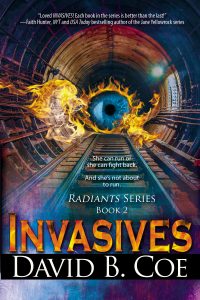 In the end, I hit my deadline. More, the book I wrote that spring, Invasives, the second Radiants novel, turned out better than I ever could have imagined. I love the book, not only because I think it’s good, but because it saved me. It got me through that terrible spring and early summer.


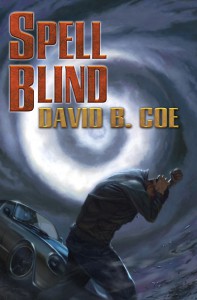 About seven years ago, I received out of the blue, an email from the actor Bronson Pinchot, who is probably best known for playing the role of “Balki” in the sitcom Perfect Strangers. He was, by then, enjoying a successful career as a voice actor, and he was writing to me because he was about to return to the studio to begin recording his reading of the second Justis Fearsson book, His Father’s Eyes. He wanted to know what I had thought of his treatment of the first book in the series, Spell Blind, and if there were things I wanted him to do differently with the second book.
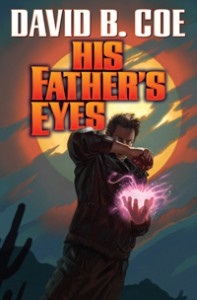 I was thrilled to get the email, and also impressed by the care he was taking with my books. But I wasn’t really able to give him the feedback he was after. “I have heard great things about your performance from friends, as well as from online reviews,” I told him. “I’ve listened to the sample on the Audible site and very much like your take on the character’s voice. The truth is, though, I am incapable of listening to others read my work. It has nothing to do with your performance, or any one else’s, for that matter, and everything to do with hearing the flaws in my own writing, which I find excruciating.”
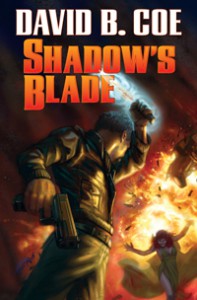 As it happens, I have from Audible the MP3 CD of the third and final book in the original trilogy, Shadow’s Blade. Since I also had in my immediate future two seven-hour drives, I thought I would go ahead and listen to the book. How bad could it be, right? Even if I hated what I heard (to reiterate, I wasn’t worried about Pinchot’s performance, but rather my writing), I could take solace in knowing that I was now seven years and at least eight novels more experienced than I was when I wrote the book.
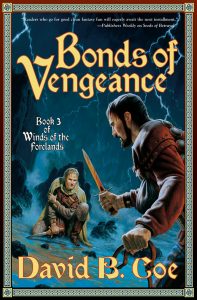 Many years back, while I was working on one of the middle books in my Winds of the Forelands quintet, my second series, I came downstairs after a particularly frustrating day of writing and started whining to Nancy about my manuscript. It was terrible, I told her. There was no story there, no way to complete the narrative I’d begun. The book was a disaster, and I might well have to scrap the whole thing.