








Have you watched the HBO series Deadwood?
It’s a Western, the creative child of the brilliant David Milch. It’s violent, brutally realistic, and absolutely the most profane thing I have ever watched, with the possible exception of the Academy Award-winning movie The Departed, (directed by Martin Scorsese, written by William Monahan).
I would challenge anyone watching Deadwood to record a full minute of dialogue in any episode that does not include an f-bomb, or some other curse. Over the three full seasons the series ran I suppose it’s possible that a “clean” minute exists somewhere. I would be hard-pressed to find it. As you might expect, some viewers are put off by the profanity. Check out online reviews of the series and you’ll find lots of people who want nothing to do with it because of all the cursing, and plenty of others who recognize the excellence of the characters, the imagery, the plotting, but lament the explicit language.
And then there are viewers like me. I LOVE the profanity. I find it poetic, and I felt the same way about The Departed. I believe there is an art to writing works that depend so heavily on strong language. While some may dismiss the profanity in Deadwood or The Departed as gratuitous, I don’t believe it is. I have seen and read other works that DID have gratuitous profanity, and you can tell the difference. For my part, I have never tried to write something with this much strong language, but neither have I shied away from using curses in my writing.
Every author has their threshold for explicit language, just as every author has their threshold for violent and sexual content. Friends of mine pretty much refuse to use any profanity at all. Others throw in a ton. Either approach is fine, so long as the author can make it work. But authors should also understand that, as with sex and violence, they also have to be aware of the predilections of editors and publishers.
The default in publishing these days is that profanity is accepted. Publishers or short fiction markets that DON’T accept manuscripts with curse words in them will generally say so in their guidelines. And, of course, we all know we’re supposed to read and follow the guidelines before submitting any work anywhere, right? Right. At one time, YA markets were assumed to be profanity free, but that rule is less strict now. Still take extra care when submitting to YA markets and understand that while mild swearing might be accepted, stronger language, including f-bombs, might not be. Works aimed at middle grade readers and younger audiences should be entirely clean.
Beyond that, the key things to remember include the following:
1) Profanity for its own sake is not good writing. I generally avoid blanket statements like this one, but in this case it seems appropriate. Just as sex and violence for their own sake, without any narrative or character-related justification, can ruin a book or story, so can pointless swearing. When is profanity justified and how much of it should you use? That will vary from author to author, story to story, even scene to scene. Only you can decide what’s right. But as with things like gore or erotic content, you need to consider your audience AND the characters you’ve created, and then decide what is appropriate for both. Beta readers can be enormously helpful in this regard. I have been working on a trunk novel recently that includes what is far and away the most explicit sex scene I’ve ever written. But the sexual encounter is essential to both my character’s journey and my plot and, therefore, it warrants the attention and detail it’s given in the book. I didn’t write it this way for a cheap thrill. I had a narrative purpose in mind. And that, I believe, should be the test for profanity as well.
2) Your setting also must be a factor in how you handle profanity. As D.B. Jackson, I write the Thieftaker Chronicles, a historical fantasy set in pre-Revolutionary Boston. Throwing in a bunch of f-bombs to a Colonial setting simply would not work. No one would believe it – excessive profanity would yank my readers right out of my world, which I don’t want. I have also written several epic fantasy series set in alternate fantasy worlds. Some of these do have a bit of strong language, but only in contexts that feel appropriate to the world. To my mind, having a foul-mouthed character in most of my fantasy novels would feel wrong; it would seem too much like OUR world instead of my characters’ world. I know of some authors who deal with this by creating their own profanities for their fantasy worlds. They can then have foul-mouthed characters without offending readers or risking too much of a “real-world” feel to their books. I think that is a brilliant and elegant solution.
3) Finally, remember that despite extreme examples like Deadwood and The Departed, a little bit of profanity can go a long way. Think about it the way you might think of hot pepper in your cooking. Yes, there are some dishes that are meant to be REALLY spicy, and you might love dishes like that. For the most part, though, REALLY spicy appeals only to certain palettes. Most people like some heat in their food, but not so much that their eyes water. Profanity is much the same. Masterful writers can get away with extreme language. They can preserve the other flavors in spite of the “spice.” For most of us, a softer touch is often the better approach. Our audiences will likely be more comfortable with the occasional f-bomb and other curses, but not with page after page after page of strong language.
Put another way, you don’t have to be Puritanical, but you don’t have to be fucking rude, either.
Keep writing.
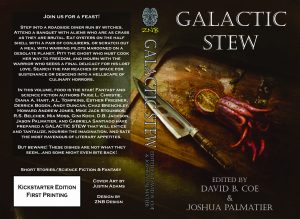 What is the difference between an idea and a story? It sounds like a basic question, but we have just begun the
 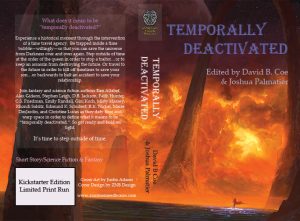 I have touched on the subject of creative ideas in other Writing-Tip Wednesday posts this year (
 As you know at this point, we are in the midst of release week for
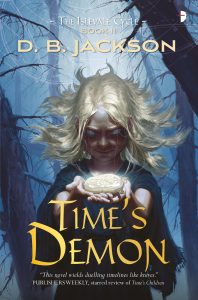
 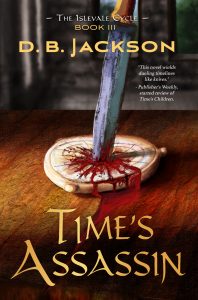 The truth is, I have felt that way about all three volumes of this trilogy. The Islevale books were incredibly difficult to write. I knew going in that writing time travel would be really hard — as one friend told me, “It’ll make your brain explode.” So much can go wrong. We have to examine every plot point from every possible angle to make certain it holds up to logic, and to the simple reality that time travel gives us endless opportunities for do-overs. Put another way, every event in a time travel story is negotiable. Each one can be altered or reversed by the very plot devices on which our stories depend.
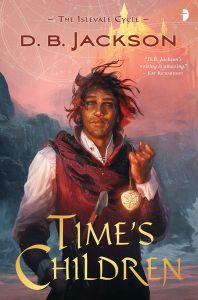 I hoped that
  I frequently tell beginning writers that they need to self-define success, something which is really hard to do in this business. All too often we writers are forced by the nature of publishing to seek exterior affirmation for our work — reviews, sales, awards if we’re fortunate enough to win them. These are the things the industry values and so, naturally, they are the things we care about as well. The problem with this is, the industry is cruel and capricious. We all know of good, even great, books that go unnoticed and unacknowledged. We all have seen mediocrity rewarded with terrific sales and undeserved attention. And we know that this is true in the world beyond publishing as well. Life is not always fair.