I got you with the title, didn’t I? I thought I might.
The horny bluebird in question lives in our yard and is so hopped up on testosterone, so eager to make himself THE player among breeding bluebirds in the area, that he has spent much of the spring attacking reflections of himself in a window downstairs and the driver’s side mirror on my Prius. The latter is the main target of his pugilistic outbursts. The mirror itself is marked with marks from bird’s beak, and the entire side of the car is dripped with bird poop. Charming, I know.
Every day for weeks he has attacked his own image, flailing at his reflection again and again and again, never seeming to tire of a battle he can’t hope to win. He is relentless, almost mindlessly so. The cute female bluebird making googly eyes at him (birds do that, you know) is HIS, and he will brook no competition for her affections. He will not surrender, no matter how many times he smacks his bill against something immovable and invincible.
Perhaps you can see forming here the beginnings of my theme for the post. But do I believe you should emulate or reject the bluebird’s behavior? Is it an example of folly, or admirable perseverance?
Both, actually.
On the one hand, I really do admire the bird’s tenacity. Sure, he’s a bit crazed, and he’s trying to drive off another “bird” that doesn’t actually exist. But he’s doing so with gusto. And the fact is, when it comes to dealing with the business side of a writing career, all of us need to be something of a horny bluebird. (Yeah, that is a line that might well haunt me for the rest of my career . . .)
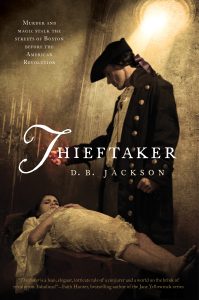 I would love to be a bestselling author. And with each new project I take on, I wonder if this might finally be the literary vehicle that gets me there. Thieftaker, Fearsson, the time travel books, the Radiants franchise. I had high hopes for all of them. All of them were critical successes. None of them has taken me to that next level commercially. So does that mean I should give up?
Of course not. I am now working on my Celtic urban fantasy, and I would be lying to you if I said I didn’t hold out the same hope for this series.
Nearly every writer, I believe, has goals they attack with similar ferocity and persistence. Some folks are looking for that first short story sale, and they keep sending out stories. Some are trying to sell a first novel. Others have done well with small presses but want desperately to break in with a New York publisher. I judge no one for their ambitions, just as I have no intention of abandoning my own.
Rather, I would encourage every writer reading this to keep up the fight. Yes, you may feel like a bird hammering away at its own reflection, but I truly believe the fight itself is worth waging. For me, at least, pursuing my goals no matter what keeps my work fresh, energizes me, and keeps a slight chip on my shoulder, which I think helps me maintain a necessary level of motivation. So battle on!
At the same time that I see value in the bluebird’s example for some business purposes, however, I think it is far less helpful in other contexts. And when I originally hit on this as a topic for today’s post, it was this aspect of the analogy that caught my imagination.
In my conversations with writers over the years, and in my observations as a professional in the business, I have seen too many aspiring authors doggedly clinging to their dreams for a single book or series idea that does not work and that is holding back their careers. They have a project they love, love, love, but simply cannot sell. And rather than move on to new story ideas, they revisit this one over and over. They edit and polish, tear it apart and rebuild it, get feedback from one beta reader after another, all in the belief that this time they’re going to get the story right and finally make the sale.
And I should add two points here. First, I also see the opposite: writers who become discouraged after only one or two rejections and give up on worthwhile projects that simply need a bit more love. There is a balance to be found. Working too long on a book or series that enjoys no success can stall a burgeoning career. Giving up too soon can cost a writer an opportunity they didn’t even know they had.
Second, I have doggedly stuck with projects for years, doing just the sort of repeated reworking I describe above, and eventually selling the books to a publisher. I did it with the Justis Fearsson books. I did it with the new Celtic series.
 The difference between what I did with those two projects and what I am telling you not to do is this: I kept working on these books, but I also moved ahead with other projects, so that I wouldn’t stall my career. Yes, I worked for six years on the first Fearsson book. But in that time, I also wrote the Thieftaker books and the Robin Hood novelization. This, by the way, is also the secret to finding that balance I mentioned. By all means, keep working on the one idea, but do so while simultaneously developing others. Don’t become so obsessed with the one challenge that you lose sight of all else.
As a general business strategy, I believe the reckless stubbornness of the bluebird can prove effective. But when applied with too much fervor to a single book idea, it can become a trap, one that keeps us from realizing our dreams.
So endeth the lesson of the horny bluebird.
Keep writing.
 And when it comes to writing, I am in something of a rut. The last novel-length piece I wrote beginning to end was Invasives, the second Radiants book, which I completed (the first draft at least) eleven months ago. Eleven months!
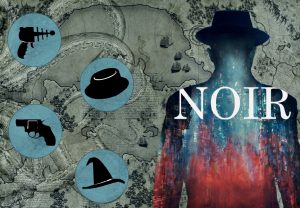 Mostly, as I say, I’ve been editing. My work. Other people’s work. The Noir anthology. I’ve been plenty busy, but I have not been as productive creatively as I would like. And I wonder if this is because of
  Honestly, I think “trust yourself” is good advice for life in general, but for me, with respect to writing, it has a specific implication. It’s something I heard a lot from my first editor when I was working on my earliest series — the LonTobyn Chronicle and Winds of the Forelands.
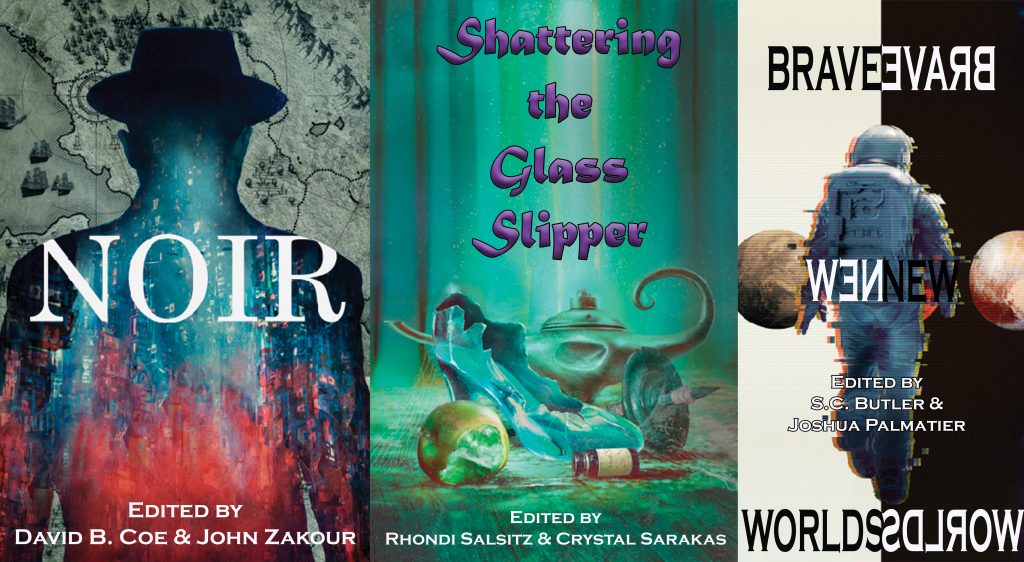 As many of you know, I am once again co-editing an anthology for
  Last year, I co-edited Derelict. We received more than four hundred stories. The year before, I co-edited Galactic Stew. We received more than four hundred stories. The year before that, I co-edited Temporally Deactivated. We received more than two-hundred and fifty stories. Again, these are submissions for a total of six or seven slots.
 Along similar lines, ZNB anthologies are themed, which means that all the stories are about something in particular. Galactic Stew was about food. Derelict was about abandoned or lost ships. Noir is about detectives, in SF, fantasy, horror, or paranormal settings, investigating mysteries. As with the GLs, anthology themes are not suggestions. We’re not saying “If you feel like writing about detectives, feel free, but we’ll take any story about anything.” We’re saying, “For this anthology, we want detective stories with a speculative fiction element.” I can’t tell you how many stories we get that have nothing at all to do with our theme. I CAN tell you that we reject every last one of them. If you send to a themed anthology open-call a story that is off theme, it will not be accepted. Ever. Full stop.
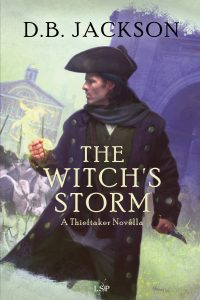 Today is release day for “The Witch’s Storm,” the first installment in my new trilogy of Thieftaker novellas,
 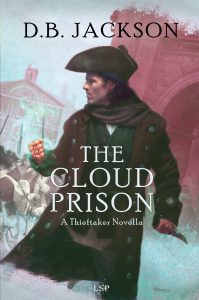 The fact is, though, as many of you already know, this release comes at a difficult time for my family and me. I have only recently returned to social media after a much-needed hiatus, and while I have adjusted to the new realities we face, they weigh on me still. And so I find myself in the position of wanting to be enthusiastic about the new stories, but also NOT wanting to be falsely positive and happy-go-lucky.
 There is, of course, a larger point here. As I say, other writers deal with these questions, too. Really, all of us do. Part of being a professional in any field is being able to set aside the personal to meet our work obligations. We compartmentalize. Our emotions have their time and place, as do the qualities that make us good at our jobs. I am married to someone who excels at compartmentalizing. I am just okay at it. I can set aside my worries, fears, sadness, etc. and write for hours at a time. As long as I remain alone, in my office, with just my plot lines and worlds and characters, I’m fine.
 DBJ: There was a lot to work with actually. On the one hand, the trials of the soldiers and their captain were a huge deal. Think of all the big trials we’ve had in recent history — the way they captivate the public — and then magnify that about a hundred times. The Boston Massacre was a huge, huge deal throughout the colonies, but in Boston in particular. It’s easy to forget that the population of the city was only about 15,000 at this time. So while “only” five people died that night in March, chances are that if you lived in Boston, you’d had some contact with at least one of the victims. Add to that the fraught political climate of the time and you have a recipe for a lot of tension. Plus, as the title of the first novella suggests, right before the trial began, Boston was hit by a hurricane. Now, I have adopted the storm for my own narrative purposes and added a magical element. But the fact is, there was a ton going on, historically speaking, and I was able to work most of it into the novellas.
 DBJ: Definitely. The fact is, I’m probably better known for Thieftaker than I am for anything else I’ve published, either as D.B. Jackson or as
 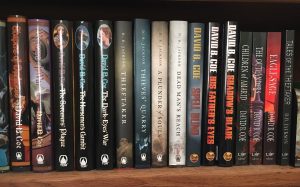 This past weekend I gave a talk on world building for the Futurescapes Writers’ Workshop. It was a lengthy talk, and I’m not going to repeat all of it here. But I did want to focus on one element of the topic, because I think it’s something writers of fantasy, of historical fiction, of science fiction, and of other sub-categories of speculative fiction lose sight of now and again.