








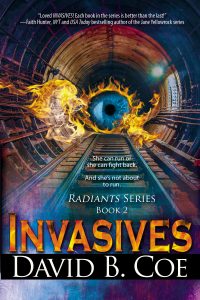
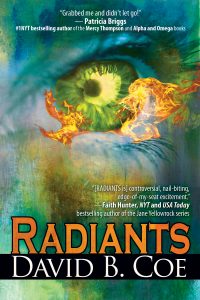
 February has begun, Punxsutawney Phil has done his schtick, and time seems to be moving at breakneck speed. In a little over two weeks, Invasives, the second Radiants book, will be released by Belle Books.
Like Radiants, this is a supernatural thriller. This time, though, I have set my thriller in New York City, and a good deal of the story takes place in the New York subway tunnels. My lead characters are a trio of homeless, runaway teens — Mako, Bat, and, my main protagonist, Drowse. They live off what they can make by scrounging and, yes, stealing, and they take shelter in a house built of cardboard and shower curtains, tape and rope and plastic ties.
Bat is blind. He comes from money, but had to leave his home. When the book opens, we don’t know why.
Mako was involved in gang activity for a time, but eventually went straight. Or tried. Did I mention they have to steal?
Drowse ran away from a terrible home situation. She turned tricks for a time. Ran drug money. Now she’s trying to hold their small “family” together and survive in the Below. And, as it happens, she’s a Radiant, whose power is invaluable to their business.
But her abilities, and the business they do, have now attracted the notice of some of the most powerful people in New York’s financial world. They want something Drowse has, and they are willing to do anything, kill anyone, to get it.
Intrigued? I hope so. I love, love, love this book. Yes, I know, I say that about all my books when they come out. Because it’s true.
Invasives, though, is special to me in a couple of ways.
First, this is the book I was writing when we first got my daughter’s cancer diagnosis last March. At first, I put my writing on hold. I could barely function. I could barely think. How the hell was I supposed to write a novel? Well, as it turned out, writing this book was just what I needed. It is a fraught narrative, filled with suspense and tension. It focuses on these three characters, on their love for one another, on their bonds, and the forces trying to tear them apart. It wasn’t about cancer at all, and that was a good thing. But the story gave me an outlet for all the emotions churning inside me. As I have said before, I could not have gotten through the ordeal of last spring and summer without this novel.
And second, Drowse, Mako, and Bat were with me, lurking in my imagination, for more than a decade before I finally started work on this book. I had the idea for them, for their circumstances and relationships, long before I knew what story to build around them. I knew only that I loved the characters, and their dynamic. I had one idea for a novel, but I could never quite figure out the storyline, the world, the ending. I did write a kick-ass opening chapter for it, though.
Then, two years ago, I began writing the first Radiants book, and as I thought about subsequent volumes, Drowse and her friends popped back into my head. This was their story. Finally. This was the perfect world in which to place them. I even was able to use an updated version of that opening chapter.
I have said before, half in earnest, half in jest, that writers are packrats. We keep everything. Or at least we should. When I figured out that Drowse et al. would be the perfect protagonists for my second Radiants book, I knew just where to find the original character sketches, the original opening chapter, the original storyline for their caper. Because even that wound up factoring in to the creation of Invasives.
I never lost faith in the groundwork I did for their story all those years ago. I knew there was a novel there, somewhere. It was just a matter of placing it.
That happens to me a lot, and I know it happens to other authors as well. Sometimes we have an idea, and we are ready immediately to write and publish it. Other times, stories and characters take a while to steep, like good, strong tea. For ten years, Drowse, Mako, and Bat waited in a file on my computer desktop. It wasn’t that the original idea was bad or lacking in some way. It just wasn’t ready. Or rather, I wasn’t yet ready to write it in a way that did justice to the power of the original notion.
And that made the final realization of their tale in this novel all the more satisfying.
Keep writing. And don’t throw any idea away!
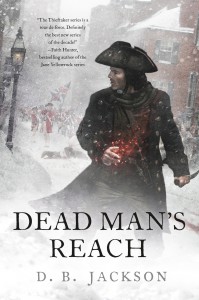 I discussed the Thieftaker books in last week’s post, and I mentioned how my love of U.S. history steered me toward setting the series in pre-Revolutionary Boston. But I failed to mention then that upon deciding to set the books in 1760s Boston, I then had to dive into literally months of research. Sure, I had read colonial era history for my Ph.D. exams, but I had never looked at the period the way I would need to in order to use it as a setting for a novel, much less several novels and more than a dozen pieces of short fiction. Ironically, as a fiction author I needed far more basic factual information about the city, about the time period, about the historical figures who would appear in my narratives, than I ever did as a doctoral candidate.
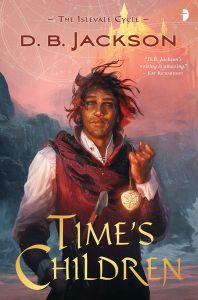
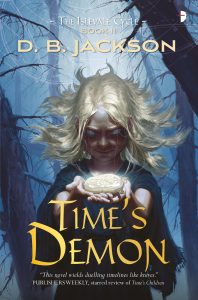 The same is true of the worlds I build from scratch for my novels. My most recent foray into wholesale world building was the prep work I did for my Islevale Cycle, the time travel/epic fantasy books I wrote a few years ago. As with my Thieftaker research, my world building for the Islevale trilogy consumed months. I began (as I do with my research) with a series of questions about the world, things I knew I had to work out before I could write the books. How did the various magicks work? What were the relationships among the various island nations? Where did my characters fit into these dynamics? Etc.
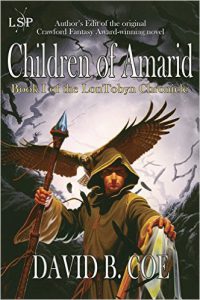 As many of you know, my first series, the LonTobyn Chronicle, had as its narrative core, a magic system in which mages formed psychic, magical bonds with birds of prey: hawks, owls, eagles. To this day, fans of the series mention those relationships between mages and their avian familiars, as the element of the books they enjoyed most.
 The thing is, we writers do and must “write what we know.” But we understand that “what we know” does not equal “what we have lived.” Writing is all about emotion, about delving into the thoughts and feelings and visceral reactions of our point of view characters. I may not have ever traveled through time (for example), or investigated a murder in pre-Revolutionary Boston, or discovered that I possess supernatural powers and then been pursued by rogue government agents intent on killing my family and making me their weapon. (If you haven’t read Radiants, it’s really time you did.) But even if I haven’t done those things, I have lived the gamut of emotions my characters experience. I have known fear. I have been in love. I adore my children and have been frightened for them. I have been enraged. I have experienced physical pain and illness, exhaustion and hunger, desire and pleasure. I have known joy and confusion and shock, the thrill of ambition realized and the bitter disappointment of expectation thwarted. I can go on, but I think you get my point.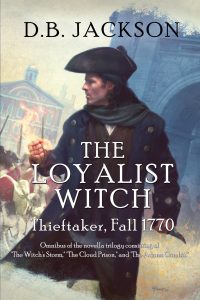
 This is a topic to which I intend to return next week and in the weeks to come. Because when we start to think of “write what you know” as an invitation to think more about what our lives, despite their mundanity, have in common with the lives of our characters, we find new ways to enrich our storytelling and world building.
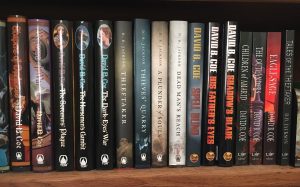
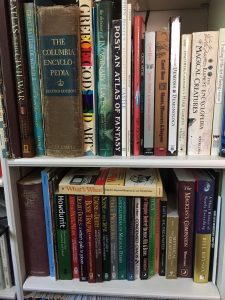 These are books I turn to again and again during the course of my work, and I expect the writer on your list will do the same. Not all of them are easy to find, but I assure you, they’re worth the effort. So here is a partial list:
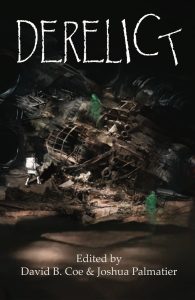 Last year, I co-edited Derelict. We received more than four hundred stories. The year before, I co-edited Galactic Stew. We received more than four hundred stories. The year before that, I co-edited Temporally Deactivated. We received more than two-hundred and fifty stories. Again, these are submissions for a total of six or seven slots.
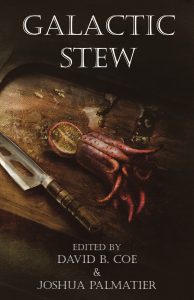 Along similar lines, ZNB anthologies are themed, which means that all the stories are about something in particular. Galactic Stew was about food. Derelict was about abandoned or lost ships. Noir is about detectives, in SF, fantasy, horror, or paranormal settings, investigating mysteries. As with the GLs, anthology themes are not suggestions. We’re not saying “If you feel like writing about detectives, feel free, but we’ll take any story about anything.” We’re saying, “For this anthology, we want detective stories with a speculative fiction element.” I can’t tell you how many stories we get that have nothing at all to do with our theme. I CAN tell you that we reject every last one of them. If you send to a themed anthology open-call a story that is off theme, it will not be accepted. Ever. Full stop.
 As you might expect, I did a great deal of prep work for my various classes — I wouldn’t dream of entering settings like those if I weren’t armed to the teeth with talking points, notes, topics for discussion, etc. For one thing, I have a responsibility to my students, and I take is seriously. And, though I don’t think most people would know it to look at me and listen to me, I suffer from profound stage fright. That preparation is my armor, my spell of warding. If I prepare well, my thinking goes, I’m less likely to make a complete fool of myself. This doesn’t always work — I’m perfectly capable of looking and sounding like an idiot even when I’ve done my homework. Still, I think my strategy is sound, at least in theory…