








 After running away from social media for six weeks, and ignoring publicity opportunities and the like, I feel a little funny offering any professional advice to anyone on anything. Which, I realize, is entirely wrong-headed.
Sometimes the stuff we write is completely divorced from our real lives, but more often than not, we draw upon personal experience and knowledge for our character work, our world building, our plotting, and our dialogue. Here’s a passage that is a case in point. It’s from The Fugitive Stone, the first book in the Celtic urban fantasy I’m working on.
“One of the insidious things about anxiety and depression—about all mental health problems, really—is the false sense that we’re the only ones who are like this. That we’re broken, and everyone else is ‘normal’”—she put air-quotes around the word—“whatever the hell that means. After all this time, you’d think I’d know better.”
The truth is, lots of writers struggle every day with problems and emotional issues that are at least as difficult as mine. Many have it worse than I do. I know this, and yet I still have to fight the tendency to think I’m the only one, that I’m messed up and everyone else is fine. There’s a little voice in my head that whispers shit like that to me all the time. I hate that fucking voice.
As I have mentioned here before, I find work to be a balm, a welcome distraction, a place I can go where my worries and griefs recede and I am free to create and thus escape for a short while. Sure, the stuff I’m avoiding is there waiting for me when I step out of my office, but the respite is the thing. It helps. Being productive, getting work done, helps me feel . . . [here’s that word again] normal.
There is no secret sauce to this. I can’t give advice on how others might find the same thing to be true with their work. Everyone suffers from mental illness in unique ways. Everyone’s challenges manifest differently. I know how fortunate I am to be able to work and produce and find solace in doing so. I know it’s not a path open to everyone.
But I will say this: Last year, when our daughter first received her cancer diagnosis, I gave up on everything, at least at first. I was convinced I wouldn’t be able to function. I called my agent and my editor and I told them both I was stepping back from all professional activities. I wouldn’t be blogging or posting to social media, I wouldn’t be attending conventions, I couldn’t imagine trying to write anything, and so I was going to stop working on the book I was writing at the time. I usually hit my deadlines, but that was one I was certain I would miss.
It didn’t take me long, though, to understand that sitting around worrying about my [adult] child and grieving for the terrible changes imposed upon our family by her diagnosis were poor activities with which to fill each day. I needed to do something that made me feel alive, that reminded there was more to my life than her illness.
This was in the spring of 2021, and the first day I tried to write was pretty much a disaster. I barely got anything written, and I’m not sure I kept a word of it. But the mere act of sitting down at my computer to work felt familiar and, thus, reassuring. I did it again the next day, and the one after that. By the end of that week, I had managed to write more than 7000 words — not close to my usual pace, but not bad at all. The weeks that followed were even more productive.
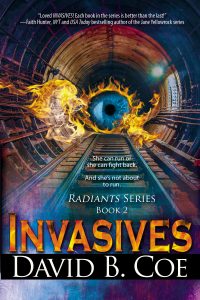 In the end, I hit my deadline. More, the book I wrote that spring, Invasives, the second Radiants novel, turned out better than I ever could have imagined. I love the book, not only because I think it’s good, but because it saved me. It got me through that terrible spring and early summer.
I guess what I’m saying is this: We are all coping with something. Life is hard. Life throws obstacles in our paths all the time. Life is a book and we are its protagonists, and just as we writers love to rain shit down on our characters, life rains shit down on us. My tendency, when the shitstorms grow too wild, is to run and hide. I did it in March of 2021. I did it again just a month or so ago, when our daughter suffered a setback in her fight with cancer.
But in 2021, and again this summer, I found that work helped.
Work might not be the answer for you. Maybe knitting is. Maybe photography is. Maybe music or birdwatching, cooking or cleaning, painting or gardening, reading or watching old movies. It doesn’t matter what it is. What matters is recognizing that something might help, that looking beyond the pain might well be just what you need.
Be well. Take care of yourself and the ones you love.
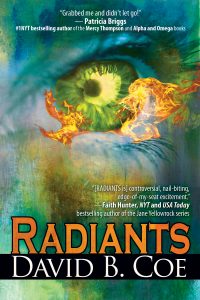 My editor at Belle Books is a woman named Debra Dixon, and she is a truly remarkable editor. This first book in the Celtic series is our third novel together, after Radiants and Invasives. In our time together, I have never once felt that her responses to my work were intrusive or unhelpful. With each book it’s been clear to me that her every observation, every criticism, every suggestion, is intended to help me tell my story with the greatest impact and in the most concise and effective prose. A writer can’t ask for more. This doesn’t mean I have agreed with every one of her comments. Now and then, I have felt strongly enough about one point or another to push back. And she’s fine with that. That’s how the editor-writer relationship is supposed to work, and she has always been crystal clear: In the end, my book is my book. But even when we have disagreed we have been clear on our shared goal: To make each book as good as it can be.


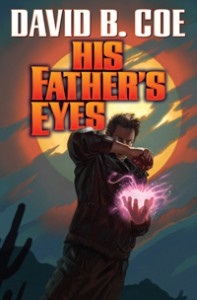
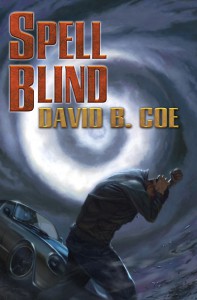 About seven years ago, I received out of the blue, an email from the actor Bronson Pinchot, who is probably best known for playing the role of “Balki” in the sitcom Perfect Strangers. He was, by then, enjoying a successful career as a voice actor, and he was writing to me because he was about to return to the studio to begin recording his reading of the second Justis Fearsson book, His Father’s Eyes. He wanted to know what I had thought of his treatment of the first book in the series, Spell Blind, and if there were things I wanted him to do differently with the second book.
 I was thrilled to get the email, and also impressed by the care he was taking with my books. But I wasn’t really able to give him the feedback he was after. “I have heard great things about your performance from friends, as well as from online reviews,” I told him. “I’ve listened to the sample on the Audible site and very much like your take on the character’s voice. The truth is, though, I am incapable of listening to others read my work. It has nothing to do with your performance, or any one else’s, for that matter, and everything to do with hearing the flaws in my own writing, which I find excruciating.”
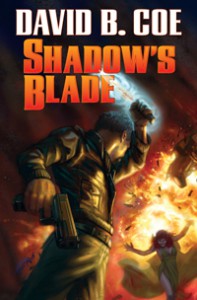 As it happens, I have from Audible the MP3 CD of the third and final book in the original trilogy, Shadow’s Blade. Since I also had in my immediate future two seven-hour drives, I thought I would go ahead and listen to the book. How bad could it be, right? Even if I hated what I heard (to reiterate, I wasn’t worried about Pinchot’s performance, but rather my writing), I could take solace in knowing that I was now seven years and at least eight novels more experienced than I was when I wrote the book.