Tomorrow night, I will be giving a talk on world building here at the university, in a themed residential house devoted to writing. The students from the house, at least those I’ve met so far, are earnest and passionate and serious about learning their craft. I’m looking forward to what I expect will be a fun and engaging evening.
For much of the evening, I will be answering questions and thus allowing the interests and concerns of the students to guide our discussion. I’ll open, however, with remarks on what I believe to be some of the keys to good world building. Some of these things I have covered in posts on this site — creating maps for our worlds, developing magic systems, building cultural and social traditions into our worlds through the creation of holidays, customs, and rites.
But I will also focus on the maintenance of our worlds. The feeding and caring of them, if you will. To my mind, one of the central elements of world building is putting all the work we do into practice.
What do I mean by this?
A couple of things, actually. First, I mean that the most important thing we do as writers who create worlds is convey the details of those worlds to our readers. The creation is the easy part. The hard part is sharing with our readers all of the cool things we’ve done, without resorting to data dumps and “as you know, Bob” moments. We want the communication of our world building to be seamless, invisible. We want the information we share to feel as natural as, well, every other part of our narrative. And so the descriptions and explanations of our worlds need to be doled out in ways that are consistent with point of view. Characters should not explain things, either in conversation or exposition, that they would not need to consider or discuss in that given moment. Put another way, if they have no reason to think or talk about these things other than to meet our needs as writers, then we have resorted to contrivance, and that’s not good writing. We need to be driven not by our narrative purposes, but rather by the exigencies faced by our characters. And so, world building needs to be conveyed in tiny increments, rather than in chunks, and it needs to be communicated, at least in part, through spoken language, with idioms and expressions and aphorisms and simple analogies that carry within them vital information.
Think of all the things we say in the course of everyday conversation that actually might give a stranger information about our world, our country, our faith traditions, our history. Elements of our landscape work their way into our speech as examples of grandeur or vastness or desolation or beauty. The same should be true of landscape features in our worlds. Figures from our history embody nobility, wisdom, generosity, courage, and also deception, betrayal, villainy. So should figures from the histories of our worlds. Tenets of faith become components of our social and cultural values, of our rituals and practices with respect to courtship and familial relationships. Faith should have a similar influence in our created worlds. I can go on, but I think you get the idea. We have to learn to write our worlds into our stories with the subtlety and pervasiveness of our own world’s insinuation into our language. That is how we communicate our world building without bludgeoning our readers with it.
And then the other element of this, the flip side of the same artistic coin, is making absolutely certain that expressions and analogies and all the rest, which might be reflective of our real, modern world, don’t creep into our writing in a way that contaminates our created worlds. We should avoid any figures of speech rooted in our traditions of faith, politics, history, culture, etc. We should avoid temporal anachronisms that might sound too modern for, say, our early-Renaissance-analogous created world. The last thing we wish to do as writers is create a world with painstaking care, only to undermine its credibility with conversations that sound more like something we might overhear in our local Starbucks.
As I say, I only have a short time at the beginning of tomorrow night’s event in which to present what I believe are key world building techniques. But to my mind the elements I have discussed here are so important that even if I had only half as much time, I would still work them in to my remarks.
Best of luck working on your worlds. Keep writing!!
 Last year, I co-edited Derelict. We received more than four hundred stories. The year before, I co-edited Galactic Stew. We received more than four hundred stories. The year before that, I co-edited Temporally Deactivated. We received more than two-hundred and fifty stories. Again, these are submissions for a total of six or seven slots.
 Along similar lines, ZNB anthologies are themed, which means that all the stories are about something in particular. Galactic Stew was about food. Derelict was about abandoned or lost ships. Noir is about detectives, in SF, fantasy, horror, or paranormal settings, investigating mysteries. As with the GLs, anthology themes are not suggestions. We’re not saying “If you feel like writing about detectives, feel free, but we’ll take any story about anything.” We’re saying, “For this anthology, we want detective stories with a speculative fiction element.” I can’t tell you how many stories we get that have nothing at all to do with our theme. I CAN tell you that we reject every last one of them. If you send to a themed anthology open-call a story that is off theme, it will not be accepted. Ever. Full stop.

 I was in the middle of writing a book — Invasives, the sequel to Radiants — and I dove back in. It’s a book about family, as so many of my novels are, and about discovering powers within. It doesn’t take much imagination to understand why I would find that particular story line comforting.
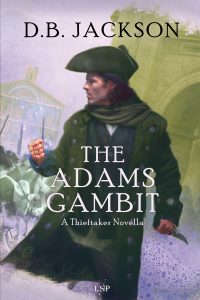 And so around that time, unsure of what to write next, I acted on an idea I’d had for several years. I hung out my virtual shingle as a freelance editor. Work came in quickly, and before I knew it I was editing a series for one friend, and talking to others about future editing projects. I also released the Thieftaker novellas. And prepared for the October release of Radiants. And started gearing up for the Kickstarter for Noir, the anthology I’m co-editing for
  Shortly after I graduated from college, back in Medieval times, I corresponded with a dear college friend, one who continues to this day to be a close friend. At the time, she was dealing with some emotional issues and had started therapy. “Counseling is the best thing in the world,” she wrote to me. “If everyone was in counseling with a good counselor there would be world peace.”
 A couple of years ago, I put the finishing touches on the third book of a time travel/epic fantasy trilogy called the
 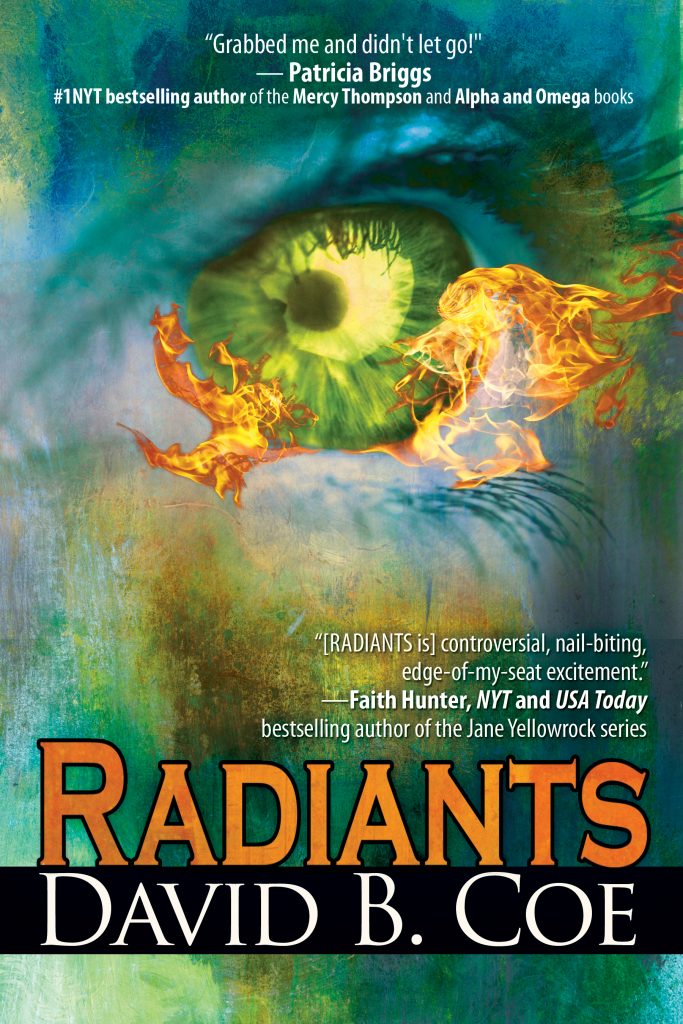 And that next book turned out to be Radiants.