








Okay, writers, raise your hand if any of your characters have ever done things you didn’t expect. Yeah, I figure that’s most of us. Now raise your hand if your characters have ever done things you really didn’t want them to do. Yep. Also most of us.
Of all the things I tell non-writers about what I do for a living, this is the one that always draws the most interest, surprise, and skepticism.
“But they’re creations of your imagination! You control them. How can they surprise you, much less disobey you?”
I control them?! Hah!
At the end of the first book of Winds of the Forelands, a series I intended at the time to be four books long (it wound up being five), one of my characters told me she was pregnant. I swear. I typed the words, sat back, and said aloud, “Freaking hell, she’s pregnant.” Except I didn’t say “freaking.”
I had the other books planned out. I knew where the plot was going and what the character arcs for the rest of the series were supposed to look like. There was no room in there for a kid. None.
“So,” a non-writer might ask, “why not delete that sentence from the manuscript and write something else? They’re your characters, inhabiting your world, right?”
Well, yes, but no.
Because while I didn’t want her to be pregnant, I knew as soon as I typed the words that she had to be, that it made far more sense with all that had come before. And the rest of the series, as eventually written and published, bears this out. It was a much better story with the child than without her. I just needed to be led there, and my character did that for me.
There is an old term, coined originally by midwives — the quickening. This is when a fetus begins to move, showing its first signs of life in the womb. And that is the term I use to describe the evolution of a character from a creature purely of our imagination, to a person capable of making decisions that surprise us and help to shape our narratives.
At my very first DragonCon some twenty-plus years ago, when I was still the newbiest of newbies, I got into an argument with a VERY famous fantasy writer about this very thing. (We were on a panel — this was in front of a crowd.) I won’t give this person’s name. Some of you have heard me tell the story, and so know. The rest of you have my apologies. But this was a BIG name, one of the very biggest. And this person swore up and down that we are the gods of our worlds, the masters of our stories, and if our characters were doing things we didn’t expect then we were doing this wrong. And at last, in my frustration, I said what I believe to this day to be the single wisest thing about character development I have ever offered: If you write them like puppets, they’ll read like puppets. (I patched things up with the Big Name afterwards. This person was gracious and kind, which is why my vehemence, and the implied criticism in my remark, did not wind up ruining my career.)
The quickening is a good thing, a great thing. When our characters begin to behave in a way that feels independent, as if they have agency and will and spirit, they become more real to our readers. They go from being words on a page to being three-dimensional beings.
Now, of course, they really are words on a page. And I have no doubt that someone versed in the workings of the psyche would tell me what is happening has nothing to do with the characters and everything to do with the mechanics of my imagination. At the moment of the quickening, they would likely say, my belief in my characters and my comfort with them reaches a point where they begin to work on my subconscious and influence my thinking about my narrative and my world. Whatever. It’s much easier to say that my characters are surprising me and guiding me. Because that’s how it feels, and in all ways that matter, that’s what’s happening.
I can’t think of any advice that will help you get to this moment with your characters. I would guess that most of you get there on your own, in the normal course of writing your stories. The truth is, the moment when our characters begin to surprise us is the moment when writing becomes really fun. When I’m writing and enjoying the process most, I don’t think so much as I describe things my characters are seeing, and document things they’re doing and saying. Writing dialogue becomes more like stenography — I’m writing down the conversations I hear in my mind.
But I will offer this — to carry the childbirth analogy a bit further…
Dealing with characters who have come alive in our minds is a bit like parenting. We want to give them the freedom they need to become the literary equivalent of living, breathing people. We want them to grow, to be independent, to have that agency I mentioned before so that the stories we’re telling feel organic and true and immediate. At the same time, though, as with real children, we don’t want to give them absolute free reign. That big name author was right in part: This is still our creative work, and while characters have to be allowed to take our stories in unexpected directions, they shouldn’t take over entirely. We wouldn’t want a five-year-old running our household, and we don’t want a fictional character, or even a set of them, making every meaningful decision in our narrative. Put another way, we don’t want to stifle the character’s growth, but by necessity we have to maintain some control.
The quickening is magical and affirming and inspirational. It’s that moment in Frankenstein (or, if you prefer, Young Frankenstein) when the doctor cries out “It’s alive!” It carries our storytelling to another level, transforming writing into something akin to discovery. But we must always remember that it does not absolve us of our creative responsibilities.
Enjoy! And keep writing!
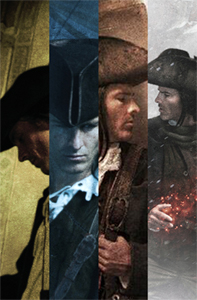 Then there are people like me. Some books, I outline in a good deal of detail. The Thieftaker novels demand preparation of this sort because I am tying together fictional and historical timelines, trying to make my story meld with established events. The Islevale books — time-travel epic fantasies — should have demanded similar planning. But for reasons I still have not fully grasped, all three books defied my efforts to outline. I simply couldn’t plot the books ahead of time. I tried for months (literally) to outline the first book, Time’s Children, and finally my wife said, “Maybe you just need to write it.”
 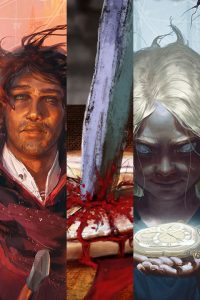 That’s what I did, and the result was a first draft that needed extensive reworking. When I began book II, Time’s Demon, I ran into the same problem. I didn’t even try to outline Time’s Assassin, the third and final volume. I knew it would be a waste of time. All three books needed extensive editing, more than I usually need to do. But they wound up being far and away the finest books I’ve written.
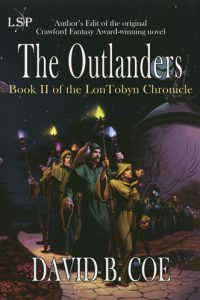 The second book, in contrast, was very much a product of its time, and I mean that in a couple of ways. In that book, The Outlanders, my heroes, Jaryd and Alayna are building a life together and starting a family, just as Nancy and I were starting our own family. When writing in book III, Eagle-Sage, about their young daughter, I drew extensively on our experience raising our first child. And in book II, when Niall lost his wife to cancer, I drew upon the experience of watching my father deal with my mother’s death.
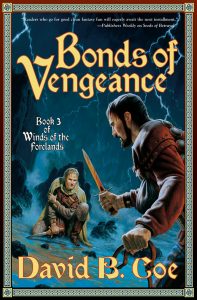 I was still working on the second book, Seeds of Betrayal, when the 9/11 attacks took place, and I wrote books three, four, and five against the backdrop of the Patriot Act, the torture of terrorism suspects, the illegal imprisonment of suspects at Guantanamo, and the deep anti-Islam sentiments of the early and mid-2000s. The Qirsi conspiracy was part of my plan for the series all along, but by the time the books were done, I realized that, without intending to, I had written a post-9/11 allegory. Again, I didn’t go back and change anything. I chose to keep the books as they developed. But I will admit to having been caught off guard by the degree to which our world had intruded upon my concept for the books.
 Still, I can say this: It’s easy to grow attached to one particular franchise, one particularly world and set of characters and style of story. Certainly I have written a good deal in the Thieftaker world, and will soon be coming out with new work about Ethan Kaille, Sephira Pryce, et al. The fact is, though, each time I have moved on to a new project, I have tried (admittedly with varying degrees of success) to challenge myself, to force myself to grow.
 After the LonTobyn books, I moved to Winds of the Forelands and Blood of the Southlands, which demanded far more sophisticated world building and character work. After those, I turned to Thieftaker, adding historical and mystery elements to my storytelling and limiting my point of view to a single character. I also started working on the Justis Fearsson books, which explored mental health issues and were my first forays into writing in a contemporary setting. Then I took on the Islevale books, time travel/epic fantasies that presented the most difficult plotting issues I’ve ever faced.