








 As many of you know, I am once again co-editing an anthology for Zombies Need Brains, Joshua Palmatier’s speculative fiction imprint. This is my fourth year as a co-editor, and each year Joshua follows pretty much the same approach to publishing his themed anthologies. Each collection has about fourteen story slots. He chooses a set of eight or so anchor authors for each volume and runs a Kickstarter to fund all the anthologies, using those anchor author names to attract support for the projects. Once the anthologies have funded (and Joshua has a remarkable success rate with his Kickstarters) he throws open the anthologies for general submissions, having reserved six story slots in each collection for non-anchor stories. He pays professional rates for the stories, and he puts out sleek, well-curated, well-edited books.
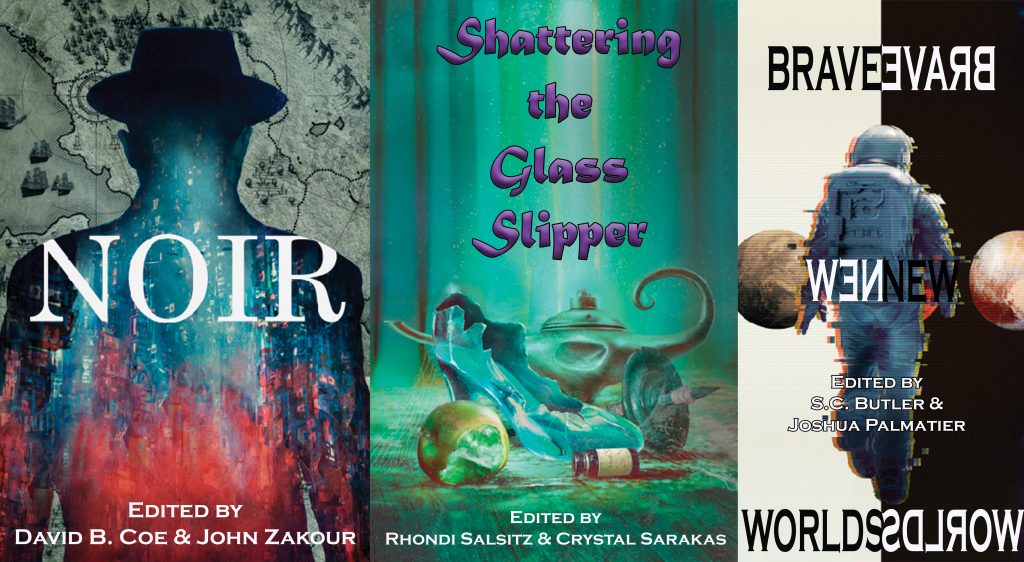
This year the three anthologies are Shattering the Glass Slipper, Brave New Worlds, and my anthology, Noir. Joshua is co-editing only one of the anthologies, a bit of a change from past years when he has nearly killed himself editing two or even all three of the books. We get literally hundreds of submissions for each anthology, making the selection of six (or five or seven) stories incredibly difficult.
As the publisher, Joshua takes it upon himself to send out acceptance letters and also rejections. Of course, he also handles the contracts and payments. His is a somewhat thankless job.
Most years, the rejection letters are met with either silence from the rejected authors, or, on occasion, with a “Thanks for considering me, maybe next time” note in return. This year was much the same. Except for one note he received:
In it the author said they had decided that if their story was rejected this time around, they would give up on submitting anywhere. And then they congratulated Joshua for killing their nascent writing career.
This is so wrong on so many levels, I hardly know where to begin.
First of all, Joshua is as nice a person as you could ever hope to meet. He doesn’t deserve this shit from anyone, much less a thin-skinned writer wannabe who doesn’t know anything about writing or the publishing business. (More on that in a moment)
I should also say that Joshua is a class act. He told his editors about the letter, but he didn’t tell us the author’s name or which anthology the story had been submitted to. I have no idea if I read the story. I do know there is a good chance Joshua had nothing to do with the story’s rejection. Even if the story in question was submitted to the anthology he’s co-editing, the rejection would have been a joint decision between Joshua and his editing partner. Mathematically speaking, it’s more likely that another pair of editors rejected the story. Joshua was simply delivering the bad news in his capacity as publisher.
But in a way, that ignores the galaxy of larger issues raised by this note. None of us editors is responsible for killing this person’s writing career. The author of the story is solely responsible for that. They are the one who chose to base their writing future on the fate of one story. They are the one who decided that one more rejection would be enough to make them give up. This was not a career murder. It was literary suicide.
A moment ago I called this person “a thin-skinned writer wannabe who doesn’t know anything about writing or the publishing business.” Maybe that sounds harsh. Too bad.
Writing is hard. Rejections are part of the business. I have been writing for more than a quarter century. I’ve published more than twenty-five novels and at least that many short stories. I have won awards, been a convention guest of honor multiple times, had fabulous reviews. And I still have my work rejected all the time. It. Is. Part. Of. The. Business. Yes, rejections suck. And upon receiving one I give myself a bit of time to be upset, angry, sad, whatever. An hour, maybe two. If it’s a big project and a publisher I really wanted to work with, I’ll give it a day. Then I pull up my big-boy panties and get back to work.
That’s what professional writers do. Chances are if you’re reading this, you’re a writer. You’ve been rejected. You’re still working. Good on you. That’s what you’re supposed to do.
Writing is not for the thin-skinned. Chances are, if a writer can’t take rejection, they can’t take criticism either. And if they can’t take criticism, they can’t work with an editor, which means they have no business being a writer in the first place.
The author of that obnoxious note has obviously not enjoyed much success as a writer. It’s pretty clear that this was the culmination of a string of rejections. I’m sorry for them. Truly. As I say, rejections suck and a bunch of them can be discouraging. And I can even see where, if these rejections have been spread over a span of several years, that could be enough to make this person give up. It’s almost enough to make me sympathetic. Almost. Because then we come back to the part where this person blames Joshua for ending their career.
Look, writing is not for everyone. Maybe you’re reading this having just been rejected yourself. Maybe you’re thinking of getting out of the business as well. I would say to you two things. First, try to remember that a rejection is not always a final judgment. Sometimes it’s a step in a creative negotiation, an indication that your story just needs a bit more work, a bit more polish, a tweak of a character or plot thread. Sometimes it has nothing to do with the quality of your story and everything to do with the other stories in the anthology and the particular slot in the collection the editors wish to fill.
And second, always remember that your reaction to rejection is a choice. You can choose to give up. You can choose to take it personally and flounce away. Or you can choose to see it as a challenge to improve your submission, or write a stronger tale next time around.
Whatever you choose, remember this: No one can make you quit but you.
Keep writing. Or don’t. But take responsibility for that choice.
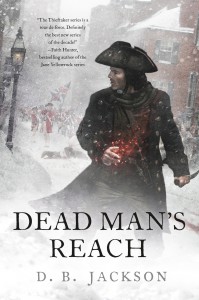 I discussed the Thieftaker books in last week’s post, and I mentioned how my love of U.S. history steered me toward setting the series in pre-Revolutionary Boston. But I failed to mention then that upon deciding to set the books in 1760s Boston, I then had to dive into literally months of research. Sure, I had read colonial era history for my Ph.D. exams, but I had never looked at the period the way I would need to in order to use it as a setting for a novel, much less several novels and more than a dozen pieces of short fiction. Ironically, as a fiction author I needed far more basic factual information about the city, about the time period, about the historical figures who would appear in my narratives, than I ever did as a doctoral candidate.
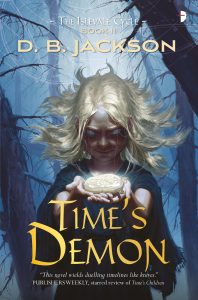 The same is true of the worlds I build from scratch for my novels. My most recent foray into wholesale world building was the prep work I did for my Islevale Cycle, the time travel/epic fantasy books I wrote a few years ago. As with my Thieftaker research, my world building for the Islevale trilogy consumed months. I began (as I do with my research) with a series of questions about the world, things I knew I had to work out before I could write the books. How did the various magicks work? What were the relationships among the various island nations? Where did my characters fit into these dynamics? Etc.
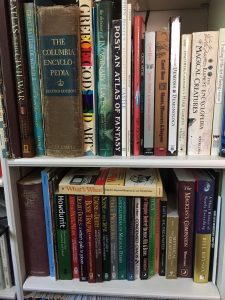 These are books I turn to again and again during the course of my work, and I expect the writer on your list will do the same. Not all of them are easy to find, but I assure you, they’re worth the effort. So here is a partial list:
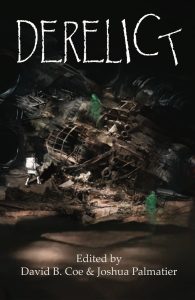 Last year, I co-edited Derelict. We received more than four hundred stories. The year before, I co-edited Galactic Stew. We received more than four hundred stories. The year before that, I co-edited Temporally Deactivated. We received more than two-hundred and fifty stories. Again, these are submissions for a total of six or seven slots.
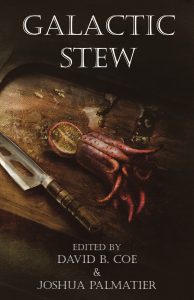 Along similar lines, ZNB anthologies are themed, which means that all the stories are about something in particular. Galactic Stew was about food. Derelict was about abandoned or lost ships. Noir is about detectives, in SF, fantasy, horror, or paranormal settings, investigating mysteries. As with the GLs, anthology themes are not suggestions. We’re not saying “If you feel like writing about detectives, feel free, but we’ll take any story about anything.” We’re saying, “For this anthology, we want detective stories with a speculative fiction element.” I can’t tell you how many stories we get that have nothing at all to do with our theme. I CAN tell you that we reject every last one of them. If you send to a themed anthology open-call a story that is off theme, it will not be accepted. Ever. Full stop.
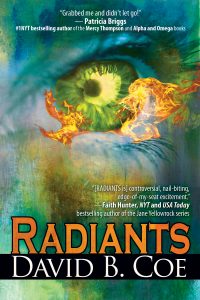 I was in the middle of writing a book — Invasives, the sequel to Radiants — and I dove back in. It’s a book about family, as so many of my novels are, and about discovering powers within. It doesn’t take much imagination to understand why I would find that particular story line comforting.
 And so around that time, unsure of what to write next, I acted on an idea I’d had for several years. I hung out my virtual shingle as a freelance editor. Work came in quickly, and before I knew it I was editing a series for one friend, and talking to others about future editing projects. I also released the Thieftaker novellas. And prepared for the October release of Radiants. And started gearing up for the Kickstarter for Noir, the anthology I’m co-editing for