Tag Archives: publishing business

Monday Musings: Where Does Mentoring Fit In With Today’s Publishing Realities?

I have a very good friend, also a writer, with whom I often discuss the depressing state of the writing world at this point in history. We have a sort of gallows humor about the whole thing — a lot of joking comments about low pay, the dearth of readers, the way New York publishing has basically lost interest in the midlist author, and the generally low quality of self-published works that we encounter when we dare to dip our toes into those murky waters. (No slight intended to anyone — seriously, if you are self-published, please don’t tell me that I have insulted you. There are good self-published books out there. But let’s be honest: The self-pubbed gems tend to be overwhelmed by the dross. Too many self-published books have had no serious editing or proofing, leaving them overlong and filled with errors that might easily have been avoided.)

Writers starting today face formidable obstacles that did not exist when I began my career (you know, back in the day when we carved novels into stone tablets….). There are more wannabe writers hawking their wares on various online platforms now than there have ever been. The democratization of publishing technology has convinced many that they can be professionals simply by writing something, slapping it into the appropriate app, and putting it up for sale. Again, some of those books might be very good, but none of them have had to make their way through any vetting process. I am a dedicated amateur photographer, and I am pretty good. I have even sold some of my work and had images published. But I am not truly a professional. I know professionals. Most of them are far, far better than I am. But I have access to digital photo equipment that has helped me elevate my skill. I have access to printing services that make my photos look professional. I have even put together a book of my work that looks like any other coffee table photography book. In short, I have benefited from the same sort of democratization in photography that I am describing with respect to publishing, even though I KNOW that I am not nearly as good a photographer as most professionals.

So, anyway, that is one obstacle: The sheer number of authors out there these days, competing for the attention of an ever-shrinking pool of potential readers.

Why ever-shrinking? That’s obstacle number two. I actually think the absolute number of devoted readers has remained roughly the same over the course of the past, say, fifty years. But if that number is remaining relatively static while the population grows, and while the number of would-be authors grows… well, you do the math.

The third obstacle I mentioned above: New York publishing — a moniker used to refer to what some might call legacy publishing — basically means the publishing houses that have dominated the industry for so long: Alfred A. Knopf, Random House, Saint Martins (which includes my old publisher, Tor Books), and other such behemoths. When I started writing, these big publishing houses were still (mostly) independently owned. They ran their businesses with at least some sense of the mission of their founders. They understood that publishing was not simply another profit-maker. The success of big-name authors allowed these houses to nurture the careers of beginning writers, and of those in the so-called midlist who had solid readership but who were probably never going to break into the ranks of those bestsellers. (And allow me to say here that legacy publishing was far from an idyllic business world. Yes, it supported authors in a range of sales categories. But the vast, vast majority of its authors were male and White.) Around the turn of the millennium, New York publishing began to consolidate. Mergers and buyouts disrupted that old model, and when the dust settled, many of the remaining publishing houses were subsidiaries of larger corporations that had no interest in sustaining the careers of authors who didn’t sell all that well. They still gave contracts to the big names, and they still gave contracts to young writers who showed promise, but they had little patience if those young voices didn’t catch on quickly, and they stopped maintaining the midlist pretty much entirely.
The publishers also squeezed out a lot of editors, feeling that editing was a luxury, and an expensive one at that. “Look at all those self-published titles selling online,” they said. “They’re not edited, and their readers don’t seem to care. Why should we spend so much when most readers just aren’t that discerning?” My editor at the start of my career was, to put it mildly, a problematic character. He was difficult to work with, unreliable, and slow. And eventually, he was fired for cause. And yet, I learned a ton from him. He taught me about the business. He taught me to be a much, much better writer, simply by working with me to improve my craft. I would be lying if I didn’t admit that I owe much of my career to his peculiar brand of wisdom. Young writers need that sort of mentorship. And in today’s world, few of them get it.

I should also say (in a post that is already lengthy) that today’s young writers also have to compete with a faceless, soulless technology that can produce passable stories at virtually no cost, in virtually no time. How the hell are human authors supposed to compete with that? Yes, AI generated characters and stories are not very good (yet). But again, many readers have come to accept mediocrity as entertainment, so long as it has a plot and serviceable characters. It may not be great, but it will divert my attention for a little while.

And all around us, civilization collapses….

Polaris Award, David B. Coe 2025That brings me to the larger point of this post. Last year, at ConCarolinas, I was given the Polaris Award, in large part for the mentoring of young writers I have done, and continue to do. Right now, I have no fewer than half a dozen writers who consider me a mentor. Over the course of my career, that number is far, far higher. I benefited from the wisdom of many established authors when first I began my career. I have always felt that it was my duty, and also my privilege, to offer the same guidance to those coming up after me. I love mentoring.

But in recent years, I have come to wonder how I can offer encouragement to young writers knowing how difficult a path they face in this profession. I have discussed this at length with the friend I mentioned at the beginning of this post. He feels much the same way, and yet he continues to mentor, too. Why do we do this?

At the risk of speaking on his behalf…. We do everything in our power not to mislead our mentees. We tell them all that I have said in this post about the state of the publishing world. We try to make certain that they understand fully the challenges laid before them. We make sure they know that there are many easier careers available to them, all of them more lucrative. But the truthis, this litany of obstacles usually does little to dissuade them. Which also begs that simple question: Why?

I believe the answer is the same for those seeking mentorship as it is for those of us who mentor. And I find hope in that answer. Storytelling is fundamental to being human. So is the act of receiving stories. Yes, that explains the glutting of the marketplace. But it also explains why so many of us continue to write for a world that seems less and less interested in the tales we create. Many of my friends who are writers tell me that they can’t not write. Writing is an imperative. It is as fundamental to their (our) being as breathing, eating, sleeping. This has been true for me for as long as I can remember. And it is also true for those seeking mentorship today. Just as reading (or listening to books and stories) is essential to those who still seek out books at cons and in bookstores. I have said repeatedly in this post that many readers are not all that discerning. They will accept stories that are just so-so in the absense of anything else. But I also believe that when they encounter a story written with passion and elegance, they recognize it, and they celebrate it.

This is a difficult time for the arts — not just writing, but also music, photography, painting, theater, dance, etc. Our digital world competes with those endeavors for our time, our ears and eyes, our money. And with the digital in our palms all the time, it has a huge advantage. And yet, new creators, with new creations, emerge from obscurity every day. Because at an elemental level, we yearn for art, for story and narrative, for beauty. These things are part of what make us human. I refuse to believe that they won’t remain so for generations to come.

Have a great week.
Monday Musings: A New Anthology and Submission Advice For Writers

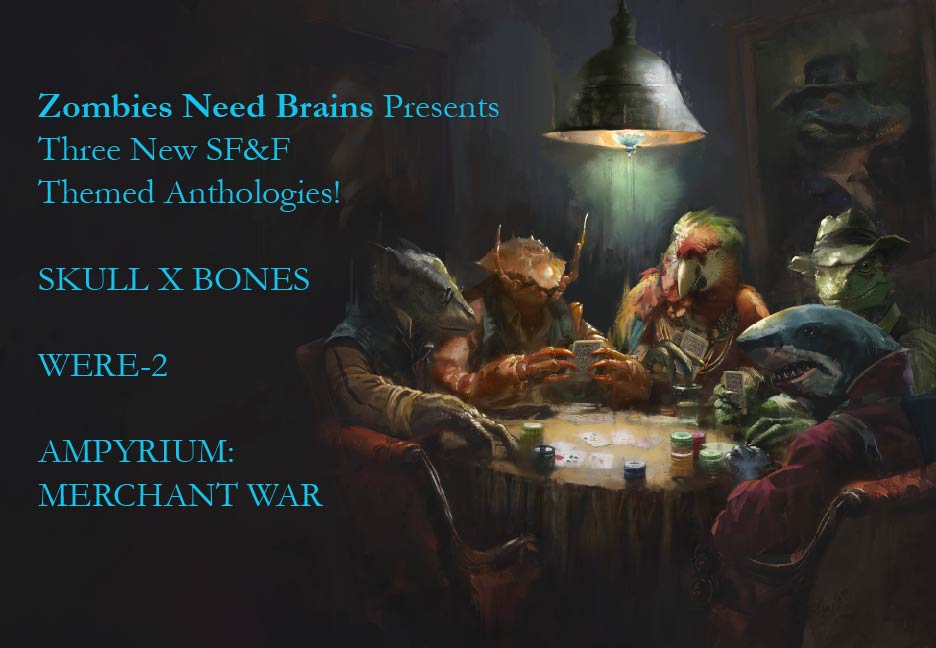
By now you might have seen the posts across several social media platforms: There is a new Zombies Need Brains Kickstarter campaign underway. For eleven years now, ZNB has been publishing quality short fiction from teams of established professionals and new voices found through open calls for stories. We’re doing three anthologies this year, and before I get to the advice part of the post, I wanted to take a bit of time to tell you about them.ZNB Kickstarter image

The first anthology is Were- 2, and is edited by Joshua Palmatier and S.C. Butler. The original Were- anthology came out in 2016, and featured stories about were-creatures other than werewolves. This new anthology has a similar theme. I wrote a story for Were-, one I still love, called “A Party For Bailey.” For my were-creatures I chose bears, and that’s all I’ll say. I’m sure you’ll love Were- 2 — its anchor authors include Randee Dawn, Auston Habershaw, Gini Koch, Gail Z. Martin and Larry N. Martin, Harry Turtledove, Tim Waggoner, and Jean Marie Ward.

This year’s second anthology is Skull X Bones. It’s a pirate anthology that I will be co-editing with Joshua. We will be looking for speculative fiction stories of any sort (fantasy, paranormal, science fiction, horror), as long as they focus on pirates. Our anchor author lineup includes Rod Belcher, Alex Bledsoe, Jennifer Brozek, C.C. Finlay, Violette Malan, Misty Massey, and Alan Smale.

Finally, Joshua will be solo editing a follow up to the Ampyrium anthology that was published earlier this summer. Ampyrium is a shared fantasy world that debuted in seven novella-length stories written by Patricia Bray, S.C. Butler, Esther M. Friesner, Juliet E. McKenna, Jason Palmatier, Joshua Palmatier, and me. The new anthology, Ampyrium: Merchant War, will have anchor stories from all seven of us, plus another seven stories (or so) from an open call.

So, as a long-time ZNB editor (Skull X Bones will be my sixth ZNB anthology), and a longer-term ZNB author (in addition to those I have edited, I have written for a half dozen ZNB anthologies), what advice can I offer to writers hoping to sell stories to one collection or another? Each ZNB anthology receives literally hundreds of open call submissions. Usually we take seven or eight stories. So you want your story to stand out in good ways.

1) Pay close attention to the anthology themes. When we ask for stories written, say, about pirates, that doesn’t mean the story should merely mention pirates or have one corsair as a background character. It means pirates, of whatever sort, should be so central to the story that without them, the narrative does not exist. For an anthology like Ampyrium: Merchant War, you should probably plan to read some or all of the first anthology, to familiarize yourself with the setting and the themes of those original tales. Speaking as an editor, I can tell you that I reject more stories for not being on theme than for any other reason.

2) Read the submission guidelines. This is important for ANYTHING you submit to any market. All editors are swamped with stories and short on time. We want to find great stories, obviously, but we also want to get through our slush piles. When I get a story that’s written in a tiny font, or that is single-spaced (which makes a story MUCH harder to read), or has wonky margins, or a weird font color, I tend to start reading it with a negative attitude. The writer in question has already ticked me off by ignoring the guidelines, and now I’m looking for one more reason to reject the story and move on to the next one.

You don’t want that. You want to do everything right in terms of formatting and following directions, so that I read the story with an open mind, so that I accept or reject the story purely based on the quality of the writing and narrative elements. Follow. The. Guidelines.

3) Proof your story. Then proof your story. And then proof your story again. Look, typos happen. All of us who edit for ZNB are also professional writers. We all have typos in our own books and stories, and chances are we could read through them 100 times and still not catch every little error. But that said, again speaking as an editor, finding two or three typos on the very first page is much like receiving a story that didn’t follow the GLs (see above). It makes me wonder if the author of the story cared enough to edit. Taking pride in our work means, in part, making our manuscripts as clean as possible.

4) Think about your narrative — and how it relates to the theme — as broadly as possible. Joshua has said, in offering advice on panels, “Your first idea is not necessarily your best idea.” And he’s right. Sometimes, a great idea comes to us immediately. Those moments are magical, but relatively uncommon. More often, our first idea is the most obvious one, which can mean that it will be similar to the ideas of lots of other writers submitting to the anthology. Let your ideas for your story steep a bit. Give them time to take you in truly innovative directions.

5) Develop your ideas. My second most common reason for rejecting a story is that the idea of the narrative failed to move beyond just that: an idea. A story is more than a cool premise. A story is about characters, be they human or fantastical or alien. A story brings some sort of change or progress to the lives of those characters or to the world around them. If your synopsis of the story you’re submitting doesn’t include something about characters, their lives, and the way things change for them, chances are you need to rethink your story. And I would add this — generally speaking, if the word count of your story is under 2,500, it probably needs more development. We rarely take stories that are shorter than that, not because we want you to pad your word count, but rather because it takes time to develop a plot into something more than an idea.

The open call for stories for this year’s ZNB anthologies will begin soon after the Kickstarter ends. So, first things first: We have to fund the projects. We are already a quarter of the way to our goal, which is great. But we still have a long way to go, and we need your help!!

Thanks, and have a great week!

Monday Musings: A Wonderful Return To Convention-ing

I spent this past weekend at ConCarolinas in Charlotte, reconnecting with fans, colleagues, and friends. And it was great.

The last con I attended was DragonCon at the end of August/beginning of September 2023, before the fall and all that came with it. Since that time, I have largely avoided crowds of people and interactions with even some close friends. I shied away from personal contact with pretty much everyone. It has just been too hard.

And so resolving to attend this con was a big deal for me. I put it on my professional calendar early in the year, committed to it, both internally and publicly. Honestly, I wasn’t sure it was something I wanted to do, but I knew it was something I should do.

All of which made this past weekend such a wonderful and surprising pleasure. Yes, I sold a good number of books — it was one of my best ConCarolinas ever in that regard. But more than that, it simply was wonderful to see people, to talk about writing and publishing, to laugh with friends who have been absent from my life for far too long.

Throughout the weekend, I was touched by the number of people who wanted to offer condolences, words of comfort, hugs of support. I was grateful again and again for the expressions of sympathy, and then for the efforts made by people around me to treat me as they always have — with affection and kindness, but also with irreverence and snark. A weekend that I feared would be awkward and challenging turned out to be fun and refreshingly natural.

It was, in short, exactly the convention I needed and wanted it to be. I have a great many people to thank for that, and I am not going to try to name them here. It’s not that they don’t deserve to be mentioned and thanked individually. They really, really do. But I am destined to forget someone important, and thus do more damage than good with such a list. Suffice it to say that if we shared a moment (or more) during the weekend — if we had a meal together, or a drink, or a panel, or a conversation; if you stopped by my book table to peruse my offerings or buy something or ask me a question about writing; if you had a role in making the convention such a great success (despite broken escalators and hobbled elevators and malfunctioning thermostats) — I am deeply grateful to you. Thank you.

Have a great week.

Monday Musings: “What’s Next?” Well, How About Some Big News?

“When I ask ‘What’s Next?’ it means I’m ready to move on to other things. So, what’s next?” — Jed Barlet, THE WEST WING

Yeah, I will seek out almost any excuse to quote from The West Wing, it being my favorite television series of all time. But as it happens, this is a question that’s been on my mind for a while now. In the show, “What’s next?” was more than a change of topic or a jump to the next agenda item. It was also used to turn the page after a setback, to refocus the staff after a triumph, even to look for a new beginning after tragedy.

As is the case with so much that happens in the course of the show’s seven seasons, the quote has long had great significance for me, and this is especially true now.

I know better than to think I can “turn the page” or “move on” from the past year. And even if I could, I’m not certain I would. But I am ready to restart my life, to venture back out into the professional and personal world, to find a new routine that makes room for all the emotional complexity of the new reality my family and I face.

In some ways, I have already started this process. I finished a book a few weeks ago, one I started back in January. It was sort of a work-for-hire, tie-in book, but it was fun to write. The plotting and character work proved absorbing, and because I started it later than I intended, the deadline kept me focused, motivated, and, yes, just a little manic. If it seems like I am avoiding telling you anything specific about the book itself, that’s because I am. Sorry. For now, I can’t really talk about it. When I can, you will all be among the first to know.

I have also written a novella for a new shared-world anthology that will be released this summer by Zombies Need Brains. And, as some of you have seen, I am again accepting clients for my freelance editing business. At the end of this month, I will attend ConCarolinas, my first convention since DragonCon last September. Baby steps. But steps forward, which is the point.

Today, I can also share some news about What’s Next that I think will please a good many of you.

First a little background.

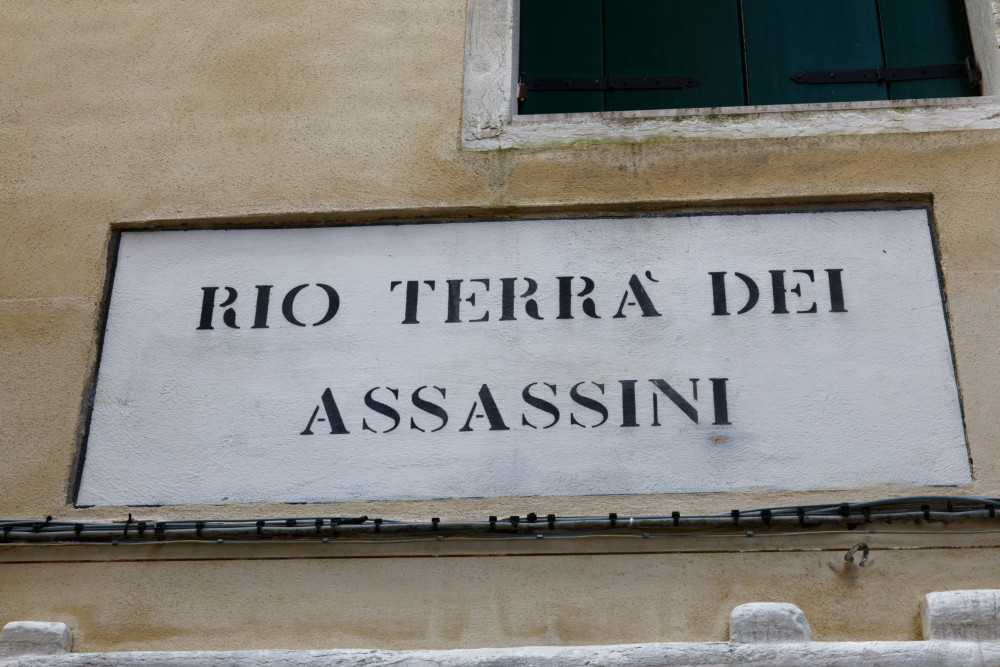
Many of you will have seen my blog post about the trip Nancy and I recently took to Italy. If you haven’t, you should check it out. For the photos, if nothing else. While we were in Venice, I fell in love with the city’s narrow lanes, ancient bridges, and gorgeous architecture. It is, visually speaking, the loveliest city I’ve ever seen. And there are no cars — all travel within the city is by boat, by foot, or by bicycle. Walking the streets was like a journey back in time.

Street sign in Venice: "Rio Terra Dei Assassini"
Street sign in Venice: “Rio Terra Dei Assassini,” which means, basically, “Street-That-Used-To-Be-A-Canal Of The Murderers.”

We took tours of the Doge’s Palace and Saint Mark’s Basilica (both were spectacular), and one of our tour guides mentioned that while Venice is a very safe city today, once upon a time it was anything but. And as proof of this, she said, we should pay attention to some of the street names. “Street of the Dead,” “Lane of the Murderers,” “Street of the Head” (that’s not a typo), and more.

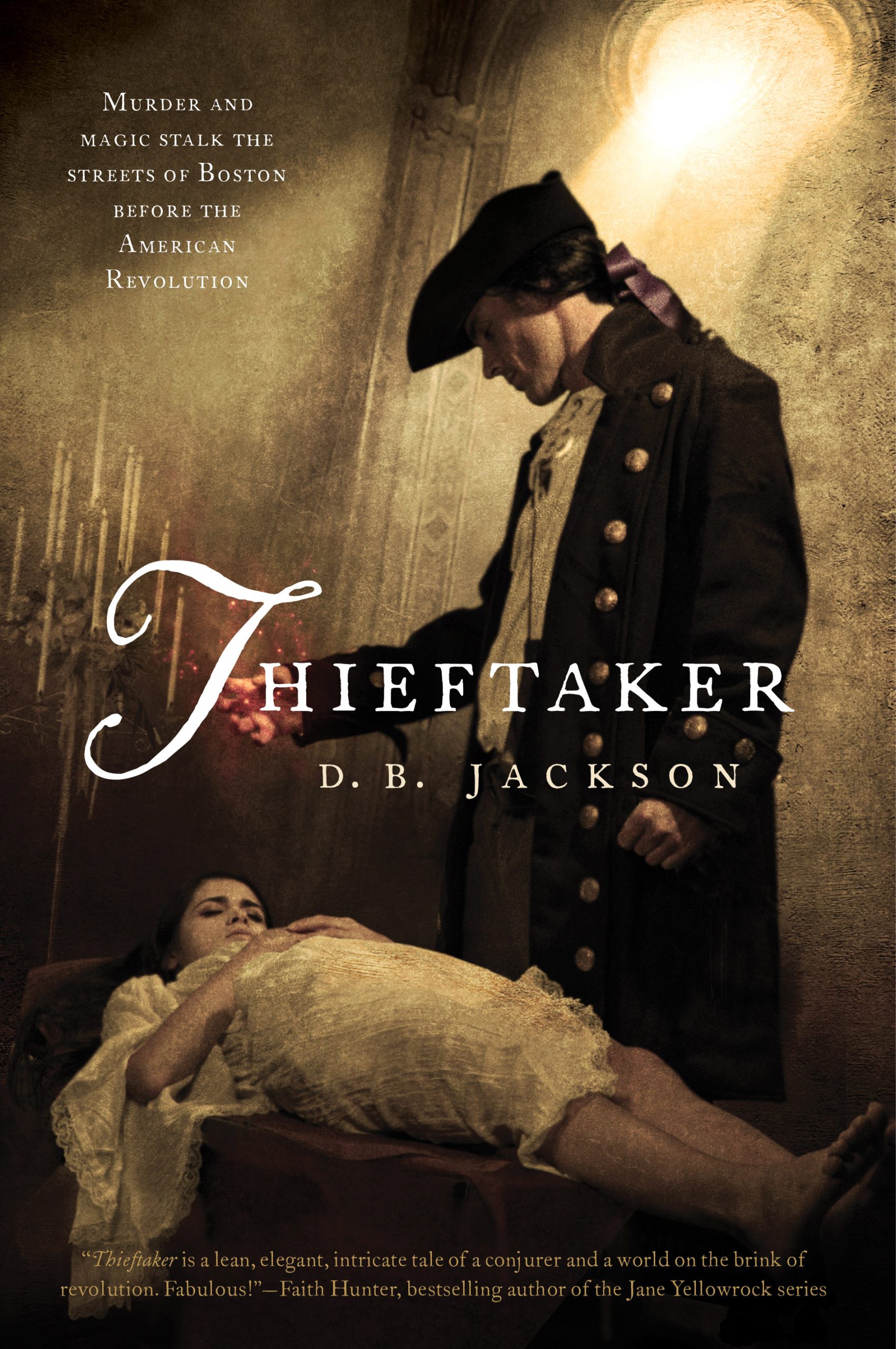
And, of course, this set my writer brain in motion. One thing led to another, and I can tell you now that I am beginning work on a new Thieftaker universe series set in 18th century Venice. I don’t know yet if it will be a spin-off or will feature Ethan throughout. I don’t even know how I am going to get Ethan to Venice, though I have some ideas about that. But I have already commenced my research for the books and I am totally jazzed. One publisher has already expressed interest in seeing a series proposal, so that’s good as well.

Thieftaker, by D.B. Jackson (Jacket art by Chris McGrath)What about the rest of my life? What’s next in other realms?
Well, we’re about to start doing some work on the house — I won’t say it’s overdue, but it comes at a good time. We have more travel planned for later in the year and several weddings to attend this summer and fall. We’ll see Erin. We’ll see other family and many friends. I’ll be at DragonCon late this summer. And we’ll continue to heal, even as we also look for ways to honor Alex’s memory and celebrate her life.

I look forward to crossing paths with many of you in the months to come. We have some catching up to do.

Have a great week.

Monday Musings: It ALWAYS Feels Good To Finish a Book

I could have ended this post at the title. That really is the point. I have been writing fiction for close to thirty years. I have finished more than thirty novels and as many pieces of short fiction, and yes, each time I complete the first draft of any story, it feels great. Kind of like completing a good workout or reaching the summit on a lengthy hike.

So, what is this new, just-completed novel about?

Well, I can’t really tell you that. I am co-writing with someone — a person of some celebrity who came up with the story concept but left much of the writing to me. Someone who, I will be honest, paid me rather well. And someone who, for now, would rather I said less than more about the story, the book, and our partnership.

I’m fine with that, but it does mean that I can’t answer questions. I’m sorry to keep secrets. Really.

I can tell you that finishing this particular book has felt better than most. In part, that is a consequence of all that my family and I have been through. I finished a novella for Joshua Palmatier at Zombies Need Brains earlier this year, and I’m pleased with how that came out. But this more recent project felt big when I started it. I didn’t know if I was up for writing a full novel.

And it is always a challenge to write in someone else’s world, bringing to life someone else’s characters and plot lines. (As it happens, the Zombie Need Brains story was written in a shared universe, so both of the things I’ve worked on this year have been not entirely my own.) On the one hand, when writing in someone else’s sandbox, I want to honor the creative vision of the person or people who conceived of the world and characters. I feel a sense of responsibility to the original idea and source material (in this case, a script). At the same time, though, I also NEED to feel some ownership in the project. I want to have a creative stake in what I’m writing. Otherwise, the work has no emotional or artistic appeal, and my writing winds up sounding flat.

As many of you know, about fifteen years ago, I wrote the novelization of a script for a major motion picture (I would rather not be more specific . . .). It was a difficult and, frankly, unpleasant process, in large part because I was given no freedom to create. I had to stick to the exact dialogue and narrative presented in the script. I could do some internal monologue, but that was all. This new project was VERY different. My co-writer gave me a good deal of freedom to write the story as I thought it should be written. As this person pointed, movies and their books are often very different. They were fine with that being the case here.

As a result, the book proved to be a great way for me to work my way back into writing after last year. A good deal of the emotional content was already spelled out in the original source material, meaning I didn’t have to do a deep dive into my own emotional world, which I am not yet ready to do. But I could add in some new content, some different characters, some different points of view. And in so doing, I could put my own creative stamp on the finished product. Which I did, quite well, I believe. The resulting story really is a collaboration, a blending of artistic visions.

What’s next for me professionally?

I’m not sure yet. Nancy and I have some travel planned for this year, as well as some long-deferred work on the house and yard. And so I think I will probably take a little break from writing fiction while we tend to other parts of our lives. But that is not to say I don’t have ideas for new stories. I do. I have Thieftaker ideas, I have an old series that I still intend to reissue sometime fairly soon, I even have Fearsson ideas. And I have ideas for stories in universes not-yet-created-or-explored. So, stay tuned.

And thank you for your patience.

Have a great week.

Monday Musings: The Emotional Challenge of Writing

Whenever I work with writers who are at the outsets of their careers — whether I’m editing their work for freelance or for an anthology, or teaching them in a workshop, or just talking shop on a convention panel — I try to stress the importance of delving deeply into emotion when telling our stories. There are so many elements that make a book or story effective. We want to create fascinating worlds, imbue those worlds with breathtaking magical systems or mind-bending imagined technologies, and give those worlds rich, complex histories, cultures, and religions. And, of course, we want our plots to be twisty, unpredictable, fun, and, ultimately, deeply satisfying.

At the end of the day, though, the key to a successful story, at least in my opinion, thirty novels and nearly as many years into my career, is character. Every other element of our storytelling can be perfect, but if our characters are flat and our readers don’t connect with them, we can’t consider our narratives successful. On the other hand, imperfections in our world building and our prose and even our plotting can be overcome with believable, memorable, relatable character work.

And I would argue that successful character work demands that we tap into the emotions of the people about whom we’re writing (even if they’re not technically “people”). Emotion is a writer’s bread and butter. Emotion is how we connect with readers, how our readers come to love (or hate) our characters, how our characters give meaning and purpose to our narratives. Emotion is everything. Without it, we might as well be writing shopping lists, or relating our stories in bullet points.

Why am I telling you this? Many of you aren’t writers, and probably don’t care about the craft of writing. And those of you who are writers have probably heard me talk about this stuff before. As I said at the outset, these are points I make at every opportunity, because I deem them so important to the success of any story.

Infusing our prose with emotion, capturing and portraying the feelings of our characters, using emotion as a tool to propel our plots — all of these things are really hard to do well. Writers spend entire careers perfecting the techniques. But sometimes — for me right now — it can be an overwhelming challenge simply to mine our own emotions so that we can draw upon them in our writing.

“Write what you know,” writers are often told. As a writer of fantasy, I approach this bit of wisdom with a healthy dose of skepticism. If all of us ONLY wrote what we “know” the literary world would be a drab, boring place. But “write what you know” does have some relevance for emotional writing. All of us have felt anger and contentment, fear and resolve, love and hate, sadness and joy. We are emotional creatures. And by drawing on our own emotional experiences and memories, we can bring authenticity and power to the emotions we impart to our characters.

The problem is, sometimes we don’t want to go there.

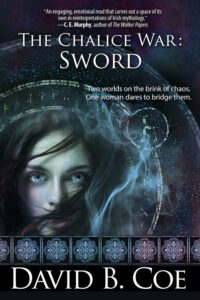
The Chalice War: Sword, by David B. CoeIn the last year, I have written two pieces of original short fiction. That’s it. I haven’t written a novel since I finished The Chalice War: Sword, late in 2022. I have recently started work on a tie-in project (I can’t really say more than that, right now), a novel. It is coming slowly, and because I am essentially playing in someone else’s world, the emotions I’ll be mining are somewhat removed from my own. I spent the first half of last year doing a bunch of editing, for myself and for others, figuring that when those projects were through, I would dive into a new book of my own.
Then our older daughter’s health took a dramatic turn for the worse, and that was pretty much it. I couldn’t write fiction anymore. I didn’t want to write fiction anymore. Because my entire existence outside of writing was about pain and grief and loss, and the last thing I wanted to do was a deep dive into my own feelings for the purpose of bringing life to new characters.

Now, a couple of things. First, fear not — this is NOT a permanent condition. I will write again, books and stories both. I have ideas I want to explore and projects I want to complete. I’m just not ready yet. And second, notice I said, “I couldn’t write FICTION anymore.” I did not stop writing; I have not stopped being a writer. Not entirely. I am writing posts again, and I have been journaling all this time. I have also been writing to friends. In all of this writing, I am processing and prodding. I may not be willing to delve deeply into my emotional world at this time, but I’m not ignoring it completely. I’m being careful. The way we might favor a twisted knee or avoid contact with a bruise on one side.

Because I am bruised, wounded. And I am far from alone in this regard. Lots of you write with and through emotional pain all the time. Which, I suppose, brings me to my final, larger point. Another thing writers are told constantly is to write as much as possible. “Professional writers write.” I’ve said this myself. And it’s true. But it doesn’t mean we can or should always be forcing ourselves to work on the next thing we want to sell. At times, we need to write for our own purposes. At times, we write not to make money, but to survive, to heal, to find peace. At times, we can only ask so much of ourselves.

This is such a time for me. As much as I would like to be “productive” again (whatever that means) I’m simply not there yet. Emotional writing may be our professional currency, but it’s not always possible. Admitting that, honoring that, is a step toward healing.

Have a great week.

Professional Wednesday: DragonCon and Professional Community

I am back from DragonCon, and I have a shortened week in which to get done a great deal, so today’s post will be fairly brief. Mostly, I want to say thank you — to the convention organizers, who did a wonderful job — yet again — with a near impossible task: keeping 65,000 people happy and safe throughout a weekend of fun, spectacle, and, for many of us professional networking and promotional activity. I want to thank the track chairs who once again welcomed me into their programming, treated me with respect and courtesy, and guided my colleagues and me through productive and interesting discussions. I want to thank the fans who came out to listen to us speak and buy our books. Without you, we writers are just a bunch of people with word processing software and voices in our heads.

And most of all, I want to thank my friends, of whom there are too many to name, who made me laugh, who engaged me in wonderful conversations — some silly, others fascinating, the best ones a combination of the two — and who expressed concern and support for me and for my family. This was a fun weekend for me, but also a hard one. At a time in my life when a part of me wants to retreat into my work and interact with no one, you all made my interactions feel safe and positive and comforting. I’m grateful to you all.

I often write and speak about the solitary nature of the writing profession. Most of us work in relative isolation, crafting our stories, polishing them, and venturing onto social media to promote them. Conventions like DragonCon offer us opportunities to emerge from our shells and reconnect with people we care about, people who understand the unique challenges of a publishing career, people who are witty and intelligent, passionate about their art and compassionate with their friends. I love to write, but I was reminded this week that I also love being a writer and having a diverse and committed creative community.

As part of my professional activity this weekend, I gave a series of brief mentoring sessions for aspiring writers. During each one, and also in several extracurricular conversations with writers seeking to break into publishing, I found myself asking them if they had Beta readers, people they could ask to read their work who would then give them honest feedback. Most of them had some, but clearly needed to widen their circle of such friends.

Since these Professional Wednesday posts are usually geared toward writing advice, I will close with this: cultivate those relationships. Find fellow writers with whom you can share your work, with whom you can talk shop, with whom you can commiserate over disappointments and celebrate successes. They are more than people who can help you improve your writing. They are your future colleagues, your convention friends, the people you will see year after year, picking up where you left off at the end of the last con that you attended together. They are your moral support and your sounding boards, your partners in goofiness and the emotional undergirding that will sustain you for the rest of what I hope will be long and fruitful careers.

Keep writing!

Professional Wednesday: Heading To DragonCon!

This coming weekend, I will be in Atlanta for DragonCon, the annual highlight of my professional calendar. For those of you unfamiliar with the phenomenon known as DragonCon, it is a huge convention that takes over Atlanta’s Peachtree Center every Labor Day weekend. In the past, the convention has attracted as many as 80,000 people. This year, in an attempt to control the crowd just a little, I believe attendance at the con has been capped at 65,000. Yeah, that’s still pretty big.
The con attracts television and movie stars (although I don’t know how the SAG strike will impact their numbers this year), directors, producers, writers (of scripts, novels, comic books, non-fiction, poetry, and pretty much every other written form), agents, editors, artists working in all media, musicians, animators, stand-up comics, costuming professionals, jewelry-makers, crafts-people of all sorts, and, of course, fans from all over the world.

The Chalice War: Sword, by David B. CoeIt is a spectacle. It is Mardi Gras for geeks. It is a party. It is a chance to do business. It is an opportunity to reconnect with friends. It is more fun than being six years old.

I will be on programming again this year, doing panels, signings, and a few mentoring sessions for the writers’ track. And when I am not involved in official convention programming, I will be in the Westin Hotel bar. If you’re in Atlanta for the weekend, please come by and say hello!

Here is my official schedule. (Note: I am listed in all program literature under “D.B. Jackson.”)

*****

Title: A Fond Farewell to Mrs. Maisel *Spoiler Warning*
Description: The final season of Mrs. Maisel took Midge’s career in a new direction, while her entire family is growing in new, unexpected ways. We might have gotten flashes of Midge’s future, but there are still plenty of things for our panelists to discuss.
Panelists: Jenna Johnson, D.B. Jackson, Dan Jolley, Cecilia Dominic, Elizabeth Carpenter(M)
Time: Fri 11:30 am
Location: Augusta Courtland Grand (Length: 1 Hour)

Title: D.B. Jackson signing booth 1201
Description: Come to the special author signing at The Missing Volume booth 1201
Panelists: D.B. Jackson
Time: Fri 01:00 pm
Location: Vendor Hall Floor 1 Mart2 (Length: 1 Hour)

Title: Themed Signing Alternate & Historic Fiction Track: History with a Twist
Panelists: Jean Marie Ward, Tamsin L. Silver, D.B. Jackson, David Boop, Gail Z. Martin, Walter Hunt
Time: Fri 05:30 pm
Location: Overlook Westin (Length: 1 Hour)

Title: The Gather: Welcome Home!!!!!!
Description: The best Gathering around of authors and fans! Who knows what surprises and treasures are to be found. We have more authors than the app will allow us to list, so you will be sure to find some great books to take home with your amazing Con stories.
Panelists: Milton J. Davis(O), John G. Hartness, Sherrilyn Kenyon, Philip Ligon, Jay Boyce, Jeffrey Falcon Logue, Patrick Dugan, William Joseph Roberts, Michael J Allen, Chris Jackson, Marc Alan Edelheit, Tamsin L. Silver, G. S. Jennsen, Katie Cross, David Boop, Quincy J. Allen, Tyra Burton, Matt Dinniman, Gini Koch, James Palmer, Darin Kennedy, Joelle Presby, Tao Wong, Harmon Cooper, D.B. Jackson, AJ Hartley, D.R. Perry, John Jackson Miller, Megan Mackie, Ellie Raine, Esther Friesner, Sean Fletcher, Katharine E. Wibell, Kaitlin Bevis, Isabelle Hardesty, Stacey Rourke, Mari Mancusi, Eric R. Asher, Frank Morin, Leanna Renee Hieber, Madaug Hishinuma, Wesley Chu, Bobby Nash, Howard Andrew Jones, Dennis Lee Robinson
Time: Fri 08:00 pm
Location: International South Hyatt (Length: 4 Hours)

Title: Anthology: A Buncha Great Writers Got Together…
Description: Wondering about anthologies? How to get invited into one? We’re going to lead you down the pathway to writing for anthologies.
Panelists: Trisha J. Wooldridge, Esther Friesner, Jeff Burns, Nancy Knight, Jean Marie Ward, D.B. Jackson
Time: Fri 08:30 pm
Location: Embassy EF Hyatt (Length: 1 Hour)

Title: A Fan Discussion of The Last Kingdom: Seven Kings Must Die *Spoiler Alert*
Description: Seven Kings Must Die was our last look into the world of Uthred, son of Uthred, and his companions. What did you think of the movie as compared to the TV series? What excited you, or left you wanting more? Did you feel that it wrapped up things nicely? Come discuss with your fellow fans!
Panelists: Emily Myerscough(M), Corey Applegate, Cathalson, Katie Brewster, D.B. Jackson
Time: Sat 02:30 pm
Location: Macon Courtland Grand (Length: 1 Hour)

Title: How Epic is Epic?
Description: Some stories are so big they require more than one book…sometimes many more than one. These can be called epic stories. What makes a story epic? How do authors decide how many books their big story requires?
Panelists: Kevin J. Anderson, Jean Marie Ward, David Weber, D.B. Jackson, Timothy Zahn
Time: Sat 05:30 pm
Location: International South Hyatt (Length: 1 Hour)

Title: Back in Time: Historical Urban Fantasy
Description: Our panelists explore supernatural beings & magic set in historical real-world settings.
Panelists: Cherie M. Priest, Chelsea Quinn Yarbro, Marie Brennan, D.B. Jackson, Carol Malcolm(M), Aaron Michael Ritchey
Time: Sat 08:30 pm
Location: Chastain 1-2 Westin (Length: 1 Hour)

Title: Many Tongues, 1 World: Using or Creating Languages in Literature
Description: We will be pulling in authors and a linguist to discuss using and creating languages for fantasy settings. Sometimes they may pull from the real world, other times it might be making things from scratch.
Panelists: Davis Ashura, Mera Rose, Mel Todd, Kevin McLaughlin, D.B. Jackson, Alex Shvartsman
Time: Sun 01:00 pm
Location: Embassy CD Hyatt (Length: 1 Hour)

Title: 15 Minute Mentor Sessions
Description: A chance for budding authors to talk one-on-one with a successful industry professional about business, promotion, the writing process, & career advice. Sign up in the Writer’s Track. (Embassy E/F)
Panelists: James Nettles, Darin Kennedy, D.B. Jackson, R.J. Blain
Time: Sun 02:30 pm
Location: Embassy G Hyatt (Length: 1 Hour)

Title: Are You a Good Witch, or a Bad Witch? Varieties & Approaches in UF
Description: Witches in Urban Fantasy run the gamut from helpful to extremely dangerous and self-serving, often in the same story. Our authors discuss their characters and the categories they fall into.
Panelists: Jennifer Blackstream, D.B. Jackson, Rachel Rawlings, Meg M Robinson, Melissa F. Olson, Carol Malcolm(M)
Time: Sun 05:30 pm
Location: Chastain 1-2 Westin (Length: 1 Hour)

Title: D.B. Jackson/David B. Coe signing booth 1201
Description: Come to the special author signing at The Missing Volume booth 1201
Panelists: D.B. Jackson/David B. Coe
Time: Mon 11:00 am
Location: Vendor Hall Floor 1 Mart2 (Length: 1 Hour)

Professional Wednesday: Writing Work-For-Hire Projects

Love what you write.

I say it a lot. It is the single piece of advice I always offer when asked what tips I would give to young writers (young of age, young of career). And I believe the advice is sound. Love what you write means a few things. It means love the process, love the act of creation, because writing is hard and isolating and, for most of us, not very profitable. It means write the story that burns in your soul, the story you ache to write, because if you write a story for which you have little passion in the hope of matching the market, chances are you will write an inferior story (and still miss the market, which is a moving target). And it means take time to appreciate your achievement in completing a story, in writing a great scene, in creating something entirely your own, because, as I say, writing is hard, and so is the publishing business, and we need to recognize our own successes.

But here’s the thing: We can’t always love what we write, and we certainly can’t always write what we love. Writing is an art, of course. It is creation. It can be fun and thrilling, soothing and healing. It can feed the soul.

It is also a business, a way of making a living. I am happiest when writing stuff that excites and nourishes me. Writing the Radiants books and the Chalice War trilogy was incredibly fun, and also a balm in a time of emotional turmoil. In the past, though, I have also written not for joy but for a paycheck. That is part of what I do. I have written media tie-in books that I would never, ever have written if not for the promise of money at the end of the process.

That may sound crass. So be it. I am a professional, which can mean a lot of things, some of them positive and dignified, some of them mercenary. I bring this up today, because I am on the verge of signing a contract for new work-for-hire writing. I can’t talk about the particulars right now. At some point, I’ll be able to. But I can discuss the process in general terms and even give some tips for dealing with this sort of work.

The thing about work-for-hire writing and media tie-in projects is that they are, in many instances, not necessarily what we would choose to write if left to our own preferences. Obviously this is not always the case. I have several colleagues who spend a good deal of time writing in the Star Wars universe, or the Star Trek universe, or some other genre franchise. And they love the work. They enjoy playing with characters they have grown attached to over the years, much as I enjoy playing with Thieftaker characters in new situations.

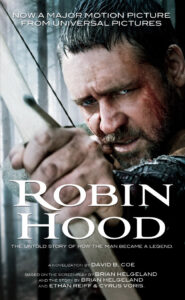
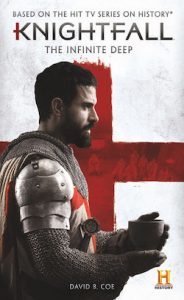
Robin Hood, by David B. CoeBut the media work I have done in the past wasn’t like that. Back in 2009-2010, I wrote the novelization of Ridley Scott’s movie Robin Hood, starring Russell Crowe and Cate Blanchett. The movie wasn’t out yet — I worked from a script — and I didn’t know whether or not I would love it. (I didn’t.) In 2018, I wrote a novel that tied in with the History Channel’s Knightfall series about the Knights Templar. In this case, I got to see all the episodes of the first season before the series was aired. I liked the show well enough.
In both cases, though, I always felt as though I were playing with someone else’s toys, which made the writing a bit challenging. I didn’t have the freedom I feel when working on my own stories in my own worlds. So, how did I make the work tolerable? DID I make the work tolerable? Good questions.

1) Look for something — anything — that allows you to take ownership of the project. This was particularly tough with the Robin Hood book, because the studio with whom I contracted maintained a death-grip over every element of the story. I could not add or delete ANY dialogue or scenes from the screenplay. I was utterly at the mercy of the script and the shoot, although the studio heads were so secretive, they would not allow me to see the movie!! I had to work from stills and from a couple of two minute movie-theater trailers. That was it!

So how did I take ownership? Point of view. I was in the minds of the characters, and since no internal monologue can be scripted, I could do with those passages whatever I wanted (to a point). There is one scene in the book of which I’m particularly proud — it’s written from the point of view of an old and fading Richard the Lionheart and I believe I nailed it.

Knightfall: The Infinite Deep, by David B. CoeWith the Knightfall book, I had a good deal more freedom and control, and so I enjoyed the process much, much more. But still I was mostly writing from the viewpoint of someone else’s characters. There is one point of view character, though, who I made my own — a child who appears later in the series as an adult. But her childhood POV was mine and gave me that sense of ownership, of personal investment in the book.
2) Take pride in what is yours and acknowledge the limitations placed upon you by what is not. Put another way, write the best book you can given the flaws inherent in the larger franchise. Robin Hood is not a great book. Robin Hood was not a great movie (though I believe it was better than many critics said). I believe I did as much with the book as I could under the circumstances, and that is all I can ask of myself.

3) Accept that work-for-hire makes possible the stuff we WANT to write. There is nothing wrong with writing for money. Hell, that’s what nearly all of us strive for when we begin this professional journey. When people ask me which of my books are my favorites, I never mention Robin Hood or Knightfall. But I don’t shy from talking about the experience of writing the books. I’m not ashamed of having written them. I’m a professional writer, and in both cases the media work provided a necessary financial bridge between personal projects. Without Robin Hood, I might not have written the Thieftaker books. Without Knightfall, I might not have written the Islevale Cycle.

Media tie-in, work-for-hire — call it what you will. This sort of work is part of the business, and while it may not be my favorite sort of book to write, it is part of what I do to maintain my career and to pay a few bills. If work of this sort comes your way, jump at the opportunity. The money is good and the publications bring exposure and possibly more jobs. Just remember to make the work your own in some way.

Keep writing!!

Professional Wednesday: In Defense of Simplicity

Today, as I was sitting at my desk, staring at a blank screen, trying to decide what I could possibly have left to write about when it comes to giving writing advice, a familiar song came on my Apple Music stream: “Rocket Man,” by Elton John and Bernie Taupin. Nancy is a huge Elton John fan, and has imparted an appreciation of his music to me over the years. We saw him live many years ago at the Shoreline Amphitheater in Mountain View, California, and it remains one of the best concerts I’ve ever seen. He closed with “Rocket Man,” and the place went nuts. It is a truly terrific song, one of his best, an iconic work of pop/rock.

It is also a deceptively simple song. It runs about four and a half minutes — a bit on the long side given when it was recorded — but lyrically it has just two sets of stanzas: each stanza four lines with a simple rhyme scheme. The two couplets of stanzas are separated by a chorus that is repeated twice. At the end of the song, the chorus is repeated twice more, and then the first line of the chorus is repeated several times as the song fades. That’s it.

As I mentioned in Monday’s post (not for the first time), I am a dedicated amateur photographer and a student of landscape and nature photography. One of my favorite artists is a guy name John Shaw, who is a renowned nature photographer and the author of many instructional books. In one of those books, he says this:

“Define your subject precisely and specifically, then include within the viewfinder only what fits your definition. My friend David Middleton [another accomplished nature photographer] has an analogy that applies here: he compares a photograph to its written description. It takes several paragraphs to describe a bad photograph, a few sentences for a mediocre photo, one sentence for a good picture, and just a phrase for a great photograph.” 1

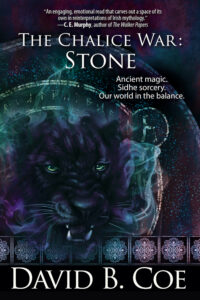
The Chalice War: Stone, by David B. CoeI have written a lot of books and stories over the years. The truth is, I love all of them. I can tell you a hundred things I like about every book I’ve published, and I believe if I could convince people to read each of them, the books would be very popular. But the fact is, as is true with most authors, some of my books have done far better commercially than others. And, as it happens, the ones that have tended to do well are those that are most easily and succinctly described. The Thieftaker books are my most successful. How do I pitch them to interested readers? “These are magical mysteries set against the backdrop of the American Revolution.” The new series, the Chalice War, is also easy to describe — “It’s a modern urban fantasy steeped in Celtic mythology.” These books, I have found, are as easy to sell as the Thieftaker books, and that is saying something.
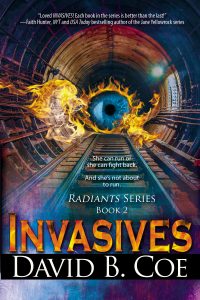
INVASIVES, by David B. Coe (Jacket art courtesy of Belle Books)The three books of the Case Files of Justis Fearsson and the Radiants duology might well be my favorites of all the books I’ve written. They are exciting, emotional, filled with great characters, and paced within an inch of their lives. But they are far more difficult to describe in a single sentence than other books and, likely as a result, they have never done as well commercially as I hoped they would.

All of this by way of saying what ought to be obvious by now. Simplicity is good. We writers love to come up with twisty plots that surprise and thrill our readers. And yes, there is much to be said for a few good plot twists. And there are plenty of books published every year that are purposefully complex and meant to blow readers’ minds. Some of them do very well.

I would argue, though, that complexity for complexity’s sake is unnecessary, and perhaps even counterproductive. I know, I know. Publishers and agents are constantly saying that they want to see something new and innovative, something that turns expectations on their head. And when they say this, I think they believe it. But I can’t tell you how often I hear of writers who have ideas that are truly different and mind-bending, but who can’t sell them because publishers don’t know how to market them, or fear that readers aren’t ready for what the authors are trying to do. Indeed, it’s happened to me; I’ve had works rejected for those reasons.

I’m not saying that you should jettison a story because it is inherently complex, or because your plot has too many twists and turns. Far from it. If that’s the book you’re writing, the idea you have nurtured and developed, great. Enjoy! And I wish you every success with it.

But if you have a story that seems “too simple” (whatever the hell that means), embrace the simplicity. Complexity comes from many sources. Your plot and concept don’t have to be complicated for your book to have merit. Sometimes a straightforward story line allows us to delve into the complexities of character and relationships, which can be every bit as rewarding for readers, not to mention easier to follow.

Again, simple is good. Make your narrative only as complicated as it needs to be and no more. Or, put another way, just write your story and make it as good as it can be on your terms.

Keep writing!

—-
1 John Shaw, John Shaw’s Nature Photography Field Guide (Amphoto Books, 2000), p. 98.