








Nancy and I received our Covid boosters on Friday. Saturday, we took naps, huddled in blankets (in addition to being without power due to powerful storms, we were both also dealing with low-grade fevers), and (once the power returned) watched a bunch of TV. By Sunday, we were feeling far better. As the week begins, we are back to ourselves, albeit with a twinge of lingering soreness in our arms.
We weren’t the only people at our local CVS receiving the booster, but we were depressingly close. Now, I know there are those who argue we should not be giving boosters to people in developed countries who are already vaccinated, when there are far too many nations in which vaccination rates remain well below 50%. It is crucial, these people say, that we get vaccines to the countries that are lagging behind. They are being devastated by Covid, and since new variants are most likely to develop in places where the virus is thriving, shifting resources to those nations protects all of us from the next Omicron.
All of this is true. But it only works as a strategy in a macro sense. Nations like the United States and our allies in Europe need to make a decision at the federal level to shift strategies and send more vaccine doses to under-served countries. You and me refusing to get the booster as a statement on national policy accomplishes nothing, and allows perishable doses to expire and go to waste. So as long as booster doses remain available, we should take advantage and get the damn shot!!
I have received the Moderna vaccine all three times now. The first shot left my arm sore. The second shot knocked me flat. Fever, headache, exhaustion. I was utterly useless for a full day and took a couple of days to recover entirely. Friday’s dose (the Moderna booster is actually half the volume of each of the first two shots), as I said above, left me tired and with a low-grade fever. It wasn’t nearly as bad as the second dose.
I will admit to being a bit reluctant on Friday. I didn’t want to be sick again, the way I was after vaccination #2. And I understand that lots of people who claim they are not worried about Covid, or who say they place their faith in God rather than vaccines, are actually just scared of getting the shot. They don’t want to be in pain. They don’t want the side effects. They would rather take their chances with the illness than deal with the certainties of the vaccine. (There is much talk about religious exemptions for vaccinations, but in the United States, only two major denominations expressly forbid their congregants to get vaccinated: The Church of Christ, Scientist, and the Dutch Reformed Church. Those are the only ones.)
Yes, the shot will hurt a bit, not just in the moment, but for a day or two or three after. And some people do feel puny for a day or two after getting the vaccine. And, yes, a very few people have even had more serious reactions to the shots. Such dangerous side effects are incredibly rare — less than one tenth of one percent of vaccine recipients reported them — but they do happen.
That the disease itself is far more dangerous, far more likely to cause long-term health problems, and exponentially more likely to prove fatal, goes without saying. Every study by every reputable institution, private and public, has come to that conclusion. Opinions to the contrary are just that: opinions — unsupported, unproven, likely unhinged. I am not going to catalogue the perils of Covid. I haven’t the time and space, and frankly, if you’re reading this now, and you haven’t yet chosen to be vaccinated, nothing I write is going to convince you.
Here’s the thing, though (and I understand some people CAN’T be vaccinated for medical reasons — this is not directed at them): Refusing the vaccine, like refusing to mask, has nothing to do with “freedom” or “liberty.” American freedom, while rooted in individual liberty, has always been an expression of community values, and refusing to take proper precautions to prevent the spread and mutation of Covid is an assault on the public good. Anti-vaxxers and mask-phobics are putting other people at risk. That’s NOT an opinion. That is fact, supported by medical professionals across the ideological spectrum. Vaccines save lives. Masks save lives.
So if you refuse to be vaccinated because you’re scared, or you’ve bought into foolish conspiracy theories, or simply because you can’t be bothered, so be it. But don’t fool yourself into thinking you’ve taken a stand for “liberty.”
If you HAVE been vaccinated, thank you. The closer we get to full vaccination, the more likely we are to prevent, or at least slow, the spread of future variants. And if you wear a mask in public, thank you for that as well. I just got a new set of masks — best I’ve had in the past two years. So I’ll be styling this holiday season…
Have a great week.
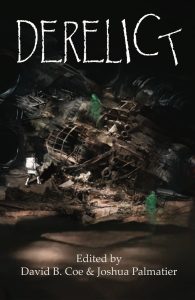 Last year, I co-edited Derelict. We received more than four hundred stories. The year before, I co-edited Galactic Stew. We received more than four hundred stories. The year before that, I co-edited Temporally Deactivated. We received more than two-hundred and fifty stories. Again, these are submissions for a total of six or seven slots.
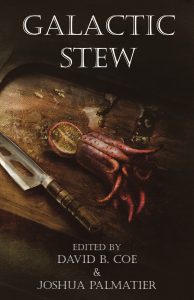 Along similar lines, ZNB anthologies are themed, which means that all the stories are about something in particular. Galactic Stew was about food. Derelict was about abandoned or lost ships. Noir is about detectives, in SF, fantasy, horror, or paranormal settings, investigating mysteries. As with the GLs, anthology themes are not suggestions. We’re not saying “If you feel like writing about detectives, feel free, but we’ll take any story about anything.” We’re saying, “For this anthology, we want detective stories with a speculative fiction element.” I can’t tell you how many stories we get that have nothing at all to do with our theme. I CAN tell you that we reject every last one of them. If you send to a themed anthology open-call a story that is off theme, it will not be accepted. Ever. Full stop.
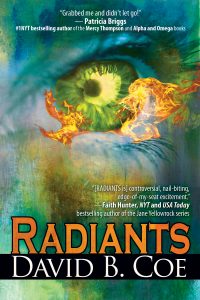 I was in the middle of writing a book — Invasives, the sequel to Radiants — and I dove back in. It’s a book about family, as so many of my novels are, and about discovering powers within. It doesn’t take much imagination to understand why I would find that particular story line comforting.
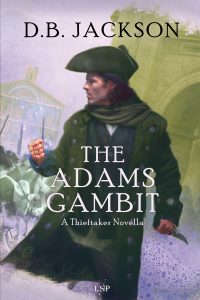 And so around that time, unsure of what to write next, I acted on an idea I’d had for several years. I hung out my virtual shingle as a freelance editor. Work came in quickly, and before I knew it I was editing a series for one friend, and talking to others about future editing projects. I also released the Thieftaker novellas. And prepared for the October release of Radiants. And started gearing up for the Kickstarter for Noir, the anthology I’m co-editing for
  Shortly after I graduated from college, back in Medieval times, I corresponded with a dear college friend, one who continues to this day to be a close friend. At the time, she was dealing with some emotional issues and had started therapy. “Counseling is the best thing in the world,” she wrote to me. “If everyone was in counseling with a good counselor there would be world peace.”