Back in November, just a few weeks after the death of our older daughter, I wrote of the difficulty I regularly encountered answering the question, “How are you doing?” At the time, my emotional state was a moving target. I didn’t know how I was doing. Not day-to-day, not hour-to-hour. I was as changeable as mountain weather, as fragile as ancient parchment, as vulnerable as a newborn. I was all over the place.
 It has now been nearly five months since we lost Alex. I still get the same question — and to be clear, I don’t mind being asked. Not at all. It’s just that I still don’t know how to answer. My friends tell me that five months is nothing, that there is no reason I should have a handle on my emotions already. My therapist says the same. I suppose I should listen to all of them. But I grow impatient with myself. I make my living with words and with emotions. The core of my art is conveying the emotional state of my point of view characters. It’s practically the definition of what a fiction writer does.
And I cannot manage to put into words what I am feeling. Worse, I can’t even explain it to myself. I had a birthday this past week. And birthdays, holidays — those can be tough when grief is fresh. I will always miss hearing from Alex on my birthday, but this was the first one without her, and the sense of loss was particularly keen. (Alex’s birthday is in early May, and already I dread its approach.) But I also had a good day. I had wonderful conversations with family and friends, a lovely dinner with Nancy. And yes, I had comforting memories of conversations with Alex on previous birthdays.
How was I doing that day? I have no idea. Great. Terrible. Okay. Not so well.
I wrote about grief just after New Year’s. Actually, I’ve written about grief a lot in the past year, but in that post in particular I wrote in praise of grief. “We grieve because we have loved,” I said. “We grieve because we remember. And while the ache of our grief dulls and lessens with time, we never stop grieving. Nor would we want to.” I hold to that still. But neither do we want to become mired in our grief. Is that what’s happening to me? I don’t know. Helpful, right? Maybe now you’re starting to grok my frustration.
In the older post I mentioned in the opening graph, I worried about those moments — fairly frequent — when I felt numb. At times more recently, I have felt as though I am emerging from that numbness. And then I’ll find myself back there again, and I’ll have no idea how I got there or when it happened. Memories still ambush me, surprising me with their vividness, stealing my breath, leaving me unable to do much of anything. No, I don’t want to stop grieving. Except when I do. Because, yes, there are times when I wish I didn’t have to grieve at all, when I’m just so tired of feeling this way, whatever “this way” might be. And then another memory warms me, brings a smile, reminding me that grieving really is better than forgetting.
I don’t think the problem is that I haven’t made any progress. I’m not sure there’s a “problem” at all. As I say, friends, family, and people who should know tell me my state of mind is pretty normal for what is an extraordinary circumstance. And then they remind as well of what I already know: There is no “normal” for something like this.
The point of all this? Well, one point is, please don’t stop asking how I’m doing. Really. I appreciate the love and concern behind the question. And the other point is, when I answer with a shrug and an “I’m not really sure,” know that I’m not being evasive. I’m being honest.
Finally, the greater point is that the answer to “How am I doing?” is as complicated and long as a novel, as a relationship, as a parent’s love for his child. I am doing all right, except on those days when I’m not. I am getting work done, except for those times when I can’t. I am eating well, exercising, taking care of myself, letting Nancy take care of me, and doing my best to take care of her. I am not curled up at the bottom of an empty bourbon bottle. I am not spending eighteen hours a day in bed. I am not paralyzed with loss and sadness. But neither am I the embodiment of emotional health. If I was, I think I’d have cause to be worried.
How am I?
I’m okay, thank you for caring. How are you?
 Today is the 22nd of January. It’s been exactly three months since our older daughter passed away.
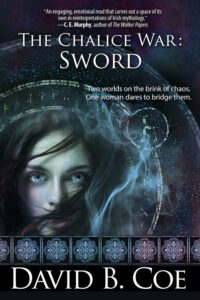 In the last year, I have written two pieces of original short fiction. That’s it. I haven’t written a novel since I finished The Chalice War: Sword, late in 2022. I have recently started work on a tie-in project (I can’t really say more than that, right now), a novel. It is coming slowly, and because I am essentially playing in someone else’s world, the emotions I’ll be mining are somewhat removed from my own. I spent the first half of last year doing a bunch of editing, for myself and for others, figuring that when those projects were through, I would dive into a new book of my own.
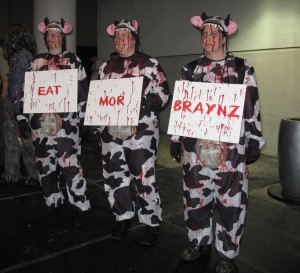 80,000 people. This year, in an attempt to control the crowd just a little, I believe attendance at the con has been capped at 65,000. Yeah, that’s still pretty big.
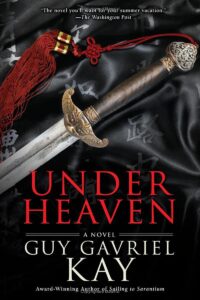 I have just started reading a book that I have read at least one time before. Maybe two. It is Under Heaven, by Guy Gavriel Kay, a terrific historical fantasy set in a world modeled after Tang Dynasty China. The truth is, I read many of Guy’s books more than once. I read books by other authors multiple times as well, and I would recommend that others do the same — writers AND non-writers.
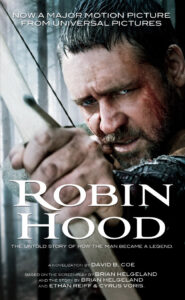 But the media work I have done in the past wasn’t like that. Back in 2009-2010, I wrote the novelization of Ridley Scott’s movie Robin Hood, starring Russell Crowe and Cate Blanchett. The movie wasn’t out yet — I worked from a script — and I didn’t know whether or not I would love it. (I didn’t.) In 2018, I wrote a novel that tied in with the History Channel’s Knightfall series about the Knights Templar. In this case, I got to see all the episodes of the first season before the series was aired. I liked the show well enough.
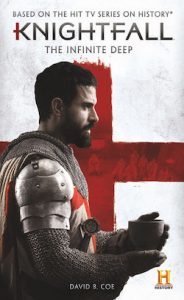 With the Knightfall book, I had a good deal more freedom and control, and so I enjoyed the process much, much more. But still I was mostly writing from the viewpoint of someone else’s characters. There is one point of view character, though, who I made my own — a child who appears later in the series as an adult. But her childhood POV was mine and gave me that sense of ownership, of personal investment in the book.
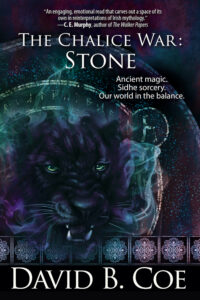 I have written a lot of books and stories over the years. The truth is, I love all of them. I can tell you a hundred things I like about every book I’ve published, and I believe if I could convince people to read each of them, the books would be very popular. But the fact is, as is true with most authors, some of my books have done far better commercially than others. And, as it happens, the ones that have tended to do well are those that are most easily and succinctly described. The Thieftaker books are my most successful. How do I pitch them to interested readers? “These are magical mysteries set against the backdrop of the American Revolution.” The new series, the Chalice War, is also easy to describe — “It’s a modern urban fantasy steeped in Celtic mythology.” These books, I have found, are as easy to sell as the Thieftaker books, and that is saying something.
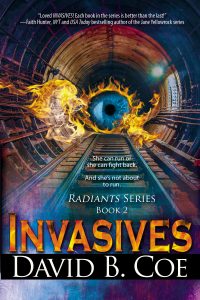 The three books of the Case Files of Justis Fearsson and the Radiants duology might well be my favorites of all the books I’ve written. They are exciting, emotional, filled with great characters, and paced within an inch of their lives. But they are far more difficult to describe in a single sentence than other books and, likely as a result, they have never done as well commercially as I hoped they would.