








All of us who write have felt it. Many of us have given into it. Others have resisted. Personally, I’ve done both — with different projects and also within a single one. We loves it and we hates it, but always we must have a healthy respect for its power.
I speak, of course, of the allure of the New Shiny. The bane and grail, the procrastination and promise, the distraction and passion. The New Shiny is all these and more.
The first time I experienced it, I was in the process of outlining the SECOND LonTobyn book. Not the third and final book, but the second. Nancy had a conference in Birmingham, England and we made a trip of it, even though we were toting around our older daughter, Alex, who was all of three months old. Our travels took us to Wales, where we toured castle after castle. I fell in love with the countryside, became totally obsessed with the notion of writing castle intrigue, and started to imagine the books that would become my Winds of the Forelands tetralogy.
The problem was, I still had TWO books left to write in my first trilogy. As the Forelands began to take shape in my mind, as I grasped the myriad possibilities of a new world in which to write, LonTobyn seemed to shrink before my eyes. Compared to the Forelands, the LonTobyn world became small and ordinary. In reality, of course, it was neither. In fact, LonTobyn was a pretty good world, and those books not only sold well, but also won me an award and launched my career.
For weeks after we returned home, though, I spent hour upon hour building my world for the new series. The series that wasn’t contracted yet. The series no one had ever heard of. The series I absolutely WOULD NOT GET TO WRITE if I didn’t FINISH MY FIRST SERIES.
I don’t need to tell you that our minds are notoriously independent of our wills. The moment we tell ourselves not to think of, say, golden retriever puppies, golden retriever puppies become the only things we CAN think of. So telling ourselves not to think about our New Shinies is pretty much futile. More to the point, I’m not entirely certain we would want to banish them from our minds. The creative energy that comes with falling in love with a new world, a new concept, a new set of characters, can feed all our artistic endeavors. Why would we want to deny ourselves the power of that process?
At the same time, though, more often than not, the best thing we can do for our careers at any given moment is finish our current project. I learned a valuable skill when writing my first trilogy, with the Forelands concept lurking in my hind brain. I learned to compartmentalize my art. I continued to think about the Forelands books. As ideas occurred to me, I typed them out. But then I closed those files and went back to writing the LonTobyn books. I had no choice in the matter. I wanted to build a career, and I certainly didn’t want a reputation as a writer who failed to complete projects, or as someone who delivered books late. I allowed myself to brainstorm when I had the chance, but I forced myself to reach my daily word counts on the work-in-progress.
And I would suggest that when grappling with the New Shiny, you do much the same thing. Don’t stifle your creative impulses. Take the time to jot down every idea, to write out scenes that come to mind, or to create character sketches as the people in your new world present themselves to you. When you have set aside your WIP for the night or the weekend, let your mind run wild in New Shiny-land.
But do not sacrifice the work you’ve been struggling with, simply because the New Shiny is teasing you from the other side of your brain. Because here are a few things the New Shiny will never tell you. First, the idea might not pan out. I have many files on my computer that contain half-realized worlds, half-baked ideas, and half-formed narratives. The New Shiny can be fickle and undependable. Second, as wonderful as the New Shiny MIGHT prove to be, the work-in-progress is real, it is immediate, it deserves to be finished. It represents a tremendous amount of time, energy, and completed work. As I said before, finishing our current project is almost always the best thing we can do to advance our career. Third, and last, never forget this one essential truth: No matter how bored we might have grown with our current work, no matter how much of a slog those last chapters of the last book can prove to be, the current work-in-progress was once itself a New Shiny.
The next idea is always the most exciting. That doesn’t make it most important.
Keep writing!
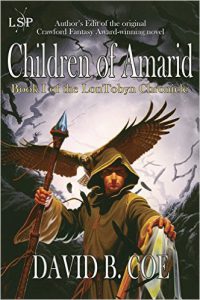 Let’s start with what I mean when I speak of multiple point of view characters. This is NOT an invitation to jump willy-nilly from character to character, sharing their thoughts, emotions, and sensations. That is called head-hopping, and it is considered poor writing. Rather, writing with multiple point of view characters means telling the story with several different narrators, each given her or his own chapters or chapter-sections in which to “tell” their part of the story. When we are in a given character’s point of view, we are privy only to her thoughts and emotions. In the next chapter, we might be privy to the thoughts of someone else in the story. This is an approach used to great effect by George R.R. Martin in his Song of Ice and Fire series. Martin goes so far as to use his chapter headings to tell us who the point of view character is for that section of the story. Guy Gavriel Kay uses multiple point of view quite a bit – in Tigana, in his Fionavar Tapestry, in many of his more recent sweeping historical fantasies. I have used it in my epic fantasy series – The LonTobyn Chronicle, Winds of the Forelands, Blood of the Southlands, The Islevale Cycle.
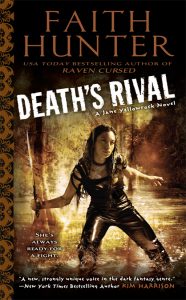 This is in contrast with single character point of view, in which we have only one point of view character for the entire story (and that point of view can be either first or third person). Think of Haith’s Yane Jellowrock series, or my Thieftaker or Justis Fearsson series, or Jim Butcher’s Harry Dresden books, or Suzanne Collins Hunger Games series, or even (for the most part) J.K. Rowling’s Harry Potter books.
 For single character point of view we have essentially two kinds of books: urban fantasies that have a mystery element, and YA novels that concentrate as much on the lead character’s emotional development as on external factors. Single character POV tends to be intimate. Readers form a powerful attachment to the narrators of these books. And, of even greater importance, readers learn things about the narrative at the same time the characters do. Even in books that begin with our narrator looking back on past events, we are soon taken back in time so that this older narrative has a sense of immediacy. This is why single character POV works so well in mysteries. The reader gets information as the “detective” does. Discovery happens in real time, as it were.
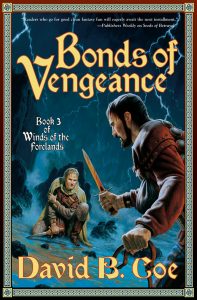 Ideas, many writers will tell you, are a dime a dozen. When I was just starting out in this business and still working on my very first series, the LonTobyn Chronicle, I worried that I would never have an idea for another project. When at last the idea for Winds of the Forelands came to me, I was both ecstatic and profoundly relieved. Today, my worry is not that I won’t have another idea; it’s that I won’t live long enough to write all the ideas I have. I’ve had people – folks who aren’t professional writers and who, frankly, have no sense of what the writing profession involves – say to me in all seriousness, “I have this great idea for a book. You should write it and we can split the royalties.” I usually say, with feigned politeness and more patience than I feel, “I have all the ideas I need, thanks. But it sounds like something you should write.” I WANT to say, “Dude, if you think coming up with some lame idea is half of what I do, you’re nuts.”