








Putting on my historian’s cap…
There are certain years in modern history that stand out as significant all on their own. They are so fraught, so filled with resonance and import, that they become both microcosms and embodiments of the periods in which they occur. They typify entire eras.
Arguably, the most prominent example of this is 1968, the capstone of a tumultuous decade. It began with the Tet Offensive at the end of January — a coordinated and devastating attack on key military and civilian positions carried out by the Viet Cong and the North Vietnamese. The offensive gave the lie to all the false assurances of “progress” the U.S. military had been offering about the American war effort in Vietnam. In March, the sitting President, Lyndon Johnson, was nearly defeated in the New Hampshire primary by Senator Eugene McCarthy. Weeks later, on the 31st of March, Johnson withdrew from the race, throwing the election into turmoil. On April 4, Dr. Martin Luther King, Jr. was assassinated, sparking riots in many cities. Only two months after that, Bobby Kennedy, by then the leading contender for the Democratic nomination, was shot and killed as well. Summer saw the chaos of the Democratic National Convention in Chicago, with riots in the streets and near brawls within the convention center. In November, former Vice President Richard Nixon narrowly defeated the sitting Vice President, Hubert Humphrey, for the Presidency.
2020 will be remembered and written about the way 1968 is. The pandemic, which introduced the world to “masking” and “social distancing,” and exposed anew the anti-science, anti-“elite” biases of a significant portion of the American public, turned the world upside down. The casualty count — total cases, hospital capacity, deaths from the disease — has become a grim daily reminder of our nation’s failure to grasp the seriousness of the problem, and our national leaders’ incompetence and lack of compassion.
The resulting economic collapse sent shockwaves across the entire globe. Here in the U.S., unemployment spiked, businesses closed, the stock market tanked, rallied, fell again, and now is rallying again, even as the pandemic’s third wave ravages rural communities in nearly every state.
The murders of Breanna Taylor, Ahmaud Arbery, and George Floyd sparked protests throughout the country, and beyond our borders. These protests, in turn, further exposed the problem of police brutality in countless cities. Confrontations between White vigilantes and police on the one hand, and protesters, Black and White, on the other, turned ugly, violent, and deadly.
At the same time, the nation went through a political campaign like no other, with the pandemic curtailing in-person campaigning and complicating the voting process. We saw the historic nomination and subsequent election of Kamala Harris as our next Vice President. And we watched Donald Trump engage in an unprecedented assault on our democratic norms, that were ultimately unsuccessful, but damaging nevertheless.
Then there were the oddities — shortages of rice and beans, toilet paper and cleaning supplies, bread flour and other staples; restaurants and bars closed for a time (and now closing again); sporting events and entire major league seasons altered, reconfigured, “bubbled;” movies and theater and concerts forsaken.
And, of course, we saw more than our share of tragic and untimely deaths, losing Ruth Bader Ginsberg and John Lewis, Kobe Bryant and his beautiful daughter, Chadwick Boseman and Naya Rivera and countless others.
Every time we thought 2020 couldn’t get crazier or darker, it did. Stress and anxiety afflicted nearly all of us in one form or another. Isolation became its own epidemic.
It goes without saying that future historians will write books about this year. Our grandchildren will ask us questions about the pandemic.
Here are a few things I’ll remember.
Early in April, our older daughter, who lives in Brooklyn, and who was living alone in the bleakest days of New York’s early struggle with COVID, texted me about what it was like living in the city at that point. All she heard, she said, were sirens. “It’s eerie because the streets are otherwise dead. Sirens are the only sound.” Except in the mornings, she added, when all the churches rang their bells. Haunting.
Our younger daughter contracted COVID in September, and I will never forget my fear, my feeling of helplessness, my awareness of the miles between us and the impracticality, even danger, of going to see her and care for her.
The news that Ruth Bader Ginsberg had died hit me like a gut punch, and prompted a very real concern that Trump’s replacement, whoever it might turn out to be, would help him steal the election.
I went to bed on election night, thinking that Trump had probably won. The counting of absentee ballots in key states hadn’t yet started, and though I had read enough about the “red mirage” and the “blue shift” to know what to expect, the numbers looked daunting. Waking up Wednesday morning to renewed hope was one of the highlights of the year.
For me, personally, this was a year of physical problems that reminded me of my advancing age. For the first half of 2020 I dealt with debilitating pain in my shoulder that made even the simplest tasks agonizing. The pain is much reduced now, but it’s not yet gone entirely. It was also a year of emotional struggles, though I’m hardly alone in that regard. Anxiety, panic attacks, stress, professional worries: I had enough of these for five years, much less one.
But amid all the sadness and worry, there have also been bright spots. Nancy and I have enjoyed our time together and have truly never been closer. I have made nature walks a feature of my daily routine, allowing myself to birdwatch each morning, and use my camera more often than ever. I have played a lot of guitar (when my shoulder allowed it) and have learned a bunch of new songs. Even with Major League Baseball’s regular season disrupted, and despite the odd spectacle of stadiums filled with cardboard cutouts, the postseason was terrific and rekindled my passion for the game.
Finally, I know this will sound hackneyed, like the worst sort of cliché, but it’s the truth: I feel that I will enter 2021 with a new appreciation for things that I took for granted most of my life. Time with friends and family, the simple pleasure of sitting in a restaurant with my wife and daughters, the opportunity to think once more about travel. We have a long distance to go, as a nation, as a global community. But I believe 2021 will start us on a path to a new normal, something different from what we knew before the pandemic, but something also more comfortable than what we’ve been through these past nine months.
That, in any case, is my hope.
Wishing you a wonderful week.
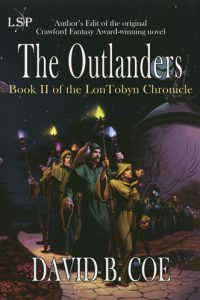 The second book, in contrast, was very much a product of its time, and I mean that in a couple of ways. In that book, The Outlanders, my heroes, Jaryd and Alayna are building a life together and starting a family, just as Nancy and I were starting our own family. When writing in book III, Eagle-Sage, about their young daughter, I drew extensively on our experience raising our first child. And in book II, when Niall lost his wife to cancer, I drew upon the experience of watching my father deal with my mother’s death.
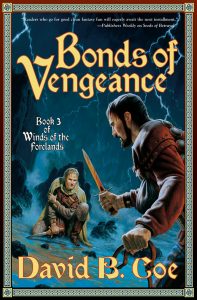 I was still working on the second book, Seeds of Betrayal, when the 9/11 attacks took place, and I wrote books three, four, and five against the backdrop of the Patriot Act, the torture of terrorism suspects, the illegal imprisonment of suspects at Guantanamo, and the deep anti-Islam sentiments of the early and mid-2000s. The Qirsi conspiracy was part of my plan for the series all along, but by the time the books were done, I realized that, without intending to, I had written a post-9/11 allegory. Again, I didn’t go back and change anything. I chose to keep the books as they developed. But I will admit to having been caught off guard by the degree to which our world had intruded upon my concept for the books.
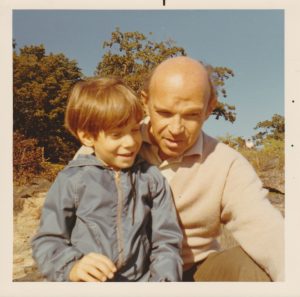 My father was born in 1919, lived through the Great Depression, lost a brother to World War II, married my mother half a year after V-E day (almost to the day). He supported Wendell Wilkie in the Presidential election of 1940 (although he would have been too young by a month to vote) and very nearly lost my mother when he confessed this to her before their wedding. Never again did he vote for a Republican for President.
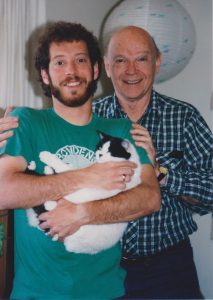 He was caring and generous, devoted to his family and friends. He loved a crass joke, but he took great pride in being gentlemanly – a product of his upbringing. My grandmother demanded no less of both her sons, just as my dad demanded no less of my brothers and me. I remember in high school he and I drove my girlfriend back to her home – I sat up front and she was in back. We pulled up to her house, and he turned around and said, “M____, you stay right there until he gets your door for you and walks you in.” Which, of course, I scrambled to do.