








 A couple of years ago, I put the finishing touches on the third book of a time travel/epic fantasy trilogy called the Islevale Cycle. I loved the Islevale books then, and I remain incredibly proud of them today. I think they represent some of my finest work, and if you enjoy epic fantasy, OR time travel, OR (best of all) both, I recommend you pick the books up and give them a try. (The books are called Time’s Children, Time’s Demon, and Time’s Assassin.)
As much as I love them, though, I also have to admit that they nearly destroyed me. I have never struggled so much with any books, and I hope I never will again. Part of the problem was simply the ambition of the project. Sprawling epic fantasies are hard to write. One must weave together multiple plot threads and write from the perspectives of numerous point of view characters. Time travel is even harder to write, first because one must keep track of several time lines at once, second because any plot point is potentially reversible (If time traveling characters are unhappy with events, what’s to keep them from going back and changing them?), and third, because in my story I had more than one iteration of several characters existing simultaneously. (At one point in book 3, I had four or maybe five iterations of the same character inhabiting my world.)
As you might expect, combining the challenges of writing epic fantasy with the difficulties inherent in writing time travel only serves to compound all of those issues. These books would have been hard to write under any circumstance. But here’s the thing: For some reason, I could not outline any of the Islevale books. I don’t know why. To this day I remain mystified. But yeah, I had to write all three books without any advance outline beyond my vague sense of where the books needed to go. The books turned out really well, but the process was excruciating.
What is the point of this?
Well, once I finished the last Islevale novel and worked with the folks at Falstaff Books to shepherd it through production and publication, I needed a new project that would be Different, and Straight Forward, and Directed.
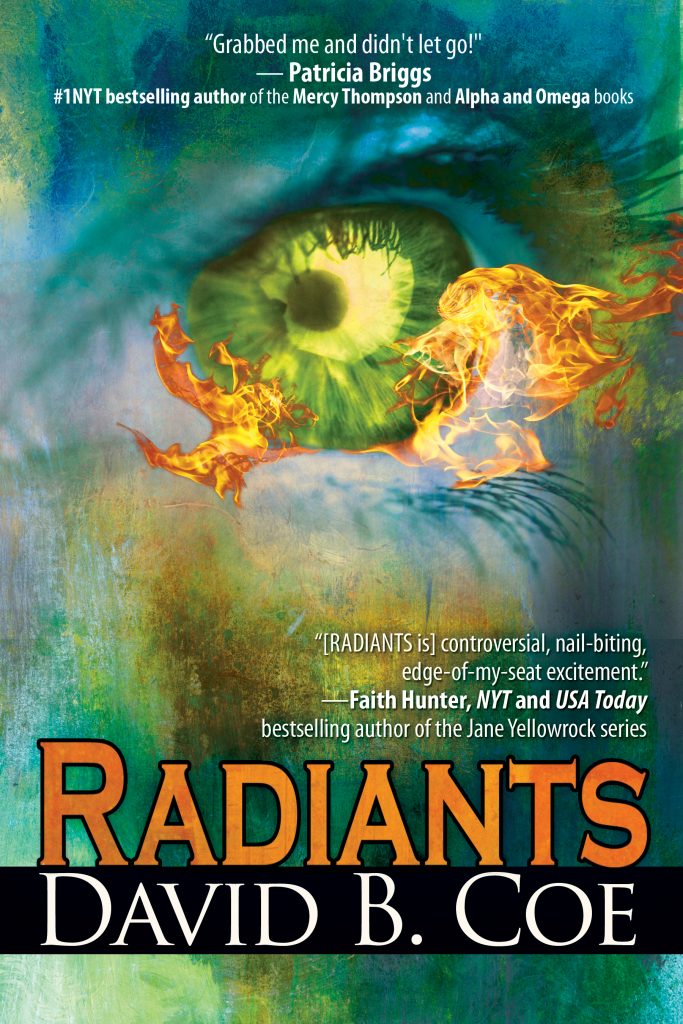 And that next book turned out to be Radiants.
Radiants, a supernatural thriller, comes out from Belle Books on Friday (yes, THIS Friday) October 15th, and this “little” book, which I thought of as a sort of creative palate cleanser, has turned out to be far, far more.
Yes, it is different from the Islevale books, and it is quite directed. But it is deceptive in its “simplicity.” It is firmly rooted in our real world, and deals with social issues of weight and emotional power. It has fewer point of view characters and concentrates to a far greater degree on a single narrative thread. As a result, it is fast-paced. Like breakneck. And it includes some of the deepest, most satisfying character work I’ve done. (In fact, in this regard, I believe it might be exceeded by its sequel, Invasives, which will be out in another few months.)
So what makes Radiants a “supernatural thriller,” as oppose to a fantasy of some sort? Partly, it’s that pacing I mentioned, and partly it’s the real world setting and the fact that the speculative fiction element of the story is limited and very specific. And that was the appeal of writing the book. After creating a world whole-cloth for the Islevale series, I wanted to remain firmly fixed in our world for the new project. I wanted my characters to deal with issues that impact us in our day-to-day lives. I wanted them to speak as we do, to think and feel and interact as we do. In short, I wanted the story to be utterly relatable.
It would be easy to ascribe this to something pandemic-related — a need for normality, say, or some recognition that we don’t have to create an imagined world to come up with situations that are ________ . . . insert your preferred word here: Frightening? Disorienting? Surreal? As it happens, though, I completed my first draft of the book in February 2020, just before the current unpleasantness hit. [Invasives, the second Radiants book, is much more a reaction to the pandemic, as well as the personal difficulties my family and I have faced in recent months.]
Radiants really was a response to my creative needs at the time. No more, no less. It is the book I needed to write next. My lead characters presented themselves to me, along with their fraught and frantic circumstances, and I simply wrote. In this sense, Radiants might be the most organic book I’ve ever written. I had no marketing strategy for it; hell, for the longest time, I didn’t even know how to classify the story. I didn’t know if I was writing something for myself, for the sheer joy of it, or if it would turn out to be something I could sell and publish. I had a story to write and I wrote it.
For that reason alone, I love this book. And I am very hopeful that you will, too.
 DBJ: Well, I suppose I should point out that while I haven’t written a Thieftaker novel in some time, I have been writing and publishing Thieftaker-universe short stories almost yearly since that last novel came out. But this was a far more demanding project and honestly, I enjoyed it immensely. I love these characters — not only Ethan, but also his nemesis, Sephira Pryce; his love, Kannice Lester; his mentor, Janna Windcatcher; his closest friend, Diver Jervis; and a host of historical figures including Samuel and John Adams, Joseph Warren, Stephen Greenleaf, and others. All of them are here in these new stories. But I have also brought in new characters: a new set of villains and some new allies as well. So for me as a writer, there was enough here that was familiar to make me feel like I was reconnecting with old friends, but there was also enough innovation for the plot lines and character interactions to feel fresh and exciting. I hope my readers agree!
 DBJ: There was a lot to work with actually. On the one hand, the trials of the soldiers and their captain were a huge deal. Think of all the big trials we’ve had in recent history — the way they captivate the public — and then magnify that about a hundred times. The Boston Massacre was a huge, huge deal throughout the colonies, but in Boston in particular. It’s easy to forget that the population of the city was only about 15,000 at this time. So while “only” five people died that night in March, chances are that if you lived in Boston, you’d had some contact with at least one of the victims. Add to that the fraught political climate of the time and you have a recipe for a lot of tension. Plus, as the title of the first novella suggests, right before the trial began, Boston was hit by a hurricane. Now, I have adopted the storm for my own narrative purposes and added a magical element. But the fact is, there was a ton going on, historically speaking, and I was able to work most of it into the novellas.
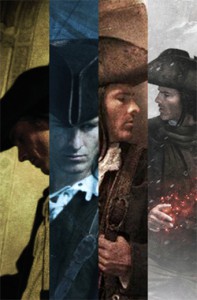 DBJ: Definitely. The fact is, I’m probably better known for Thieftaker than I am for anything else I’ve published, either as D.B. Jackson or as
 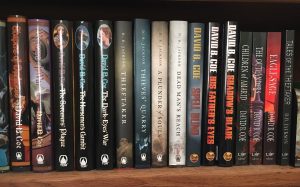 This past weekend I gave a talk on world building for the Futurescapes Writers’ Workshop. It was a lengthy talk, and I’m not going to repeat all of it here. But I did want to focus on one element of the topic, because I think it’s something writers of fantasy, of historical fiction, of science fiction, and of other sub-categories of speculative fiction lose sight of now and again.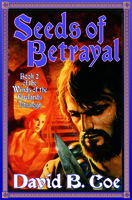
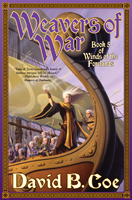 For the Winds of the Forelands series (Rules of Ascension, Seeds of Betrayal, Bonds of Vengeance, Shapers of Darkness, Weavers of War) , I created what is without a doubt the most complex “calendar” I’ve ever undertaken for any project. For those of you not familiar with the world, I’ll give a very brief description. The world has two moons, Ilias and Panya, the Lovers, who chase each other across the sky. Each turn (month) has one night when both moons are full (the Night of Two Moons) and one night when both moons are dark (Pitch Night). Each turn is also named for a god or goddess, and so each Night of Two Moons and each Pitch Night has a special meaning.
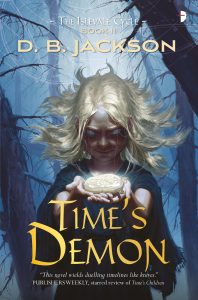 I did something similar for the Islevale Cycle novels (Time’s Children, Time’s Demon, Time’s Assassin). In this world there are two primary deities, Kheraya (female) and Sipar (male), and the calendar is structured around them. It begins with the spring equinox — Kheraya’s Emergence, a day and night of enhanced magickal power and sensuality. The spring months are known as Kheraya’s Stirring, Kheraya’s Waking, Kheraya’s Ascent. The summer solstice is called Kheraya Ascendent, a day of feasts, celebration, and gift-giving. This is followed by the hot months of summer: Kheraya’s Descent, Fading, and Settling.