Sarah and I will be co-editing the collection. Falstaff Books will be publishing it. And we have a terrific lineup of authors who have committed to submitting stories. The theme of Disruptive Intent is, essentially, stories that have a key element challenging the political/social/cultural orthodoxy of this moment in history. Each story will be accompanied by an author’s note, detailing their intent and their reasons for challenging that orthodoxy as they have. Ever wonder while reading a story, “Did the author mean to do that?” Well, wonder no longer!
We are not yet announcing who our authors are — that will come as we draw nearer to the start of the Kickstarter. But trust me: You’re going to want to read these stories. As for my fellow editor, Sarah J. Sover, author of the Fractured Fae series, is as wonderful a writer as she is a person. She is passionate about this project, and like our other authors, she is committed to writing a story as well as editing. And, for the record, I’m committed to writing one, too.
Our publisher, of course, is Falstaff Books, owned and operated by the shy and retiring (/snort) John G. Hartness. So, you know the book is going to be beautifully produced, reasonably priced, and packed with the sort of innovative, exciting stories for which Falstaff is known.
So, watch this space for updated Kickstarter information and author announcements! And help us meet our funding goal!
I have avoided posting for some time now. Not because things have been going badly — they haven’t. I feel that I am doing well, that our family is doing well. But it’s hard to post about things like travel (we spent a couple of weeks in Maine at the end of August) or the stuff we’ve been streaming and I’ve been reading (Poker Face, Wednesday — season two; the new Guy Gavriel Kay novel and Wolf Hall, by Hilary Mantel) when around us our nation continues its descent into hatred and chaos.
I don’t want to write about the Cheese-Doodle-In-Chief. I don’t want to write about a hopelessly compromised Supreme Court enabling our drift into authoritarianism. I don’t want to write about the hypocrisy of the right, who mocked the assassination of two political leaders in Minnesota earlier this summer but now profess outrage at all who point out that Charlie Kirk, while not deserving of his violent fate, spewed hate speech throughout his political career. I don’t want to think about, much less write about, the imperiling of American children by RFK, Jr., and his fellow quacks.
I also don’t want to write yet again about my grief. It is what it is. It will never go away. But I can live with it. I WILL write about Alex next month, on the anniversary of her passing, but for now I am not willing to go there.
So, what does that leave?
(c) 2006 Bonnie Jacobs
Well, how about freedom of speech?
The recent cancellation of The Late Show with Stephen Colbert, and the subsequent (and apparently short-lived) suspension of Jimmy Kimmel Live!, have demonstrated the fragility and the resilience of our most sacred and basic Constitutional right. Colbert and Kimmel ran afoul of the current Administration by having the gall (/sarcasm) to speak critically of the aforementioned Cheese-Doodle-In-Chief. Colbert went after him relentlessly for months, highlighting every contradiction, every ridiculous boast, every gaffe, and doing so with his characteristic wit, aplomb, and intelligence. Kimmel did much the same thing, but apparently went too far when he pointed out that Charlie Kirk’s killer, whom the MAGA right had prematurely characterized as a far-left, transgender, un-American hater of all things wholesome and patriotic, turned out to be the Mormon, gun-toting, scion of a White, Republican family.
The Cheese-Doodle wanted these men (Colbert and Kimmel) off the air, and he was willing to pressure their networks to make this happen by using the full weight of the Federal Communication Commission’s regulatory power. Think about that. The President of the United States used the power of the government to force off the air comedians who dared to criticize him. This is something one might expect to happen in Cuba or Russia, China or North Korea, Iran or Venezuela, Saudi Arabia or Myanmar. But here?
As it turns out, people in this country don’t like government censorship of the airways. Less than a week after the announcement of Kimmel’s suspension, he is set to return to late night television this week. ABC/Disney faced a growing boycott on multiple levels, including subscription cancellations and celebrities withdrawing from previously scheduled appearances. They quickly caved. CBS’s firing of Colbert seems more likely to stick, but in the wake of that firing, Colbert’s ratings, already the highest in the late-night category, surged. And last week, his show won its first Emmy Award.
It seems that when at least some of our core rights as Americans are threatened, we get our collective back up.
This, of course, has done nothing to curb the Chief Doodle’s appetite for speech suppression. In just the past few days he has called for the censorship of all network news programs that don’t pander to him. “It’s no longer free speech,” he said, speaking of networks that he perceives as too critical of his Presidency. He called such criticism “illegal.” He recently sued the New York Times for $15 billion (yes, billion, with a “b”) citing the paper’s negative coverage of his 2024 campaign. The suit was dismissed within days, but he and his lawyers are bound to try again. Late last week, the Pentagon announced new and unprecedented restrictions on press access to the military, suggesting that only Pentagon-approved access will be tolerated.
Make no mistake, First Amendment rights are under attack from this Administration on multiple fronts. We the people can fight these assaults, but as the Cheese Doodle broadens his siege against our system of government, continued resistance becomes harder and harder to maintain. That is his hope, of course. He has four years. He is waging a war of attrition, hoping and expecting to wear us down.
But why? What does he hope to gain? Why does he hate our Constitution so much? I can’t answer. I can’t imagine. Few in this country have benefited more from all society has to offer than this undeserving, talentless, incompetent, incurious, unintelligent boor of a man. Despite his many shortcomings, he is rich, famous, powerful. Why would he seek to destroy the country that has given him so much?
This past week, Nancy and I spent a few days in Philadelphia. I hadn’t been there since the World Science Fiction Convention of 2001 (known, I kid you not, as Millennium PhilCon — think of the name of Han Solo’s ship…). Nancy had never been.
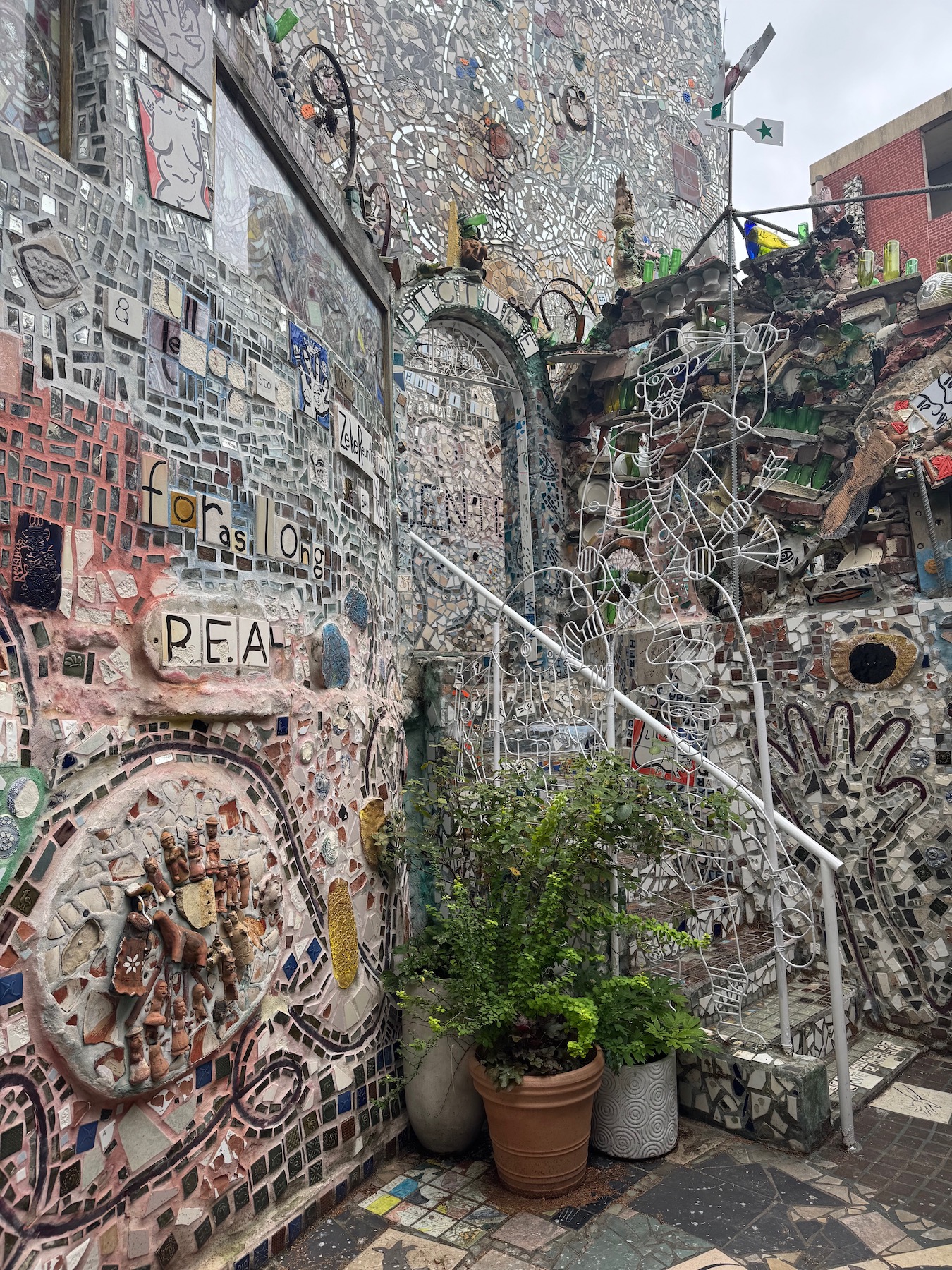
We ate well, did a lot of walking and exploring, and had a wonderful visit, despite triple-digit heat for our first two days there. We visited the Barnes Foundation — a fabulous art museum. We went to Philadelphia’s Magic Garden, which, for those unfamiliar with fully immersive art environments, is really worth a visit. It is an art installation, indoors and out, that makes use of broken plates and bottles and glass, parts of old bicycles and household items, folk art from around the world, and original work by the founding artist, Isaiah Zagar, to create a cityscape that is stunning, whimsical, thought-provoking, and truly awe-inspiring. We went to a Phillies game Friday night, which was really fun and ended in a thrilling, come-from-behind win for the home team.
A corner of Philadelphia’s Magic Garden. Photo by David B. Coe
And, of course, we went to Independence Park in the old city, not far from where we stayed. There, we saw the Liberty Bell, the Museum of the American Revolution, and Independence Hall, where the Declaration of Independence, the Articles of Confederation, and the U.S. Constitution were signed in 1776, 1777, and 1787 respectively.
It is easy to glorify the founders. We do it every day in this country. We focus on their brilliance, and many of them were brilliant. We celebrate their courage, and as a group they were quite brave. We marvel, with cause, at their creativity and their understanding of history and political thought. Their achievements — the eloquence of the Declaration, and the elegance of the representative republic envisioned in our Constitution — deserve to be celebrated.
But it is also necessary, especially in this historical moment, as our system of government staggers through the authoritarian nightmare of this current Administration, to remember that the Continental and Constitutional Congresses were riven by sectional conflict, competing interests, cross-cutting rivalries that bred suspicions and hostilities. We cannot ignore the fact that too often the Founders chose to follow their basest instincts: their racism, their classism and snobbery, their dismissal of women’s concerns and opinions. For all their brilliance and courage and creativity, they were deeply human. They were stubborn, prideful, set in their ways and defined by their times. They were bigots, many of them. They were driven by their hunger for power and influence. And, understandably, they could not foresee many of the problems that arose as the nation they created moved from infancy to childhood to adolescence to adulthood and beyond.
They saddled us with the Second Amendment, counted slaves literally as less than human, and ignored women altogether. They laid the groundwork for the Civil War, and ultimately built a system that is completely dependent on the pure motives and good will of their political heirs. Their naïveté, it turns out, may prove to be too much for today’s leaders to overcome. They never imagined that a man driven solely by self-interest and ego, someone who cares not a whit for the democratic principles they honored, could ever find his way to the highest office in the land. Had they managed to imagine a man like our current President, they would have created a very different government.
The Assembly Room of Independence Hall, Philadelphia. Photo by David B. Coe
But here is the point, the thought that buoyed me as we stood before the Liberty Bell, and gazed upon the desks where Madison and Franklin, Hamilton and Washington, Dickinson and Morris and Sherman and so many others did their work: For all their faults, and despite all that divided those congresses more than two centuries ago, they managed to build the country of which they dreamed. Yes, it is flawed as they were themselves. Yes, the mistakes they made in writing the Constitution have precipitated catastrophes that have threatened to tear the nation to pieces. And yes, we have seen villains before, men who have sought to exploit the weaknesses of what the Founders built — the Palmers (Attorney General A. Mitchell Palmer — look him up) and McCarthys, the Hardings and Nixons. Is Trump worse than these others? Maybe. He’s greedier, less of a patriot, more corrupt. He’s also far less intelligent than any of the others, which gives me hope.
As a nation, we have careened from crisis to crisis. And yet, here we are still. Most other nations have been through every bit as much as we have over the past 250 years, if not more. Our system is messy and inefficient. At times it is anti-democratic. It fosters the same bigotries that ailed the Constitutional Congress two and a half centuries ago. And today it faces threats that are terrifying and unprecedented. As I stood in Independence Hall, though, I found myself believing — truly believing — that we as a nation would survive this newest crisis, that the country created all those years ago by men of imperfect genius would not be undone by a two-bit, tin-pot dictator and his feckless lackeys.
Here’s hoping that my optimism proves well-founded.
Summer is speeding by, and I have been terribly remiss in keeping up with my blog. For those who have reached out to me in recent weeks, asking if I am okay, the short answer is, “Yes, I am.” I won’t claim to be wondrously fantastic, because you wouldn’t believe me if I did. But I am well.
Our new house continues to feel more and more like home. The house itself is pretty much where we would like it to be at this point. A few more doors, door frames, and window frames need painting, but that can wait for cooler weather. We have found a couple of pieces of furniture to fill gaps in the three-season room on the back of the house, and we now have outdoor furniture for the backyard patio. All we need now is a fire pit for the fall. The yard looks great — Nancy has been planting and transplanting and weeding, and I have been keeping the grass under control with my new (used) standing mower. (If you don’t know what a standing mower is, look them up. This thing actually makes cutting the lawn sort of fun.)
We have a large flock of Wild Turkeys that walks through the yard a couple of times each day. How large? Five hens and twenty-two growing chicks. The young were adorable when they were little fuzzballs. Now they’re bigger, more awkward — like adolescents — but still dependent on their moms. Apparently it really does take a village… We also have a White-tailed doe and two fawns who show up most evenings while we’re eating dinner in the back room. And there is a young buck, with velvet still on his antlers, who appears to be shadowing them. Add to that our hummingbird family, the Indigo Buntings and Chipping Sparrows, and our local Cooper’s hawk, and we have a nice selection of wildlife paying us visits on a daily basis.
I have recently finished reading slush for the Skulls X Bones anthology I am editing with Joshua Palmatier for release from Zombies Need Brains. Soon, we will be making our final choices of which stories to include and will begin the actual editing of the manuscripts. And already I am working on my next editing project, which will be for Falstaff Books with the fabulous Sarah J. Sover. More details to come.
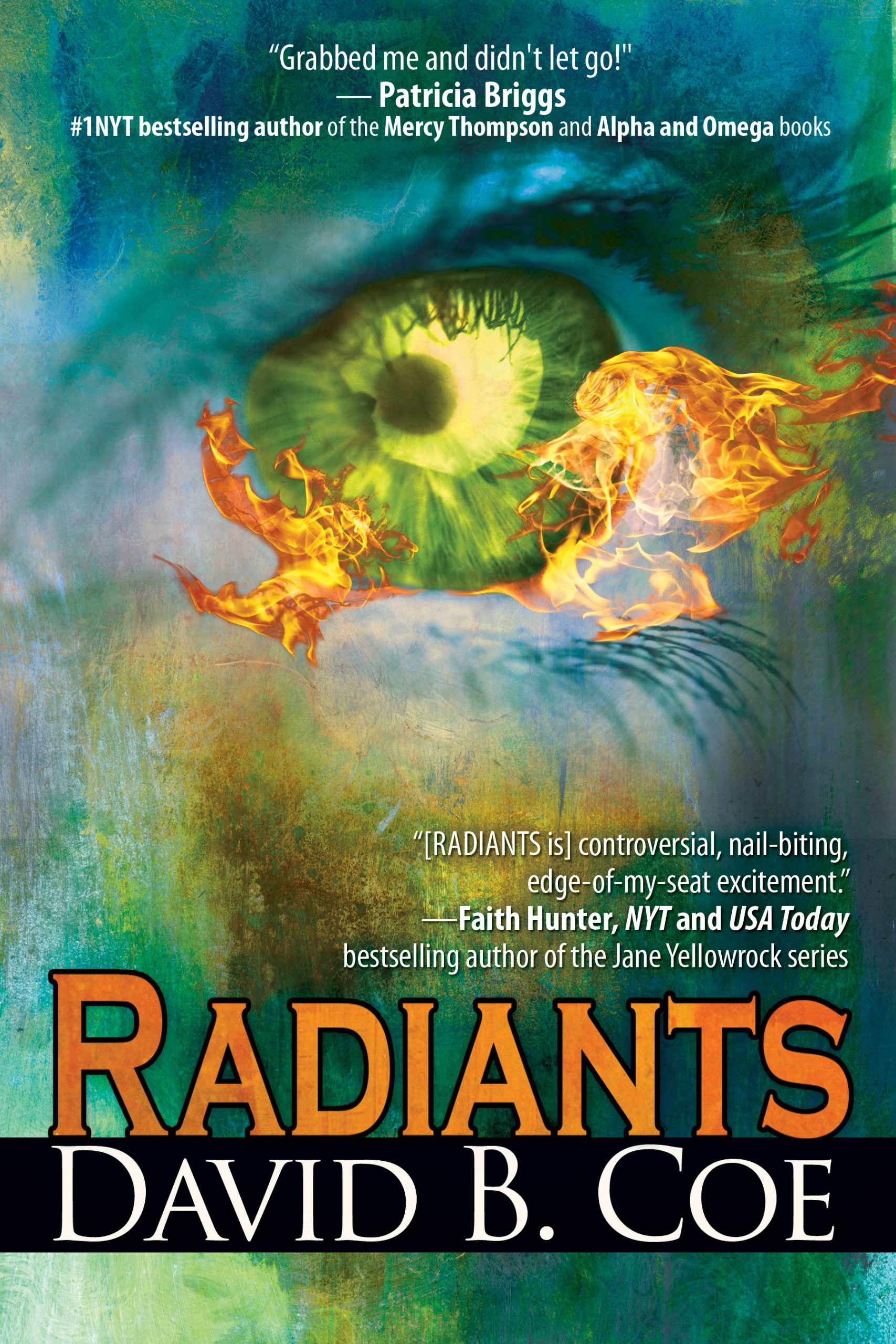
As for writing, I have still not done much at all. But that might be changing soon. There are a lot of moving parts to this development, and nothing is set in stone yet, but for fans of the Radiants books, who have wondered if I ever planned to go back to those stories, stay tuned . . . . Yes, I know that I have promised a return to the Thieftaker universe as well, not to mention a reissue of Winds of the Forelands, which I have had on the back burner for years now. Those will be coming eventually as well. I am slowly working my way back into a writing mindset. I would ask for your patience, as I continue to heal and find my emotional footing again.
Nancy and I have been out to see Erin in Colorado, and will be seeing her again before too long. We have plans for multiple trips later this summer and into the fall, and are also looking forward to welcoming some guests to our home.
Other than that, life has been sailing along. We see family and friends. We watch our favorite shows and listen to music. We cook fun foods and taste new whiskeys. I have been playing music as well, polishing long-neglected guitar skills and trying to retrain my voice.
Alex, of course, is a constant presence in my thoughts. I am learning to live with my grief, to honor her memory in ways that do justice to the loss while also allowing me to function and breathe and be thankful for all that we still have in our lives. At the risk of misspeaking for Nancy and Erin, I believe it is a journey for all of us. There’s no real end point. It is just the reality of our world now, and always will be. Not long ago, I shared a song with my guitar buddy and dear, dear friend, Alan Goldberg. It was a tune I first heard on a mix CD Alex made for me when she was in high school, a tune I hadn’t listened to in several years, since well before her death. I knew he would love the song, but I was also afraid to play it for him. I didn’t know how I would feel upon hearing it again.
I needn’t have worried. It brought a smile. It made me feel close to her, thankful for this tiny gift she had given me — one gift among so, so many. Did it make me miss her? Of course, but it’s not like I need help in that regard. And the sweet memories that came with the melody were a balm.
Here is the song. Enjoy your weekend. Hug those you love.
The title speaks for itself. These are recent epiphanies I’ve had. Some are profound others less so. Enjoy.
Last weekend, at ConCarolinas, I was honored with the Polaris Award, which is given each year by the folks at Falstaff Books to a professional who has served the community and industry by mentoring young writers (young career-wise, not necessarily age-wise). I was humbled and deeply grateful. And later, it occurred to me that early in my career, I would probably have preferred a “more prestigious” award that somehow, subjectively, declared my latest novel or story “the best.” Not now. Not with this. I was, essentially, being recognized for being a good person, someone who takes time to help others. What could possibly be better than that?
Nancy and I recently went back to our old home in Tennessee for the wedding of the son of dear, dear friends. Ahead of the weekend, I was feeling a bit uneasy about returning there. By the time we left last fall, we had come to feel a bit alienated from the place, and we were constantly confronting memories of Alex — everywhere we turned, we found reminders of her. But upon arriving there this spring, I recognized that I had control over who and what I saw and did and even recalled. I avoided places that were too steeped in hard memories. I never went near our old house — I didn’t want to see it if it looked exactly the same, and I really didn’t want to see it if the new owners made a ton of changes! But most of all, I took care of myself and thus prevented the anxieties I’d harbored ahead of time from ruining what turned out to be a fun visit. I may suffer from anxiety, but I am not necessarily subject to it. I am, finally, at an advanced age, learning to take care of myself.
Even if I do not make it to “genius” on the Spelling Bee AND solve the Mini AND the Crossword AND Wordle AND Connections AND Strands each day, the world will still continue to turn. Yep. It’s true.
I do not know when or if I will ever write another word of fiction. But when and if I do, it will be because I want to, because I have a story I need to tell, something that I am certain I will love. Which is as it should be.
The lyric is, “She’s got electric boots/A mohair suit/You know I read it in a magazine.” Honest to God.
I am never going to play center field for the Yankees. I am never going to appear on a concert stage with any of my rock ‘n roll heroes. I am never going to be six feet tall. Or anywhere near it. All of this may seem laughably obvious. Honestly, it IS laughably obvious. But the dreams of our childhood and adolescence die hard. And the truth is, even as we age, we never stop feeling like the “ourself” we met when we were young.
Grief is an alloy forged of loss and memory and love. The stronger the love, and the greater the loss, and the more poignant the memories, the more powerful the grief. Loss sucks, but grief is as precious as the rarest metals — as precious as love and memory.
As a student of U.S. History — a holder of a doctorate in the field — I always assumed that our system of government, for all its obvious flaws and blind spots, was durable and strong. I believed that if it could survive the War of 1812 and the natural growing pains of an early republic, if it could emerge alive, despite its wounds, from Civil War and Reconstruction, if it could weather the stains of McCarthyism and Vietnam and Watergate, it could survive anything. I was terribly wrong. As it turns out, our Constitutional Republic is only as secure as the good intentions of its principle actors. Checks and balances, separation of powers, the norms of civil governance — they are completely dependent on the willingness of those engaged in governing to follow historical norms. Elect people who are driven not by patriotism but by greed and vengeance, bigotry and arrogance, unbridled ego and an insatiable hunger for power, and our republic turns out to be as brittle as centuries-old paper, as ephemeral as false promises, as fragile as life itself.
I think the legalization of weed is a good thing. Legal penalties for use and possession were (and, in some states, still are) grossly disproportionate to the crime, and they usually fell/fall most heavily on people of color and those without the financial resources necessary to defend themselves. So, it’s really a very, very good thing. But let’s be honest: Part of the fun of getting high used to be the knowledge that we were doing something forbidden, something that put us on the wrong side of the law. It allowed otherwise well-behaved kids to feel like they (we) were edgy and daring. There’s a small part of me that misses that. Though it’s not enough to make me move back to Tennessee….
I’ll stop there for today. Perhaps I’ll revisit this idea in future posts.
Our beloved older daughter would have been thirty years old today.
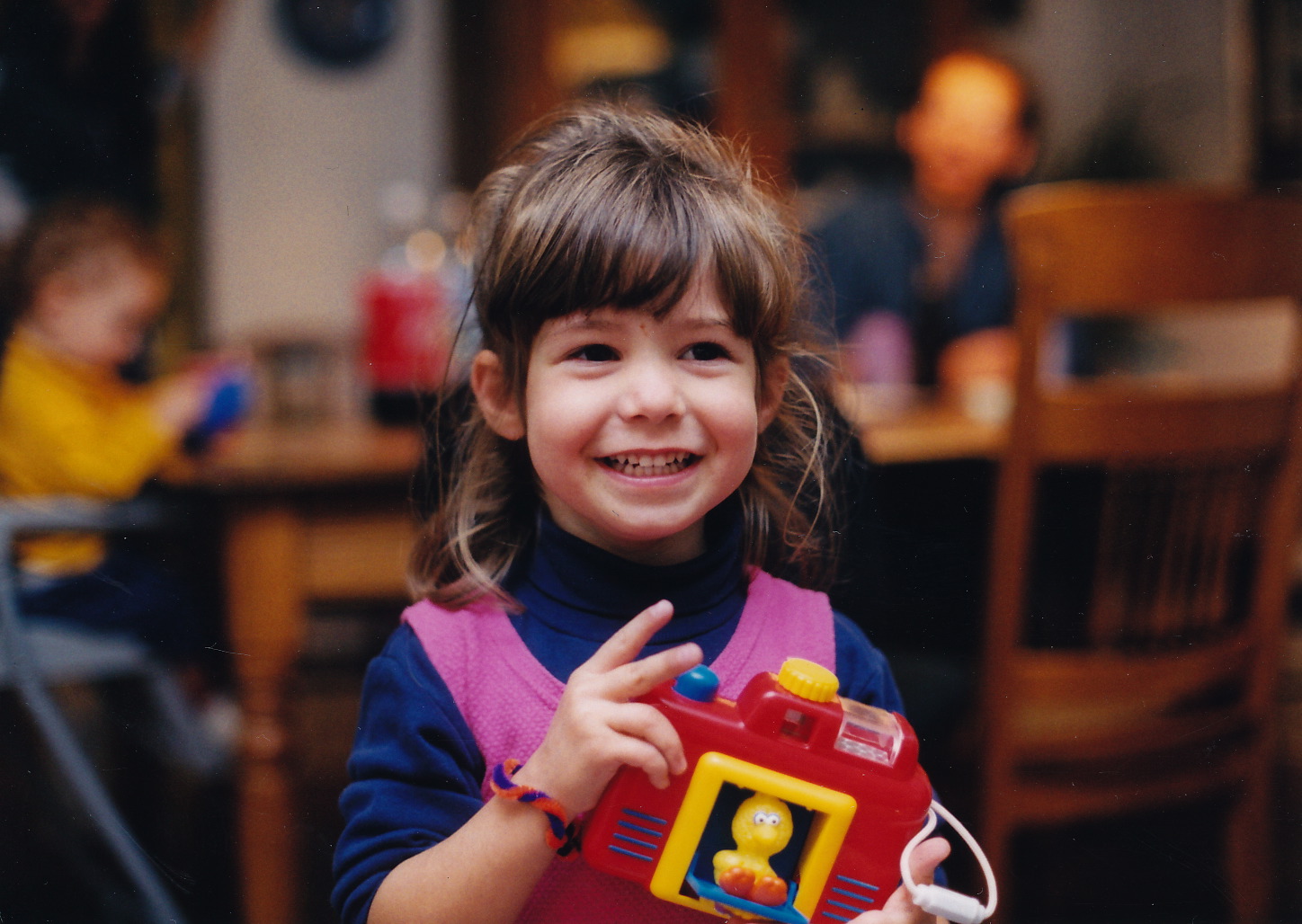
Alexis Jordan Berner-Coe. Early on, it felt like a big name for such a tiny child. She was always the smallest in her class, the smallest on her team, the smallest in her dance recitals. We called her Alex. The head counselor at her first summer soccer camp called her “ABC” — for Alex Berner-Coe. The name stuck.
Later we realized that the name was too small to contain her, too simple to encompass all that she was, all that she would grow to be. She might have been the smallest in her class, but she was smart as hell and personable, with a huge, charismatic personality. She might have been the smallest on her teams, but she was fast and savvy and utterly fearless. On the soccer pitch and in the swimming pool, she was fierce and hard-working. Size didn’t matter. She might have been the smallest on stage, but she danced with passion and joy and grace, and, when appropriate, with a smile that blazed like burning magnesium.
One time, in a soccer match against a hated rival, a player from the other team, a huge athlete nearly twice Alex’s size, grew tired of watching Alex’s back as she sped down the touchline on another break. So she fouled Alex. Hard. Slammed into her and sent her tumbling to the ground. I didn’t have time to worry about my kid. Because Alex bounced up while the ref’s whistle was still sounding, and wagged a finger at the girl. “Oh, no you don’t,” that finger-wag said. “You can’t intimidate me.”
When she was in eighth grade, she decided to try out for the annual dance program at the university where Nancy worked. The program was called Perpetual Motion, and it was almost entirely student run. Each dance was choreographed by a student or group of students. They decided who they wanted in their dances and who they didn’t. The men and women in the program could easily have dismissed this thirteen-year-old as too young, too inexperienced, not really a part of the college. But instead, to their credit, they judged her on her dancing and maturity. She appeared in Perpetual Motion every year from eighth grade through twelfth, and we saw pretty much every performance. Not once did Alex ever seem out of place or beyond her depth.
She was effortlessly cool, like her uncle Bill — my oldest brother. And she had a wicked sense of humor. She was brilliant and beautiful. She loved to travel. She loved music and film and literature. She was passionate in her commitment to social justice. She adored her younger sister. And she was without a doubt the most courageous soul I have ever known.
When Alex was three years old, Nancy took a sabbatical semester in Quebec City, at the Université Laval. I stayed in Tennessee, where I was overseeing the construction of what would become our first home. Once Nancy found a place for them to live, I brought Alex up to her and helped the two of them settle in. In part, that meant finding a day-school for Alex so that Nancy could conduct her research. We put her in a Montessori school that seemed very nice, but was entirely French-speaking. The first morning, Alex was in tears, scared of a place she didn’t know, among people she could scarcely understand. But we knew she would love it eventually, and as young parents, we had decided this was best. So we explained to her as best we could that we would be back in a few hours, that the people there would take good care of her, and that this was something we needed for her to do. I will never forget walking away from the school, with tiny Alex standing at the window, tears streaming down her face as she waved goodbye to us. And I remember thinking then, “She is the bravest person I know.” Remember, Alex, all of three years old, didn’t speak a word of French!!
Needless to say, when we returned that afternoon to take her home, she was having the time of her life. She’d already made a bunch of friends. She’d already charmed her two teachers. And, I kid you not, she had already picked up several French phrases, which she spoke with a perfect Quebecois accent.
Her dauntlessness served her well on the pitch and in the pool, on stage and in the classroom. It fed an adventuresome spirit that took her to Costa Rica for a semester in high school, to the top of Mount Rainier with a summer outdoor program, to a successful four years at NYU, to Germany for part of her sophomore year in college, to Spain for all of her junior year in college, and on countless side-trips all over Europe.
And it allowed her to face the cancer that would eventually claim her life with remarkable strength, equanimity, and grace. She knew from the time of her diagnosis — a rare form of cervical cancer already at Stage 4 — that she faced long odds. I know that in private moments, and with her closest friends, she grieved for all that the disease would take from her. But she never allowed cancer to control her. She continued to work, to see friends and family, to travel, to go to movies and concerts and parties. She took classes. While undergoing chemo treatments, she turned her need for headscarves into a fashion statement. She lived her final years on her terms, refusing to wallow in self-pity because to do so would have meant sacrificing the joy for living that defined her.
She was, in short, remarkable. I loved her more than I can possibly say. I also admired her deeply. To this day, I push myself to do things that might make me uncomfortable or afraid by telling myself, “Alex would do it, and she’d want me to do it as well.”
She had twenty-eight and a half years, which wasn’t nearly enough. She did amazing things in that short time and could have done — should have been able to do — so very much more.
I miss her and think about her every minute of every day.
Happy birthday, my darling child. I love you to the moon and back.
Back in early January, with snow falling on our bare trees and the brisk cold of a northeastern winter defining our days, I wrote a post for this blog about “Nesting.” The title referred to what Nancy and I had been doing around the house — unpacking, finding places for our stuff, making improvements to the new house.
That process has continued in the months since. While we have also done other stuff — editing, music, birding, and other pursuits on my part; weaving, knitting, and getting her last academic paper published on Nancy’s part — we (mostly Nancy) have still been working on the house. My hands are not (and never have been) steady enough to paint the trim around the interior of the house, so Nancy has carried the bulk of that burden. And with the onset of spring, my multi-talented spouse has also been planning her approach to landscaping our new yard. And I have done more unpacking and have been slowly hanging our art around the house.
I posted a couple of photos of the new place back in January, but wanted to follow up with a few more today.
And I wanted to say a few things about this blog, which I seem to be struggling to keep up with consistently. I am trying. Truly. A lot of the time, though, I just don’t want to write. It really is as simple as that. Most days, I wake up, confront the newest atrocity committed by this hateful, cruel, criminally incompetent Administration, and am torn between wanting to write yet another outraged screed and wanting to ignore politics altogether. I don’t want this blog to become nothing more than a nonstop critique of all the current occupant of the White House is doing to undermine the strength of our republic. But I also don’t want to post about birds or baseball or our latest favorite series on Netflix when the country is burning down. And so I go for weeks without posting at all, which isn’t an answer either.
This is actually symptomatic of a larger problem. I’m not writing much of anything — not blog posts, and not fiction. I did some fiction writing early last year, when I was hired to write something in someone else’s world. But the truth is, I haven’t written a word of fiction that was really my own since we lost Alex back in October 2023. Will I write again? I hope so. That’s all I can say for certain. I want to write again. But I don’t want to write now, and I feel that I owe it to myself to take this time to continue healing. I have no idea how long this feeling will last. A month? A year? A decade? Maybe. Maybe. Maybe. All I know is, I need to take care of myself.
Because I AM healing. I’m doing better in most ways than I was a year ago, and far better than I was a year and half ago, when the grief was fresh and I thought it would never ease.
Watching the house come together has been good for me. Watching spring touch our little slice of the Hudson Valley has been lovely. Trees are blooming. Flowerbeds are revealing themselves. We moved in late in November, so the arrival of warmer weather has been a revelation for us.
I saw Erin in March. I will see her again in May. And then June. And then maybe later in the summer. And then . . . soon after that. Being with her is a balm for both Nancy and me. And so is Nancy and my time together. The love tying our family together remains strong, and in many ways missing Alex, loving her, grieving her, has become one more unbreakable filament binding us to one another.
So we nest. We heal. We love. And we continue to ask your patience and support.
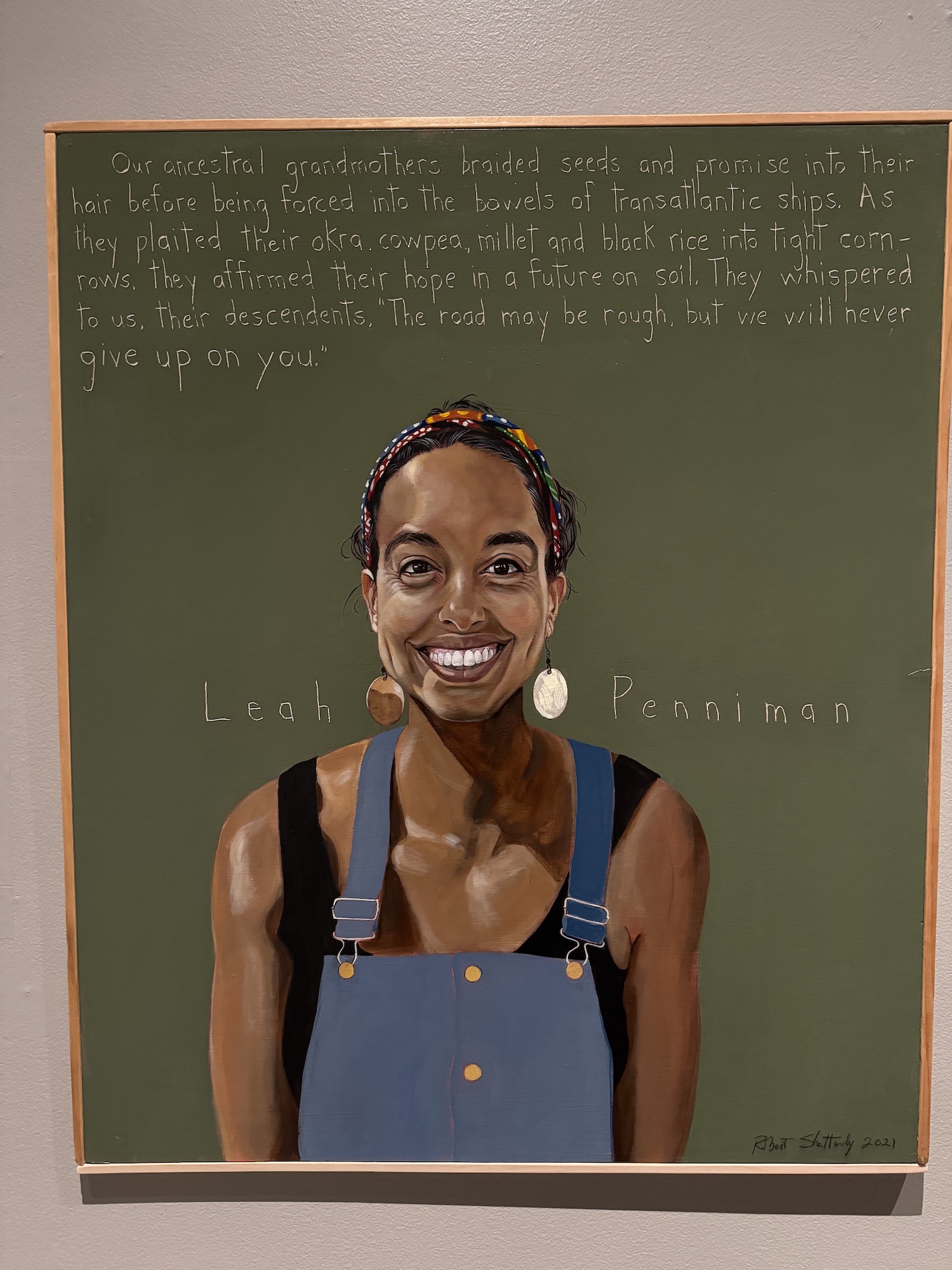
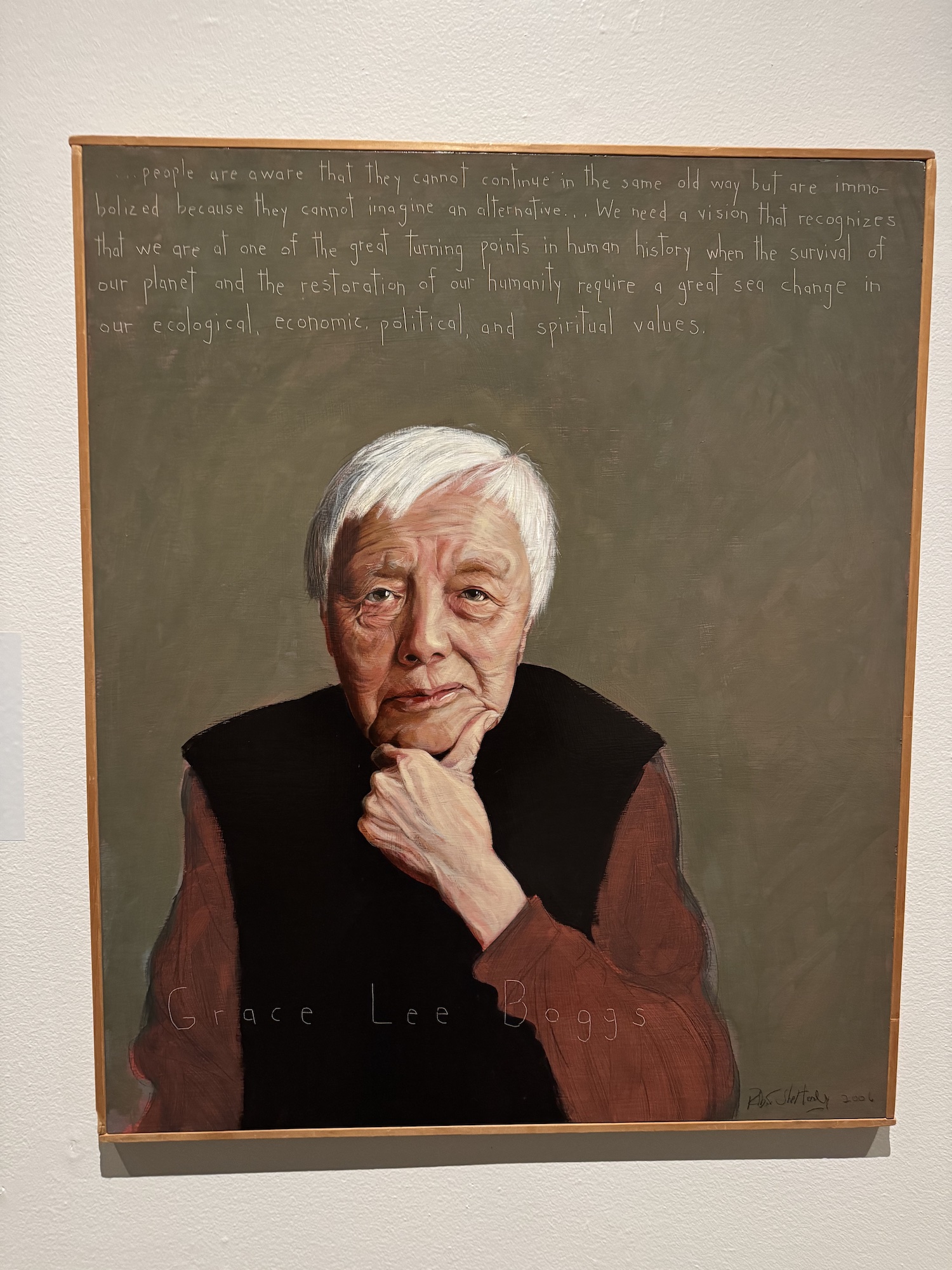
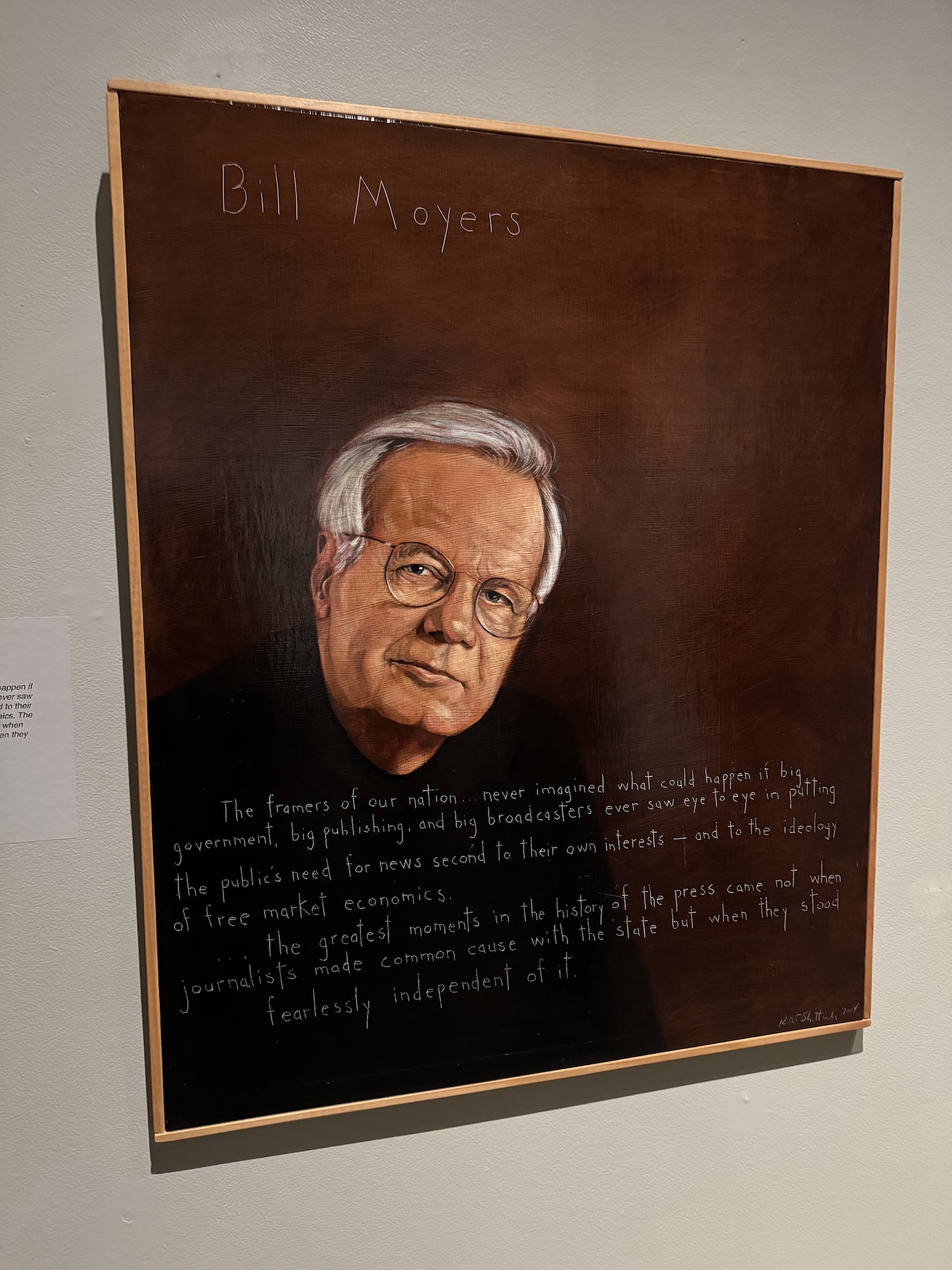
Last weekend, we went into Albany, with my brother and sister-in-law, to have dinner with friends of theirs, and to attend an exhibit at the lovely Albany Institute of History and Art. The exhibit is called “Americans Who Tell The Truth,” and it features portraits by Robert Shetterly, along with quotes from his truth-telling subjects.
Shetterly’s art is unusual. His portraits are simple, even primitive in some respects. The bodies of his subjects, and the backgrounds of his paintings, are flat, lacking in detail, unremarkable. But the faces are nuanced, instantly recognizable, filled with life and spirit and personality. And the names of the subjects, as well as their quotations, are scratched into the paintings themselves (while the paint is still wet, as my brother, the painter, pointed out). Shetterly has painted more than two-hundred truth-tellers, including forty-two that have been selected for the Institute’s exhibit. Some of those included are obvious selections. Others are less well-known, and still others have somewhat checkered histories, which makes for an interesting blend of portraits.
On the one hand, featured subjects include Rosa Parks and Bayard Rustin, Pete Seeger and Ella Baker, Cecile Richards, the late president of Planned Parenthood, and Sister Helen Prejean, the anti-death-penalty crusader portrayed in the movie Dead Man Walking. But among the other truth-tellers whose portraits are on display, are John Brown, the anti-slavery activist whose violent raid on Harper’s Ferry in 1859 resulted in several deaths and helped to spark the Civil War; Mother Jones, the late-Nineteenth/early-Twentieth century labor organizer and activist; Frank Serpico, the New York city cop who resisted and later exposed corruption within the police department, at risk of his own life, and whose harrowing story was brought to life in Serpico, a 1973 movie starring Al Pacino and directed by Sidney Lumet.
Yet, the figures who fascinated me most during our afternoon at the museum were those of whom I’d known nothing — not even their names — before seeing the exhibit. One of them was Leah Penniman, a food justice advocate and activist whose portrait exudes warmth and joy. Her quote is wonderful and worth repeating in full:
Our ancestral grandmothers braided seeds and promise into their hair before being forced into the bowels of transatlantic ships. As they plaited their okra, cowpea, millet and black rice into tight cornrows, they affirmed their hope in a future on soil. They whispered to us, their descendants:
“The road may be rough, but we will never give up on you.”
Another was Grace Lee Boggs, an author and community organizer, who gazes out from her portrait appearing tough, frank, unwilling to put up with any BS. Her quote:
People are aware that they cannot continue in the same old way but are immobilized because they cannot imagine an alternative… We need a vision that recognizes that we are at one of the great turning points in human history when the survival of our planet and the restoration of our humanity requires a great sea change in our ecological, economic, political, and spiritual values.
Few moments in our nation’s history have demanded more of American truth-tellers than the one we find ourselves in right now. We are governed by liars, bombarded by falsehoods every time we go online or turn on certain news channels, confronted by people — some of them friends, some of them family, most of them well-meaning — who have armed themselves with misinformation in order to parrot talking points they have heard on TV or from someone else who might be equally well-meaning and equally misinformed. Just the other day, I encountered online a post from someone I like and respect, who was repeating the jumble of untruths and recklessly manipulated data used by this Administration to justify their disastrous tariffs. I didn’t bother to comment. I didn’t wish to alienate a friend, nor did I have the energy or inclination to engage in a flame war. Instead, I allowed the disinformation to go unchallenged. I’m not proud of this.
Fallacy, disingenuousness, quackery, distortion. They pummel us. They insinuate themselves into every discourse. They are disheartening, infuriating, exhausting.
Which makes Robert Shetterly’s bold honoring of those who have stood up for truth again and again, all the more admirable, all the more important. We as a people have been challenged before by those who traffic in lies, and ultimately honesty has prevailed. Truth broke Joseph McCarthy’s fear-driven hold on the U.S. Congress, just as it ended the corrupt presidency of Richard Nixon. I choose to believe that it will wash away the bullshit that currently coats our most sacred institutions. But I have to be willing to stand up for honestly when next I am presented the opportunity. All of us do. We need to be inspired by those who inspired this exhibition.
One of my favorite portraits was of a media hero of mine, PBS’s Bill Moyers. I will leave it to him to have the last word:
The framers of our nation never imagined what could happen if big government, big publishing, and big broadcasters ever saw eye to eye in putting the public’s need for news second to their own interests – and to the ideology of market economics.
The greatest moments in the history of the press came not when journalists made common cause with the state but when they stood fearlessly independent of it.
This past weekend marked my Gram’s birthday. I won’t tell you how old she would have been because, well, I’m not sure I can do the math. Old. Really old. She passed away in 1983, and at the time she was just shy of her 92nd birthday. I think. I’m pretty sure she would be, like, 134 now. I am also pretty sure she would be ticked at me for telling you how old she would be . . . .
Gram was a wonderful grandmother. She adored all of her grandkids and she doted on us in all the grandmotherly ways. She made a huge fuss over every achievement, she always wanted to hear all about our lives, our friends, our classes at school. I never knew my mother’s parents, and my grandfather on my father’s side was not really part of our lives growing up. But it didn’t matter, because Gram showered us with enough love for four grandparents.
Clara Bartels was born in Amsterdam and came to the United States as a small child. Her father was a diamond cutter, and diamond cutters were in great demand in the diamond district of New York City. She grew up around the block from Jacques Cohen, who later in life changed the family’s last name to Coe, and whose father also was a diamond cutter who emigrated from Amsterdam. They would marry, have three kids, and then divorce, bitterly, at a time when divorce was not really something people were supposed to do.
Gram endured a lot in those years. She raised three children by herself, when single mothers with children were expected to remarry with alacrity. She nearly lost my father to meningitis when he was a sophomore in college. The youngest of her kids, my Uncle Bill, died in France during World War II. But she was a survivor and much tougher than anyone would have thought just looking at her.
Clara was maybe — MAYBE — five feet tall. With shoes on. In a stiff tail wind . . . . She had dark hair early in life. When I knew her, she had beautiful, silky white hair. Her smile could power entire cities. Her laugh, which we heard frequently, sounded like a car engine struggling to turn over. She had a terrific sense of humor and loved to laugh when she wasn’t supposed to. Each year, we would go to my Aunt Jean’s house for Passover, and my Uncle Bud would lead the Seder. He was more religious than the rest of us, and he took the Passover rites fairly seriously. And so when Gram would laugh at one thing or another in the Haggadah (which she did every year), he would grow annoyed. Which only served to make her laugh more. Which annoyed him a little more. Which increased her laughter yet again, making the rest of us laugh. Etc. Etc. I loved my uncle. He was a sweet, generous man. And for most of the year, he adored Gram. He always tried to be a good sport during Passover, but Gram didn’t make it easy . . . .
Staying with Gram was a treat. When I was young, whenever my parents went away, I would stay with her in her apartment on the east side of Manhattan. 245 East 63rd Street. The address is seared into my brain. So is her apartment number: 1104. It was a beautiful apartment — I shudder to think what it would cost today — and yet it was a pale substitute for the apartment my older siblings and cousins remember from when they stayed with her. That one was near Central Park and was huge and gorgeous. But no matter where she lived, when we stayed with her we had her all to ourselves. She would make the foods we liked, would take us to Atlantic Beach during the summer, or during the colder months, would take us FAO Schwarz, the famous toy store (the Tom Hanks-Robert Loggia floor-piano scene from Big was filmed there). We would walk with her there, and would be allowed to pick out any (reasonably priced) toy we wanted. After, we would get an ice cream at Schraffts.
Gram wasn’t always the easiest personality. She could be stubborn and even prickly on occasion. The summer after my senior year in college, my folks went away for a couple of weeks, and I stayed alone at our house. (At this point, I hadn’t stayed overnight at Gram’s for several years.) But my dad asked me to call Gram while they were away and I forgot. My high school girlfriend and I were going through a rough patch, and I had friends I wanted to see, and, well, I was a teenager . . . . It was entirely my fault. I know that.
But Gram was really angry with me. So angry that one night, when she and I had dinner at my aunt and uncle’s house, she wouldn’t speak to me. Literally. She directed all her questions and comments to me through my Aunt Jean, who reluctantly served as intermediary, and who later offered her heartfelt sympathy.
Lesson learned. When I went off to college, I made a point of calling Gram every Sunday, no matter what. And at the end of my freshman year, she commented to my father that Brown was a very good place for me. It had taught me responsibility. You can’t make this stuff up.
But episodes of that sort were the exceptions. Most of the time, Gram was fun, loving, silly, and totally engaged in all of our lives. She was, as I have said, a wonderful grandmother. To this day, I miss her laugh, and can hear it in my head when something funny happens.
Last week, I flew out to Colorado to visit, Erin. Now, it goes without saying that I will leap at any chance to have time with my Peanut. I don’t need excuses to visit. But in this case, we had a bit of an agenda. Erin was in need of a car, and I went out to help her with the purchase.
Yes, she is 25 years old and could have done all of it on her own. But here’s the thing. Statistics show that women, on average, pay more for cars — new and used — than do men. In fact, White men pay the least of all. Women and all people of color will, on average, pay more for the same car, in the same regions, and even at the same dealerships. This is not an imagined form of discrimination. This is real and documented and supported by data.
So, out to Denver I went. We found her a car at a decent price. She’s happy, and I had time with my darling girl.
Erin in her new car!
But . . .
The other night, I finally saw On The Basis of Sex, the Ruth Bader Ginsberg biopic that came out in 2018. The movie is, of course, a Hollywood take on an extraordinary historical figure, and so is bound to suffer from some flaws. But it offers an unstinting look at the barriers placed before RBG, who was always the smartest person in whatever room she entered, and always the best lawyer in any courtroom she graced. In this way, it reminded me of 42, the Jackie Robinson biopic starring the late Chadwick Boseman, and Hidden Figures, which told the stories of Katherine Johnson, Dorothy Vaughn, and Mary Jackson, Black NASA mathematicians whose revolutionary work helped make possible the American space program.
In all of these movies (and countless other similar films that I have failed to mention) we are reminded of the irrefutable truth that sexism and racism (as well as homophobia, religious bigotry, and discrimination against people with disabilities) create nearly insurmountable barriers to success for too many.
And this is the insidiousness of the current Administration’s hysterical and irrational assault on DEI programs across the country. The assumption underlying this “policy” is that white, cis, straight males are the standard that define what it means to be qualified and competent. This is, of course, utterly ridiculous, and to see how foolish it is, take a moment to read any online biography of General Charles Q. Brown, the former Chairman of the Joint Chiefs of Staff fired by the present occupant of the White House for no other reason than because he happens to be Black. For that matter, take a moment to read a biography of Admiral Linda Fagan, the first female commandant of the Coast Guard, or Admiral Lisa Franchetti, the first woman to serve as Chief of Naval Operations and thus the first female member of the Joint Chiefs. Both were fired, apparently, because they’re woman and, like Brown, were seen by the Administration as “DEI hires.”
As if the Administration itself isn’t filled with (and led by) hires that are based entirely on race and gender! Does anyone honestly think that Pete Hegseth would be Secretary of ANYTHING if he weren’t a straight White guy? Does anyone think that Donald Trump would be anything more than a two-bit grifter if he hadn’t been born White, male, and rich-as-fuck?
When I was in graduate school, my (white male) advisor told me the story of how he came to be hired as a history professor at Stanford. He happened to be in the office of his (white male) advisor when the (white male) chair of the history department at Stanford phoned the aforementioned advisor, who was an old pal from Yale. The history department chairman said, “We have an opening here for an American history professor. Do you have any grad students who are on the verge of finishing their dissertations?”
“Actually, I have one sitting right here, and he’d be perfect.” At that point, my advisor’s advisor turned the conversation over to my future advisor who was “interviewed” and hired on the spot.
They call it an Old Boys Network for a reason, and such advancement has long been available to White men across academia, as well as throughout the business world, the legal and medical professions, politics, and in pretty much every other professional realm imaginable. Was my advisor qualified for the job? Absolutely. Was he more qualified than anyone else — of any race, gender, or group — who might have sought the job at Stanford had it been advertised and thrown open to all properly credentialed applicants? Who knows?
DEI is not intended to give an unfair advantage to underrepresented groups. Rather it is intended as a corrective for a culture, society, and economic system that have been tilted in favor of White men literally for centuries.
And yes, I count myself among those who have benefited from that uneven playing field. Absolutely I do! I was born White, male, upper-middle class. I’m straight. I was given every opportunity to succeed — I grew up in a nice house, in a good school system, raised by parents who fed me well, kept me safe, and took an active role in my education. I was taught from an early age that being smart, and being perceived as smart, are good things. I never faced any social pressure to hide my intelligence in order to be deemed “more attractive,” as so many girls my age were. I never feared the police. I never was called by the “N” word, as my best friend was, in my presence, when we were twelve. When the time came, I was in an economic position that allowed me to attend an Ivy League university. What an advantage all of that was! My privilege set me up for success. I know this. And I deal with it the only way I know how: by being an ally to those who didn’t have my privilege, and by fighting (and voting) for social justice and economic equality at every opportunity. Yes, I’m Woke. You’re damn right I am.
The current Administration is attempting to reverse more than half a century of progress on women’s rights, Civil Rights, LGBTQ+ rights, and antipoverty efforts. Why? Because they see anything that further levels the playing field as being to their personal disadvantage. Many of their supporters feel the same way. They would rather perpetuate a system filled with bias, one that rewards mediocrity by limiting competition from qualified women, qualified people of color, qualified people with disabilities, qualified people who identify as queer. They are terrified by the surety that if forced to compete with a wider group of skilled, talented people, they are likely to lose out. And they’re probably right. But that doesn’t change the fact that they are pursuing an ideological agenda that is immoral, cruel, and bad for our country.









 In the next week or so, we — Sarah J. Sover, the good people at Falstaff Books, and me — will be starting a Kickstarter for a new anthology, Disruptive Intent.

 As for writing, I have still not done much at all. But that might be changing soon. There are a lot of moving parts to this development, and nothing is set in stone yet, but for fans of the
  Last weekend, at ConCarolinas, I was honored with the Polaris Award, which is given each year by the folks at Falstaff Books to a professional who has served the community and industry by mentoring young writers (young career-wise, not necessarily age-wise). I was humbled and deeply grateful. And later, it occurred to me that early in my career, I would probably have preferred a “more prestigious” award that somehow, subjectively, declared my latest novel or story “the best.” Not now. Not with this. I was, essentially, being recognized for being a good person, someone who takes time to help others. What could possibly be better than that?
 Our beloved older daughter would have been thirty years old today.
 Later we realized that the name was too small to contain her, too simple to encompass all that she was, all that she would grow to be. She might have been the smallest in her class, but she was smart as hell and personable, with a huge, charismatic personality. She might have been the smallest on her teams, but she was fast and savvy and utterly fearless. On the soccer pitch and in the swimming pool, she was fierce and hard-working. Size didn’t matter. She might have been the smallest on stage, but she danced with passion and joy and grace, and, when appropriate, with a smile that blazed like burning magnesium.
 One time, in a soccer match against a hated rival, a player from the other team, a huge athlete nearly twice Alex’s size, grew tired of watching Alex’s back as she sped down the touchline on another break. So she fouled Alex. Hard. Slammed into her and sent her tumbling to the ground. I didn’t have time to worry about my kid. Because Alex bounced up while the ref’s whistle was still sounding, and wagged a finger at the girl. “Oh, no you don’t,” that finger-wag said. “You can’t intimidate me.”
 She was effortlessly cool, like her uncle Bill — my oldest brother. And she had a wicked sense of humor. She was brilliant and beautiful. She loved to travel. She loved music and film and literature. She was passionate in her commitment to social justice. She adored her younger sister. And she was without a doubt the most courageous soul I have ever known.
 When Alex was three years old, Nancy took a sabbatical semester in Quebec City, at the Université Laval. I stayed in Tennessee, where I was overseeing the construction of what would become our first home. Once Nancy found a place for them to live, I brought Alex up to her and helped the two of them settle in. In part, that meant finding a day-school for Alex so that Nancy could conduct her research. We put her in a Montessori school that seemed very nice, but was entirely French-speaking. The first morning, Alex was in tears, scared of a place she didn’t know, among people she could scarcely understand. But we knew she would love it eventually, and as young parents, we had decided this was best. So we explained to her as best we could that we would be back in a few hours, that the people there would take good care of her, and that this was something we needed for her to do. I will never forget walking away from the school, with tiny Alex standing at the window, tears streaming down her face as she waved goodbye to us. And I remember thinking then, “She is the bravest person I know.” Remember, Alex, all of three years old, didn’t speak a word of French!!
 Her dauntlessness served her well on the pitch and in the pool, on stage and in the classroom. It fed an adventuresome spirit that took her to Costa Rica for a semester in high school, to the top of Mount Rainier with a summer outdoor program, to a successful four years at NYU, to Germany for part of her sophomore year in college, to Spain for all of her junior year in college, and on countless side-trips all over Europe.
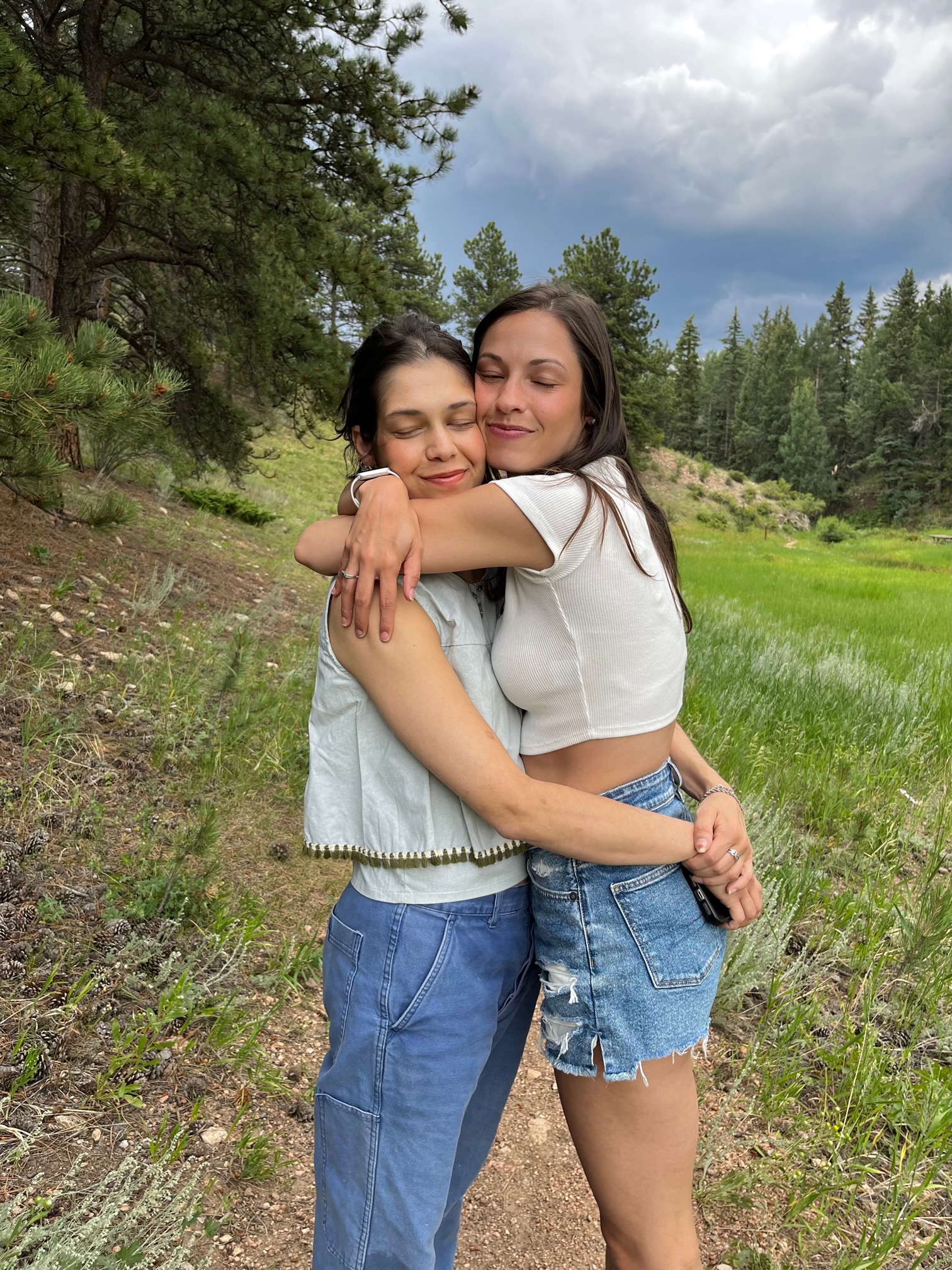 She was, in short, remarkable. I loved her more than I can possibly say. I also admired her deeply. To this day, I push myself to do things that might make me uncomfortable or afraid by telling myself, “Alex would do it, and she’d want me to do it as well.”





 Yet, the figures who fascinated me most during our afternoon at the museum were those of whom I’d known nothing — not even their names — before seeing the exhibit. One of them was Leah Penniman, a food justice advocate and activist whose portrait exudes warmth and joy. Her quote is wonderful and worth repeating in full:
 Another was Grace Lee Boggs, an author and community organizer, who gazes out from her portrait appearing tough, frank, unwilling to put up with any BS. Her quote:
 One of my favorite portraits was of a media hero of mine, PBS’s Bill Moyers. I will leave it to him to have the last word:
 Clara Bartels was born in Amsterdam and came to the United States as a small child. Her father was a diamond cutter, and diamond cutters were in great demand in the diamond district of New York City. She grew up around the block from Jacques Cohen, who later in life changed the family’s last name to Coe, and whose father also was a diamond cutter who emigrated from Amsterdam. They would marry, have three kids, and then divorce, bitterly, at a time when divorce was not really something people were supposed to do.