Back in early March, I posted about creating magic systems, and said then that I expected I would post about world building at least once more over the course of the year. And so here I am, making myself a prophet (because right now making myself a profit is proving difficult [rim shot]).
I am world building again, for the first time in a while, actually. The last time I created a world whole-cloth was when I began work on the Islevale Cycle, which was several years ago. I have a completed novel that my agent and I are shopping around, but that is set in our world with only a small speculative fiction element. My other most recent work has been in the Thieftaker universe, which I developed nearly a decade ago. I’ve written a couple of Fearsson short stories, but that world even pre-dates the Thieftaker world (though the books took longer to find their way into print).
My point being that it feels a little odd to be immersed again in world building, and several times over the past few weeks I have had to remind myself of lessons I thought I had internalized long ago. So I figured I would share some of these lessons with you.
1) Begin with questions: As I said in that March post, I love world building. There is something thrilling about starting from scratch with limitless possibilities. I had forgotten, however, how overwhelming the process can feel, particularly at the outset, when ideas are amorphous and we don’t yet grasp what we need to discover about our world. And so I like to start with a series of questions, which serve to rationalize and structure my task. (This, by the way, is how I approach research as well; I see research and world building as connected parts of the same creative act.) That list of questions is long, and early on, as I learn more and more about my world, the list continues to expand, the addition of new questions outpacing my ability to answer them. Eventually, though, the questions get answered and the contours of my world — literal and figurative — come into relief.
2) Organize from the outset: I am not nearly as organized as some assume I am, or as I would like to be. Too often, my impulse is to dive into my world building and research and jot down what I find as quickly as I can. The result is haphazard to say the least. I do much better when I slow myself down from the start and make an effort to keep orderly notes. That means using Scrivener as it is meant to be used, as a catch-all for ALL world building and research. Already with this new project, I have not been as good in this regard as I would like to be. But the first step toward curing myself is recognizing that I have a problem, right? Right??
3) Consult with smart people: This new project of mine is NOT fantasy. It’s science fiction, almost space-opera-ish. I know. I can’t believe it either. But there it is. And so I know even less about my subject matter than I usually do at this stage. I have been in touch with literal rocket scientists about this stuff, and I’m learning a lot. Chances are, no matter the nature of the project we’re working on, we know someone — or we know someone who knows someone — who can help us fill in gaps in our knowledge base. Don’t be afraid to reach out to friends, or acquaintances, or even perfect strangers. The truth is, most people like to talk about the things they know, they like to help people, and they often think it’s pretty cool to learn we’re writing a book about something that fascinates them. Moreover, institutions like police departments and medical examiners offices, not to mention museums, government agencies, and scientific institutions, often have public relations offices that are there to answer our questions. Avail yourself of these resources.
4) Let your brain go wild: Plotting our books takes time and precision. It’s hard work, in part because we are forced to reign in our creative impulses a bit in order to come up with narratives that are logical, that make sense to our readers. World building is hard, too, and it also requires a certain rationality. But, as I said before, it is a time of possibility. We can choose what it means to be logical in this new setting. Decisions that will become immutable once we begin to write, remain fluid for now. This is the stage in the process when our imaginations should be most at liberty to roam. Enjoy that freedom.
5) Finally, be patient: Most of the time, I measure my work output in terms of pages and word counts. Progress is tangible and easily quantified. World building isn’t like that. At this stage of a project, I spend much of my time staring out the window, thinking, trying to come up with ideas, with names, with histories and forms of government and religions and the like. It is an amorphous, sloppy process that is nearly impossible to measure in any concrete way. This bothers me — it always has. I grow impatient. I chide myself for not “getting more done.” I have been world building for this new series for, like, two weeks, and already I’m railing at myself for not being done. Just for the sake of comparison, I took three months to research the Thieftaker books, so I need to cut myself some slack. World building is work. It might not break down into units that are easily counted and banked, but it’s work nevertheless. And if you’re like me, and you chafe at that sort of thing… Well, give yourself a break. That’s what I plan to do. Because I have a lot more world building to do.
Keep writing!




 As you know at this point, we are in the midst of release week for
 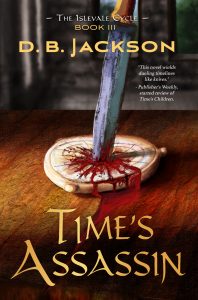 The truth is, I have felt that way about all three volumes of this trilogy. The Islevale books were incredibly difficult to write. I knew going in that writing time travel would be really hard — as one friend told me, “It’ll make your brain explode.” So much can go wrong. We have to examine every plot point from every possible angle to make certain it holds up to logic, and to the simple reality that time travel gives us endless opportunities for do-overs. Put another way, every event in a time travel story is negotiable. Each one can be altered or reversed by the very plot devices on which our stories depend.
 I hoped that
  I frequently tell beginning writers that they need to self-define success, something which is really hard to do in this business. All too often we writers are forced by the nature of publishing to seek exterior affirmation for our work — reviews, sales, awards if we’re fortunate enough to win them. These are the things the industry values and so, naturally, they are the things we care about as well. The problem with this is, the industry is cruel and capricious. We all know of good, even great, books that go unnoticed and unacknowledged. We all have seen mediocrity rewarded with terrific sales and undeserved attention. And we know that this is true in the world beyond publishing as well. Life is not always fair.
 I’ve just finished working on a set of three novellas set in the
  …And allow me take a moment to urge you get a copy of Time’s Assassin. (