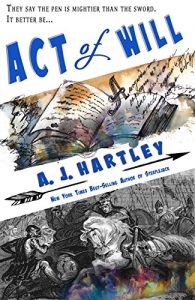
Last week, John Hartness, my good friend and the owner and editor at Falstaff Books, posted on Facebook about something he was seeing while editing manuscripts. Many of his writers were starting too many lines of dialogue with, “So…” As John said in the post, “We do this in real life, and it does sounds realistic, but most of us (myself 100% included) are using it too often, and it doesn’t work as well on the page as it does in real live conversation.”
What I found especially interesting about John’s post was the response to it. Writer after writer (including me) confessed to relying on all sorts of repeating words and phrases — what we in the industry call “crutch words.”
I use “So…” a bit, though not that much. On the other hand, lately my editors and I have noticed that I start way too many lines of dialogue with “Well…” As with “So…” it is something lots of us do in actual conversations, but on the page it becomes intrusive and repetitive.
I have lots of other crutch words, too, but honestly I’m reluctant to share them with you, because I don’t want you looking for them while reading my books and stories. Once you start doing this, it can totally ruin a work of fiction for you.
Suffice it to say, all of us have verbal tics that show up in our prose — words we overuse, approaches to dialogue that occur again and again, mannerisms we give to our characters that repeat themselves throughout our stories. Sometimes they are the result of habit. I know that in my case they often are a product of laziness — I need a gesture or a spoken word, and rather than pausing to come up with something different and unexpected, I throw in a standby. Moreover, even as we work to eliminate some crutches from our writing vocabularies, new ones creep in. (For me, “Well…” didn’t used to be a problem, and I’m not entirely sure when it showed up.)
So how do we deal with this issue?
First, understand that this doesn’t make you a bad writer. All writers from beginners to seasoned professionals grapple with crutch words. Don’t let yours undermine your confidence.
The key, of course, is to identify your wording habits and control them. Beta readers can be enormously helpful in this regard. When you ask people to read your manuscripts, by all means ask them to look for plotting problems, and character inconsistencies, and all the other narrative problems we writers sometimes face. But also ask them to keep an eye out for overused words and phrases. If and when they find some, start a list and keep that list around for future projects.
If you don’t have Beta readers, or don’t want to wait for outside feedback, try reading your books and stories aloud. This is one of those problems that we can gloss over all too easily when reading through a manuscript. But if we read the work out loud, and thus hear the story as well as see it, we are more likely to recognize those annoying repetitions. Again, as we find them, we should add them to our list.
Once we start to develop a bank of overused words, we can use the search function in our word processing software to find all instances of a given word or phrase and look for ways to replace some of the offending passages with something else. Remember, you don’t need to eliminate every “So…” occurrence (or whatever crutch you happen to be looking for at a particular time). The idea is to use the word/phrase in moderation.
How many instances is too many? A good question, and the truth is I don’t have a great answer. I might use as a yardstick one of my completed books, one I believe is well-written, polished, and relatively free of crutch words. If the new book has way more “Well…”s (for instance) than that old one, I assume there’s a problem and I try to fix it. If the numbers in the new book are about the same as, or lower than, the older yardstick, I move on to the next crutch. I will confess that my running list of crutch words/phrases has probably 50 entries. Maybe more. Some I’ve managed to control and eliminate as problems. Others, not so much. And, as I said before, I’m always adding new ones.
Finally, keep in mind that most readers don’t notice our crutches nearly as much as we do, or as a good editor might. Chances are one or two verbal mannerisms are going to sneak by our attempts to limit them and will wind up in the published version of our book. Don’t worry too much about that. Make sure the word is on your list, so you can address the issue in subsequent manuscripts, and then move on.
So, best of luck.
Well, keep writing.



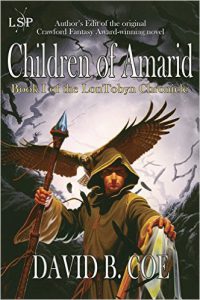 I believe my action scenes are pretty effective, and, actually, I would say the same about my sex scenes. But that wasn’t always the case. In the first draft of my very first novel, Children of Amarid, I wrote a sex scene that my editor tore apart. And with good reason. While the rest of the narrative worked pretty well, the sex scene felt completely staged and out of character. And the reason was quite simple: For that one encounter, I forgot about my characters’ points of view and tried to write a sex scene that felt, well, sexy. That didn’t work, because my characters were young and in love, but also inexperienced and still a little awkward with each other. None of that came through in the writing.
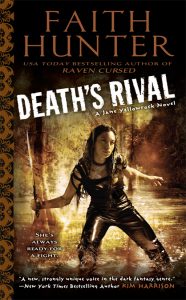 In the same way, action scenes – fight scenes, battle scenes, violent scenes; whatever you want to call them – also hinge on the qualities, histories, experiences, and emotions of our point of view characters. A seasoned fighter, someone who makes their living in a violent world or who was brought up to be a warrior, is going to experience violence quite differently from, well, someone like me, who has little knowledge of fighting technique and scant history with violence and bloodshed. The practiced fighter’s point of view might sound almost clinical – this person will know how to control emotion, how to draw upon skills and observations learned over years of training. The novice’s point of view should come off as far more desperate, fearful, overwhelmed by the frenzy of violence in which they find themselves. Again, point of view is all. One is not necessarily more exciting to read than the other – think of the battle scenes in Faith Hunter’s thrilling, New York Times Bestselling Jane Yellowrock books and in A.J. Hartley’s wonderful Will Hawthorne novels, which are not only entertaining but also a master class in writing voice. Jane is a warrior; Will is SO not.. The scenes in both make for compelling reading, but they couldn’t be more different.